
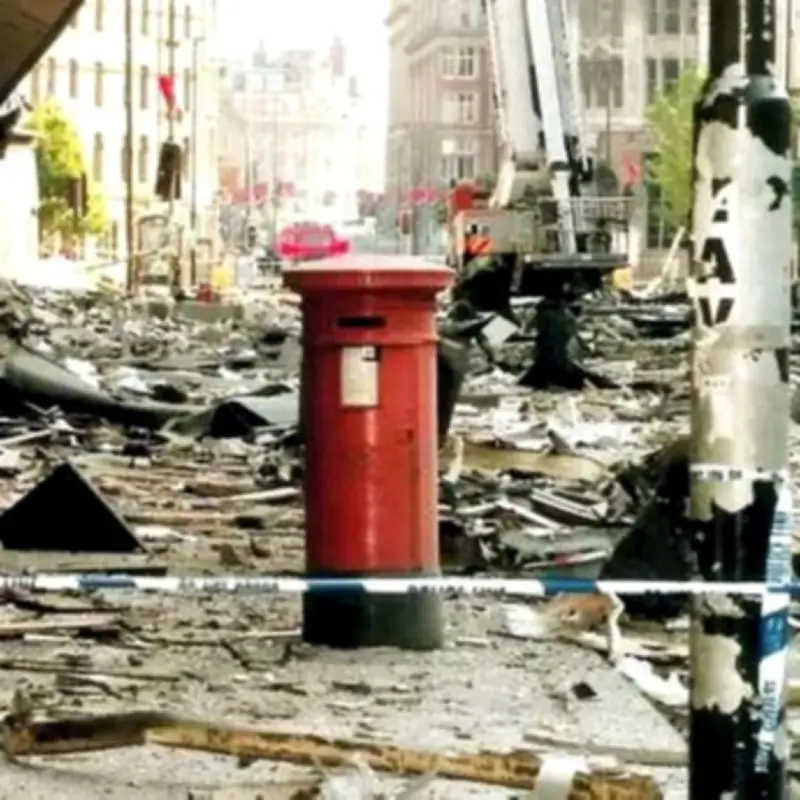
As the radio crackled, a voice warned PC Lee Cullen to expect a 'bang'. Standing at a hastily erected cordon near Victoria Station, the 29-year-old braced himself for the blast, just a few hundred metres from the UK mainland's largest bomb since World War Two. Seconds later, the 3,300lb device exploded.
"It was just an incredible explosion of power," Lee told the Manchester Evening News, recalling the moment at 11.17am on June 15, 1996, that changed the city forever. "There was a massive white flash that almost went inward on itself, and then in a nanosecond blew out with fire and smoke. The shockwave was instantaneous. It came all the way down Corporation Street. All the windows were going in. Glass was just spraying onto the road."
The immediate aftermath was unforgettable: "People were running, screaming, children absolutely distraught. I was thinking, 'My God, did that really happen?' And then the radio just filled up with frantic shouts for help."
A Day That Started Calmly
The day had begun in much calmer circumstances. In London, anti-terror police were on high alert amid fears the IRA could target Trooping the Colour. A few months earlier, the group had ended a 17-month ceasefire by blowing up a lorry in Canary Wharf, killing two people. But in Manchester, the atmosphere was more relaxed. It was the day before Father's Day, warm and sunny, with thousands of football fans arriving for that afternoon's England vs Scotland match at Euro 96 and the following day's clash between Germany and Russia at Old Trafford.
The Bomb Is Found
At 9.38am, a security guard at Granada Studios on Quay Street answered a telephone call from a man with a 'very calm' Irish voice. He explained the IRA had planted a bomb that would explode in an hour, and passed on a codeword known to Special Branch. Similar calls were made to Sky News, Salford University, North Manchester General Hospital, and the Garda in Dublin. Moments later, an officer spotted a red and white Ford Cargo box van parked on double-yellow lines with hazard lights flashing near Marks & Spencer, at the corner of Corporation Street and Cannon Street. Peering through the window, he saw wires running from the dashboard to a device made of Semtex and fertilizer, weighing about the same as a saloon car.
The van, bought in Peterborough the day before for £2,000, had pulled up around 9.20am. CCTV showed two men wearing anoraks, baseball caps, and sunglasses walking away. Three minutes later, a traffic warden slapped a ticket on the vehicle, as the men made their way to a burgundy Ford Granada driven by a third man. Along the way, they called an IRA chief in Ireland to confirm the bomb was planted. The Granada was later found abandoned in Preston.
Evacuation and the Blast
Greater Manchester Police set about evacuating an estimated 80,000 people from the city centre. Dozens of extra police were on duty for the football, making it one of the most extraordinary operations in the force's history. By 11.10am, the normally bustling heart of the city was practically deserted. Market Street, Cross Street, the Arndale, and surrounding streets were eerily empty. Just a handful of office workers, shoppers, and shop staff remained, either unaware or missed in the evacuation.
Around 500m away, off Cross Street near Sam's Chophouse, the Army's bomb disposal unit prepared to detonate the device. Over the radio, Insp Dave Comerford told colleagues there would be two blasts – a smaller one as a remote-controlled robot blew a hole in the van, followed by a second to disable the bomb. At 11.16am, the first blast occurred. A minute later, the bomb went off as attempts to defuse it failed. The explosion could be heard 15 miles away.
It blew a crater in the road two metres deep and 15m wide. Every window within a half-mile radius was shattered. Debris travelled 800m. Parts of the van were found in the basement of the Printworks and on top of surrounding buildings. Rubble lay knee-deep on Corporation Street, with shop mannequins briefly mistaken for bodies.
Aftermath and Heroism
Lee Cullen said the force of the blast took him aback. "Particularly in the Tactical Aid Group, a lot of the guys were ex-forces, ex-military and we've heard explosions before, but the size of that particular explosion was huge. It basically ripped off all the fabric of the buildings all the way down Corporation Street. Everything that was inside a building was out on the roadway. Mannequins were hanging out the windows. It was surreal. On the street it was literally knee deep to waist high in rubble, debris, everything twisted up. My stomach flipped over a couple of times, but then the adrenaline just kicks in and you just get on with it."
As the bomb went off, screens in Bootle Street police station showing CCTV went black. Dozens of 999 calls were made. At Manchester Royal Infirmary, 70 casualties arrived at A&E within minutes. An evacuation point was set up near the cathedral as paramedics toured the city centre picking up the wounded. Some 220 people were injured, almost all from falling debris.
Manchester city centre lay in ruins. Hundreds of businesses were affected, with an estimated £700m of property damage. Landmarks such as Manchester Cathedral, Chetham’s School of Music, the Corn Exchange, and the Royal Exchange theatre would take years and millions to restore. Longridge House and Shambles Square were demolished, while the bus station under the Arndale centre never reopened. But remarkably, no one was killed – a fact the M.E.N. described as the 'Miracle of Manchester'.
It was testament to the heroism of police officers like Lee Cullen, who retired in 2011 and now works as a civilian investigator for GMP. "It was a massive team effort," he said. "The carnage that would have ensued if it had just gone off would have been massive. It was typical Manchester. You'd think an event like that would finish us, but it made us stronger."




