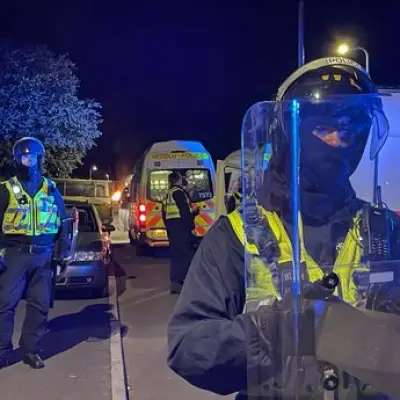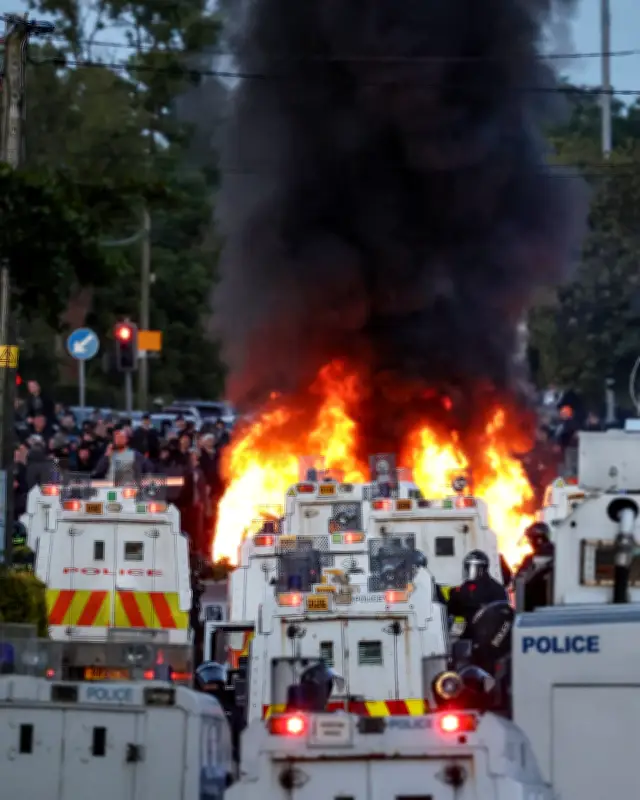
Fires burn as protesters stand off with police in Glengormley, north of Belfast. As the people of Glengormley tidied up and prepared for more violence in what has been described as a modern-day pogrom, a court 500 miles away in Southampton started to deal with its own outbreak of thuggery.
The trigger for this week's riots in the Northern Irish capital had been the image of a black assailant appearing to stab and slash his supine white victim while shouting in Arabic. The suspect was later revealed to be a refugee from Sudan. In Southampton, the courts dealt with separate violent demonstrations after the release of police bodycam footage showing the last moments of Henry Nowak, a white 18-year-old student erroneously arrested and handcuffed over false racism claims while dying from stab wounds inflicted by Vickrum Digwa, a British Sikh.
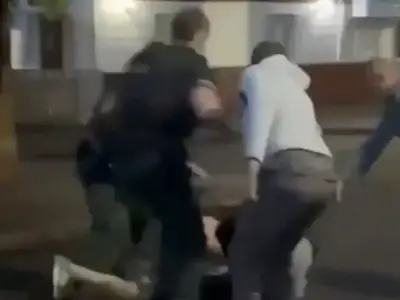
A quarter of those who gathered outside the police station in Southampton over the Nowak case appeared to be drinking alcohol, masks were worn, and one speaker shouted: “Do you want the house, the Digwa house?” Hundreds then moved towards an incorrect address for the Digwa family, throwing bricks, chairs, and bins at police. The disorder lasted about two and a half hours, with police “coming under almost constant assaults.”

The demonstrators included members of far-right groups such as the Southampton Patriots, White Vanguard, and the Portsmouth branch of the National Rebirth Party. Taylor Grundy, 22, who pushed a burning bin at officers and threw a plank of wood, cried throughout his hearing and was sentenced to two and a half years. Dillon Crawford, 29, a father of two with another child on the way, received a three-year jail sentence for throwing a bin and a metal chair at officers, telling the court he had been “angry in the moment.” Crawford had 19 convictions for 33 offences including battery, robbery, burglary, and shoplifting.
Political Narratives and Complex Realities
For Nigel Farage, leader of Reform UK, the police decisions at the time of Nowak's murder offered evidence that “the rights and privileges of white people matter less than ethnic minorities.” Regarding the Belfast violence, where homes were burned and women and children forced to flee from masked men shouting “foreigners out,” Farage said it showed that while there were bad actors, the “vast majority are fearful… they want action to make their streets safer.” Critics saw this as a threat rather than a warning, another way to stoke division for political ends.
An editorial in the Times, headlined “Burning resentment in Belfast fuelled by inaction on immigration,” argued that a “bemused and drifting government has done nothing to tackle the root cause” of the violence, which it claimed was illegal immigration. Yet, when unpicked, the facts arguably do not support the populist narratives. Migration to Northern Ireland is low: in the 2021 census, almost 97% of people described their ethnicity as white, and just 2,248 asylum seekers were in receipt of government support as of March 2024. Only about 200 people were estimated to have been involved in the unrest.
The claim of “two-tier” policing that discriminates against white people also drew skepticism. For decades, Britain has grappled with racism in policing, with official reports demanding forces do more to tackle the problem. The police response to Nowak is under investigation, but that single case has been used by Farage and the extreme party Restore Britain to flip widespread concerns about disproportionate criminalisation of minority ethnic people.
Expert Analysis on the Riots
Prof Tim Newburn, who led a landmark study into the August 2011 England riots, said such outbreaks of mass violence are “quite unusual” in the UK. “It actually takes something quite special to make them go… some combination of the degree of stress or anger that people feel and a lack of control by the police.” Both riots showed signs of understaffed police. Jon Boutcher, chief constable of the Police Service of Northern Ireland, activated a “mutual aid” mechanism, asking other forces for officers after 12 of his officers were injured. The police and crime commissioner for Hampshire force complained it was one of the lowest-funded forces in England and Wales; 11 officers and a police dog were injured in Southampton.

Newburn said the riots say something about the “zeitgeist” of the country. The UK has endured a cost of living crisis, yet recent riots have predominantly been attached to issues of race and migration rather than leftwing causes. “It tells us a lot about the current preoccupations of our politics… the most obvious points of contest seem to be around nationhood, race, borders and so forth.”
John Drury, professor of social psychology at the University of Sussex, co-authored an analysis of the 2024 riots after the murder of three girls in Southport, where the perpetrator was falsely claimed to be an asylum seeker. “These are collective racist attacks,” Drury said of the scenes in Belfast and Southampton. “White victimhood is a massively powerful mobilising grievance… Some participants honestly believe it’s part of their ideology. It’s called modern racism.” He noted a normalisation of toxic anti-immigrant rhetoric, accelerated by online voices and now empowered by established media and politicians. “If you look at what happened with Brexit… we had an immediate spike in hate attacks because people felt they were not alone. We’ve got a problem of racists becoming empowered.”
The disturbances in Belfast continued for two nights, ending with a peaceful protest on Thursday. They did not spread elsewhere, despite calls from far-right activist Tommy Robinson (Stephen Yaxley-Lennon) for all of the UK to rise up. His posts on X were amplified by Elon Musk but to little effect. “It is difficult to predict a riot,” said historian Keith Flett.
In Southampton on Friday, Judge Mousley KC continued sentencing, calling the violence a “hate crime, born out of a hatred of the police and in some cases racist views.” The impact on the community was profound, with local residents subjected to fear, distress, and a genuine sense of danger.