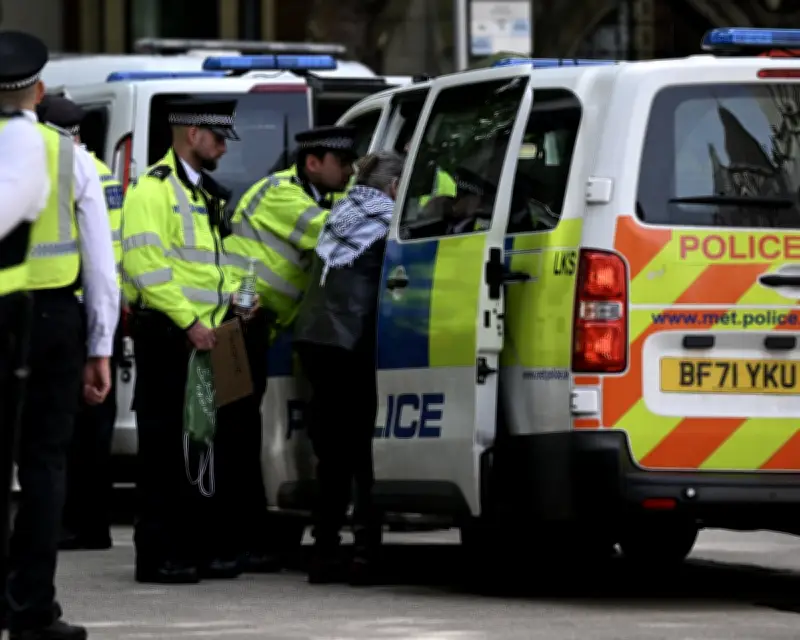
Arrested protesters have expressed devastation after the court of appeal ruled that the ban on the direct action group Palestine Action was lawful. The decision, handed down on Monday, overturns a high court ruling from February that had declared the proscription unlawful.
Five judges ruled that the ban was lawful, meaning that more than 3,000 people arrested under the Terrorism Act since proscription, including over 700 who have been charged, could now face prosecution. Palestine Action co-founder Huda Ammori has stated she will appeal to the supreme court, but for now, the possibility of the ban being quashed and prosecutions being discontinued has been removed.
Deborah Hinton, 82, a former magistrate from Truro, Cornwall, who has been charged, described the judgment as "devastating and shocking." She said: "Obviously I'm very upset, I'm very nervous, but I couldn't do anything else but do what I did. I didn't have a choice. We are heading towards an authoritarian state, and as I saw it, it was my duty to take a stand."

Hinton added: "One did hold out hope that the government would see sense. We haven't got enough money to have a proper defence system for this country and yet they're wasting millions and millions on this ridiculous prosecution of people holding placards." The vast majority of those arrested were holding placards with messages such as "I oppose genocide, I support Palestine Action" at Defend Our Juries demonstrations.
Marianne Sorrell, 81, from Wells, Somerset, who was held by police for nearly 27 hours after being arrested, called the judgment a travesty of justice. "I'm thinking very seriously of getting arrested again for the same offence," she said. "I haven't up to now, because it meant going to London but I'm so incensed by what's going on and very perturbed that I'm thinking I will go to London if the action to support Palestine Action is to continue."
Both Hinton and Sorrell expressed outrage about lengthy custodial sentences imposed on Friday on four Palestine Action activists who smashed drones and equipment at an Israeli arms manufacturer's UK factory. A judge ruled there was a "terrorist connection" to their offending. Hinton described the sentences as "completely out of all proportion and of anything that one could expect in a civilised country like ours."
Father John McGowan, 75, who was among 532 people arrested at a demonstration in Parliament Square on 9 August last year, said he was angry and disappointed but remained at peace. "Being arrested and charged is an inconvenience for me compared to what the people are currently experiencing in Gaza, and still are," he said. "My judge is myself, my conscience, I'm at peace with myself and with what I've done and so let's see what happens. I'm prepared even to go to prison."
In her written judgment, the lady chief justice, Sue Carr, stated: "When the severity of the effects of proscription on an individual's rights to freedom of expression and assembly are balanced against the importance of the objectives of protecting national security and the rights and freedoms of others, we find that the latter in this case outweighed the former."
The court of appeal's decision prompted renewed criticism from human rights groups. Tom Southerden, Amnesty's legal programme director, said: "We have long said that the banning of Palestine Action as a terrorist organisation was a grave misuse of sweeping counter-terrorism powers with serious consequences for human rights, and today's outcome does not alter that assessment. It is fundamentally disproportionate to treat direct action protest as terrorism."
He added: "The images of people from all walks of life – from nurses and pensioners to military veterans – being bundled into police vans for peacefully holding placards will be long remembered as a deeply shameful chapter in our history."