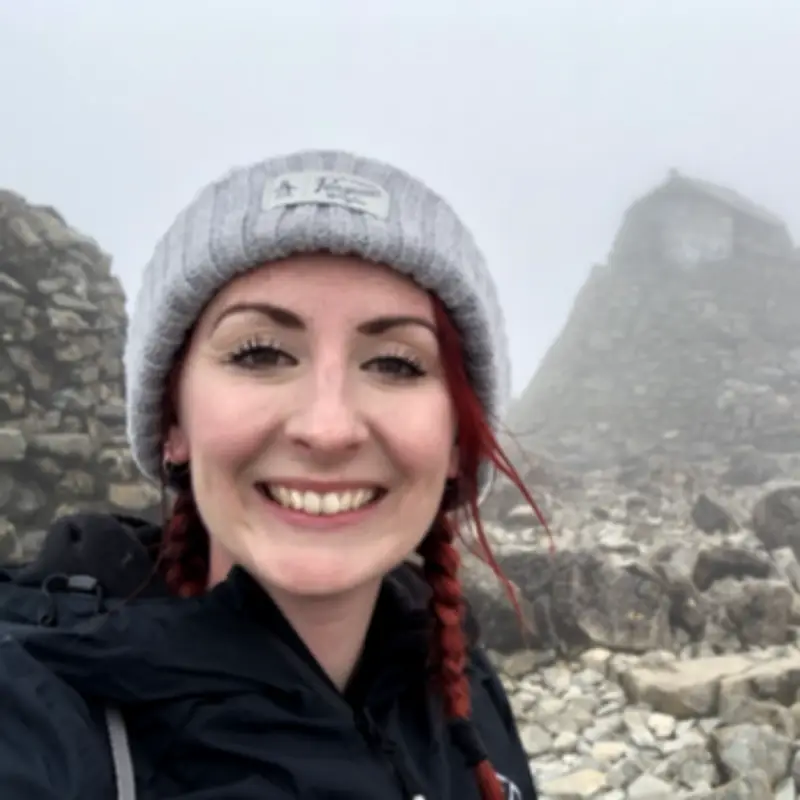
A woman who said she received the all-clear from aggressive breast cancer was told two months later it had spread to her bones, after she claims her GP dismissed her initial warning sign. Rebecca Bell, 33, a sales manager, had just become engaged at the beginning of 2025 when, in April of that year, she discovered a grape-sized lump in her left breast.
When she visited her GP a few days later, she said she also mentioned experiencing pain in her shoulder blade, but was reassured the two issues “were not linked” and was told it was “one problem, one appointment.” Following scans and tests in May 2025, doctors confirmed she had triple-negative breast cancer – a type of the disease that around 15% of breast cancer patients are diagnosed with.
She was told the tumour measured 95mm by 75mm, but immediately underwent treatment and by December 2025, the tumour had shrunk to 75mm by 55mm. After surgery and radiotherapy, she said she was given the all-clear from breast cancer in February 2026.
Despite the “heartbreak” of her engagement ending around the same time, Rebecca, from Rainham, Kent, said she was feeling positive about the future. However, in April 2026, a PET scan carried out for a drug trial revealed that the cancer had spread to her bones, and she said doctors confirmed that the shoulder blade pain she had previously reported to her GP was a sign of this. In June 2026, Rebecca restarted chemotherapy and immunotherapy and is now determined to adapt to life “living with cancer.”
Rebecca told PA Real Life: “I didn’t really want to tell anyone that it had spread – I didn’t want to be known as the sick one again. I had already lost all my eyebrows, eyelashes and patches of hair, and I didn’t want to go through that all over again. Last time there was an end point, but now there isn’t, it’s like I’m going through hell again. That doesn’t mean I’m not going to live a good life – I’ve just got to change my mindset.”
At the beginning of 2025, Rebecca was in a “very happy bubble” having just got engaged, and was living a “normal life,” focusing on work and her family. However, in April 2025, she said her nephew was playing around her and accidentally knocked into her, causing an “achy and heavy” pain in her left breast. On April 26, she checked her breasts in the shower for any lumps or swelling – something she said she did regularly. While checking, she felt a lump on her left breast, around “the size of a grape.”
She said she immediately rang her GP and secured an appointment a few days later at Marlowe Park Medical Centre in Rochester. At the appointment, she said she explained there was a lump, but also wanted to raise the fact she had pain in her shoulder blade. She said: “They told me it was one problem, one appointment, and it won’t be linked. They just ignored me, basically.”
Rebecca said she was then referred to hospital for an ultrasound scan on her breast. Three weeks later, in May, following the ultrasound, she underwent a mammogram and biopsy on the same day. “I thought everything was fine, I thought they might just tell me I had a cyst, but I realised it was serious after all the scans,” she said. “They told me they were confident I had cancer.”
While waiting for the biopsy results, she also underwent CT and MRI scans. At a follow-up appointment on May 28, 2025, she said doctors confirmed she had triple-negative breast cancer and that it was “curable.” According to Cancer Research UK, triple-negative breast cancers are cancers whose cells do not have receptors for oestrogen and progesterone and a protein called Human Epidermal Growth Factor Receptor 2 (HER2). Triple-negative breast cancer develops more often in women under 40, and symptoms often include a lump or thickening in the breast or armpit, a change in the size, shape or feel of the breast, skin changes in the breast, and fluid leaking from the nipple.
She said doctors told her the tumour measured 95mm by 75mm. Rebecca added: “That’s where it was scary – I would always check myself in the shower and I can’t believe it got so big without me knowing. I felt really silly because I didn’t notice until it was that size. I was petrified and it didn’t feel real.”
She said her doctors explained she could freeze her eggs through the NHS, where they would be stored for 10 years, and she went ahead with this immediately. Rebecca underwent chemotherapy for six months, starting in June 2025, alongside immunotherapy every three weeks. She also had hormone therapy in the form of a Zoladex injection once a month, which put her into a premenopausal state. She said: “I wore a cold cap during the chemo, but I still lost clumps of my hair and I had to go through all the premenopausal symptoms at the same time. You go into fight mode because you’ve got no choice.”
Around halfway through chemotherapy, in September 2025, she said an ultrasound and MRI scan showed the tumour had shrunk. She finished chemotherapy on December 4, 2025, by which point the tumour had reduced in size from 95mm by 75mm to 75mm by 55mm. “I felt really happy and positive,” Rebecca explained. “Life was good, we were going to get back on track with planning our wedding at that point.”
She underwent surgery in January 2026 to remove the remaining tumour in her breast, along with surrounding lymph nodes. After three weeks of radiotherapy, on February 4 she said she got the all-clear from breast cancer. By this point, her relationship with her fiancé had ended, leaving Rebecca “heartbroken.” She added: “I have amazing friends and family who make sure I’m looking after myself and message me every day.”
In April 2026, she underwent radiotherapy to destroy any remaining microscopic cancer cells. The same month, preliminary tests for a drug trial with the aim of preventing cancer recurrence, one of which involved a PET scan. The scan revealed Rebecca had cancer in her collarbone, and later tests showed it had also spread to her spine, hips, femur and pelvis, meaning her cancer had progressed to stage four. “If I hadn’t had those scans, I might have just had a follow-up mammogram in a year’s time,” Rebecca said. “My doctors said there was a lot of cancer growing in my clavicle (collarbone) area, and it had been there for a long time. They said that was what was causing the pain in my shoulder blade at the beginning, which I explained to my GP. The GP said it wasn’t linked – but that pain actually showed the cancer had spread.”
In June 2026 she began immunotherapy and chemotherapy again and doctors informed her she would most likely remain on treatment for the rest of her life. She said immunotherapy has also caused her to have an underactive thyroid, meaning she feels “even more” tired and “puffy.” To get her the “best possible care,” Rebecca’s sister, Jennie, has set up a fundraiser.
A spokesperson from Marlowe Park Medical Centre said: “While we are unable to comment on the details of an individual patient’s care due to patient confidentiality obligations, we recognise that concerns about healthcare experiences can be deeply distressing for those involved. We take any concerns raised seriously and review them through the appropriate processes. We remain committed to providing safe, high-quality care and to continually learning and improving the services we provide to our patients.”