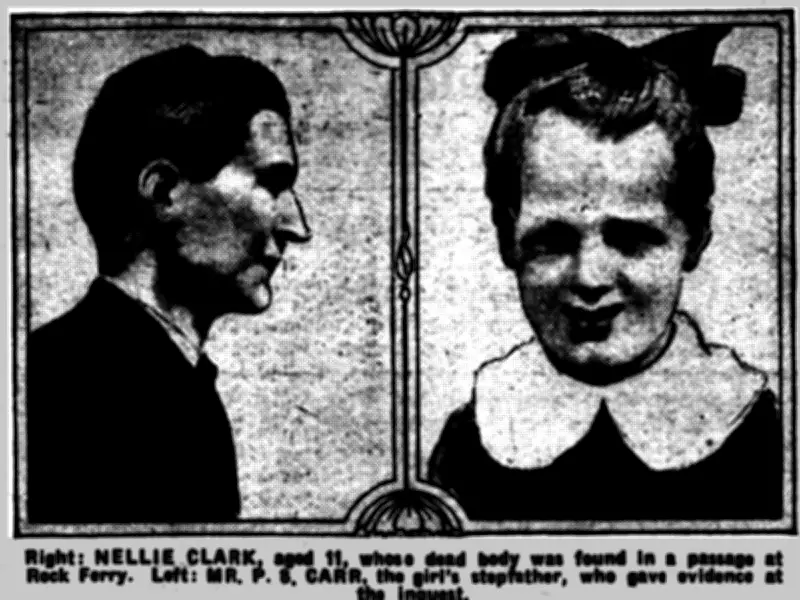
On January 10, 1925, the children of Birkenhead were treated to a rare party at the Town Hall, with sandwiches, fresh scones, and cakes courtesy of the Mayor. Among the joyful crowd was 11-year-old Nellie Clarke, who attended with her 13-year-old brother John. Tragically, just one day later, the little girl was found murdered, dumped in an alleyway in a crime that horrified the town.
The Victim and Her Family
Nellie Clarke (also spelled 'Clark' in some old newspapers) was the second child of Sarah and John Wallace Clarke. John had been killed in the First World War, and Sarah later remarried Peter Carr and had two more children. The family lived in a modest house on Byrne Avenue, Rock Ferry.
The Evening of the Murder
After returning home from the Mayor's party at around 6:30 p.m. on January 10, 1925, Nellie was asked by her mother to run an errand to a nearby shop. She did not return, and her body was found slumped 'as if asleep' in an alleyway the next morning. Her face was 'blue and badly bruised'.
The Inquest
An inquest took place the following month. A Liverpool Echo article from February 5, 1925, described a 'mother's pathetic figure in court' as witnesses testified. Unfortunately, the testimonies only deepened the mystery.
Nellie's mother Sarah, who had 'a decided Scots accent', told the court her daughter had her pink-lined handkerchief with her when she returned from the Mayor's party at 7 p.m. on January 10. At 7:30 p.m., she sent Nellie on an errand to a shop on Old Chester Road, a 10-minute walk away. When Nellie had not returned by 9 p.m., Sarah looked out of the house and saw no sign of her. At 10 p.m., she went out to look for her, leaving her husband at home with the other children. She went to the shop on Old Chester Road, where she was told that Nellie had arrived as planned but did not stay long.
Nellie's stepfather Peter Carr supported Sarah's story. He said she went out to look for Nellie at 10 p.m. and returned an hour later after failing to find her. She then went with John to Meadow Lane police station while Peter and the other children stayed at home.
The shopkeeper, Sarah Elisabeth Sorahan, told the inquest Nellie called about some shoes at 7:55 p.m. Another witness, Annie Elizabeth Dalton, said she saw Nellie looking through the window of a sweet shop on Old Chester Road around 8:30 p.m. Another girl, Lillian Mary Smith, said she saw Nellie 'skipping along the road' on Wycliffe Street between 8:30 p.m. and 9 p.m., and that the 11-year-old 'seemed very happy'. This was the last sighting of Nellie before her body was found slumped against a telephone pole in a passage to the rear of Browning Avenue and Spenser Avenue.
Discovery of the Body
The ECHO reported: 'PC Arthur Salmon stated that he patrolled the Spenser Avenue neighbourhood between 9:30 p.m. on Saturday January 10 and 5:30 a.m. the next day. He passed the end of Spenser Avenue frequently, but saw nothing to arouse his suspicions.' Martin Doran, who lived on Browning Avenue, told the inquest he returned home at 8:30 p.m. on January 10 and entered through his back door. The report said: 'It was a clear night and he was absolutely certain the body was not there at that time. He slept at the back of the house and did not hear his two dogs in the yard make any noise during the night. After the body had been removed, witnesses saw a pool of blood about the size of a half crown on one of the passage setts where the body had been lying.'
Nellie's body was found by Martin Doran at around 8:30 a.m. on January 11. She was lying against a telephone pole near the back door of 96 Highfield Road, with bruises on her hands and face. Her clothing was not disarranged, the inquest said, but her handkerchief and wool vest were missing.
Medical Evidence
A second article, published in the Liverpool Weekly Courier on February 7, 1925, detailed evidence from Dr. William Arthur Pierce, police surgeon for Birkenhead. He said: 'The girl had been dead for more than eight or nine hours, but it is difficult to say exactly how long. A small amount of blood was found near where the body was found. All the bruises and abrasions, except that to the lobe of the left ear, were caused by the hands of the girl's assailant during the course of a struggle between them. The cause of death was shock and exhaustion. I am of the opinion that the girl was assaulted in a house or other building, and I think she was carried to where she was found.' He believed Nellie had eaten another meal since leaving the Town Hall, though her family said she had not eaten before leaving the house again at 7:30 p.m.
Further questions arose about whether Nellie had been murdered in the alleyway or transported there after the killing, and whether the crime was sexually motivated. Dr. J.E.W. McFall of Liverpool University gave evidence that he believed the girl had been 'violated at the spot where her body was found', though other reports said there was no evidence of a sexual assault. Some contemporary newspapers reported Nellie had been 'outraged' and redressed afterwards, while others reported that she was dressed 'in every detail'.
Bloodstains were found on the girl's clothes, along with an oil mark 'probably caused by contact with a machine or engine' and a clay or mud stain. A missing button from her coat was found opposite a cab stand near Rock Ferry station, 200 yards from where the body was found. Her stepfather Peter Carr was asked by the coroner whether they had any lubricating oil in the house, but he said no. He said they did have a perambulator (it was theorized a pram was used to move Nellie's body), but it had not been greased recently.
Unresolved Investigation
The Coroner, summing up, said it was 'a matter of profound regret that it had been impossible up to the present to arrest the assailant of the girl, but he had high hopes that in the near future the man would be brought to judgment'. He said: 'With my long experience in Birkenhead, both in criminal practice and as coroner, I have no hesitation in saying the case has in no sense been prejudiced by Scotland Yard not being called in before they were... The closing of this inquest does not mean that the activities of the police will be in any way curtailed. On the other hand, those activities will continue with increased energy.' His confidence in the police, however, was misplaced: no suspect was ever identified in the case of Nellie Clarke's murder, and the case went cold.
In 1927, rumors swirled that a German seaman later convicted of two murders was stationed on the River Mersey when Nellie was killed. Speculation that he was involved in Nellie's murder, however, was quickly dispelled by the Home Office. On October 17, 1930, Peter Williams, a 26-year-old painter from Liverpool, walked into Chesterfield Borough Police Office and confessed to the killing. He was brought before Chesterfield magistrates court, charged and remanded in custody awaiting a Birkenhead police escort. Later that day, Chesterfield police received a phone call from Birkenhead police stating that Williams was not at Birkenhead at the time of Nellie's murder, and that they were satisfied he had nothing to do with it. Appearing at Birkenhead Police Court on October 27, 1930, Williams said: 'I believe all my statements were made in a fit of insanity.' He was discharged two days later.
The case of Nellie Clarke appeared infrequently in newspapers from 1930 onwards. Landmark anniversaries of the crime passed by with no acknowledgment. Her killer was never caught.
Controversy at the Inquest
In a tangent which made national news, controversy arose about the girl's inquest as the coroner decided to ban women from the courtroom, with the exception of witnesses. The Mayor of Birkenhead, Mary Ann Mercer, said: 'If women are excluded, then men must be excluded also.' Liverpool City Councillor Mabel Fletcher, a magistrate herself, said: 'The whole thing is ridiculous. The coroner has no power, nor has the Chief Constable power to exclude from a public inquiry citizens of goodwill. It must not be forgotten that women are liable to serve on juries.'