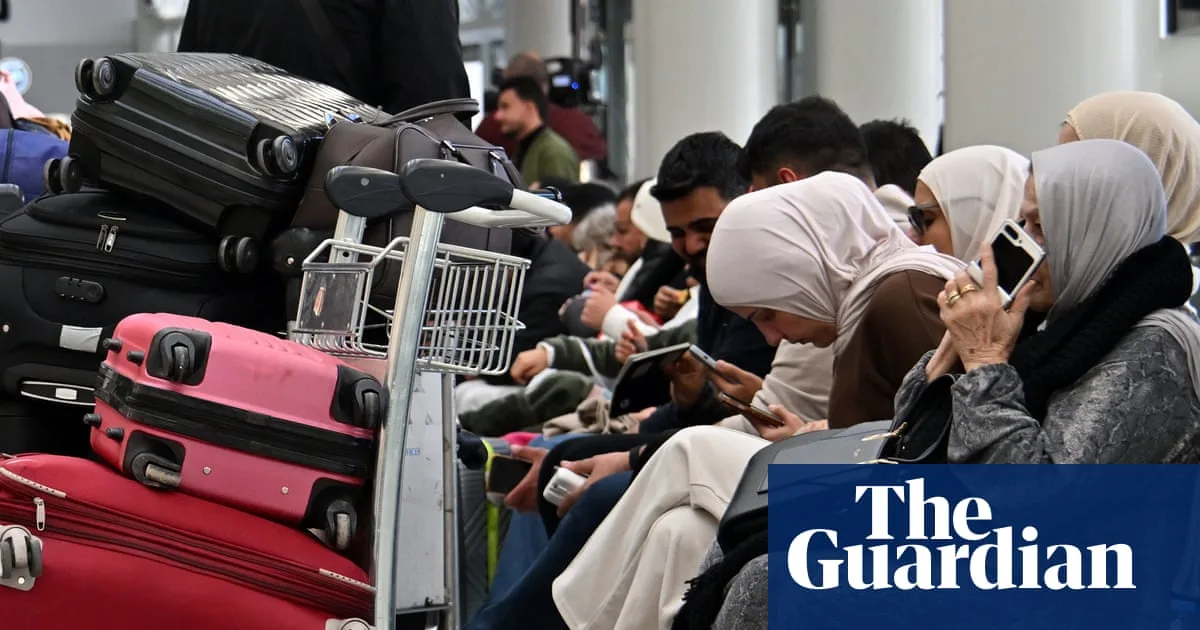
Middle East Airports Shut Down, Thousands Stranded Following Iran Attack
The coordinated military strike by the United States and Israel against Iran has triggered widespread aviation chaos across the Middle East, forcing the closure of critical airports and leaving tens of thousands of travelers stranded globally. The conflict, now entering its second day, has severely disrupted the primary air corridors connecting Europe, Africa, and the West to Asia.
Widespread Airspace Closures and Airport Shutdowns
On Saturday, nations including Israel, Qatar, Syria, Iran, Iraq, Kuwait, and Bahrain shut their airspace entirely. The United Arab Emirates implemented a temporary and partial closure, leading to a complete halt in flight activity over the country according to FlightRadar24. This resulted in the shutdown of major hub airports in Dubai, Abu Dhabi, and Doha, with over 1,800 flights canceled by leading Middle Eastern carriers.
Emirates Airlines suspended all operations to and from Dubai until at least Sunday afternoon, while Qatar Airways announced the closure of Doha's airport until Monday morning. Israeli airspace also remained closed on Sunday. Aviation analytics firm Cirium noted that the three major airlines operating from these hubs—Emirates, Qatar Airways, and Etihad—typically facilitate around 90,000 passengers daily, with even more travelers destined for other Middle Eastern locations.
Direct Impacts and Casualties at Airports
The UAE government condemned what it described as a blatant attack involving Iranian ballistic missiles. Incidents were reported at two UAE airports. Dubai International Airport, one of the world's busiest, confirmed four injuries. At Zayed International Airport in Abu Dhabi, a drone strike resulted in one fatality and seven injuries. Strikes were also reported at Kuwait International Airport.
Although Iran has not publicly claimed responsibility, Gulf nations attributed the retaliatory strikes to Iran, noting they extended beyond previously stated targets of American bases.
Global Travel Disruption and Passenger Ordeal
The closures have stranded hundreds of thousands of travelers, with many flights diverted or canceled. FlightAware data shows at least 145 planes en route to cities like Tel Aviv and Dubai were diverted to airports in Athens, Istanbul, or Rome early Saturday. Some aircraft, including one from Philadelphia that turned back over Spain after nearly 15 hours in the air, returned to their origin points.
Jonathan Escott, a traveler whose Emirates flight from Newcastle to Dubai was canceled, expressed the widespread uncertainty: No one knows. No one really knows what's going on with the conflict, really. Not Emirates, Emirates don't have a clue. No one has a clue. Airlines are issuing waivers allowing affected passengers to rebook without extra fees, but the situation remains fluid.
Airline Responses and Extended Flight Rerouting
Major global carriers have suspended services. Air India canceled all flights to Middle East destinations. Turkish Airlines suspended flights to Lebanon, Syria, Iraq, Iran, and Jordan until Monday, with services to Qatar, Kuwait, Bahrain, the UAE, and Oman also halted. U.S. carriers Delta and United suspended Tel Aviv flights through the weekend, while British Airways canceled flights to Tel Aviv and Bahrain until next week and scrapped Saturday services to Amman, Jordan.
Airlines are now forced to reroute flights south over Saudi Arabia, adding hours to journey times and increasing fuel consumption. This rerouting could quickly drive up ticket prices if the conflict persists and will strain Saudi air traffic control capacity. The closed countries will also lose significant overflight fees.
Expert Analysis and Future Outlook
Airline industry analyst Henry Harteveldt warned travelers: You should prepare for delays or cancellations for the next few days as these attacks evolve and hopefully end. He advised those yet to travel that they likely won't be leaving home for several days and returning travelers will need to be very creative.
Mike McCormick, former FAA air traffic control official and current professor at Embry-Riddle Aeronautical University, suggested partial airspace reopenings might be possible within 24-36 hours if military flight information is shared and Iran's missile capability diminishes. However, the duration of disruption remains uncertain, with the previous US-Israel attack on Iran in June 2025 lasting 12 days.
India's civil aviation agency has designated much of the Middle East, including airspace over Jordan, Saudi Arabia, and Lebanon, as a high-security risk zone. Virgin Atlantic is avoiding Iraqi airspace, potentially lengthening flights to India, the Maldives, and Riyadh, while carrying extra fuel for possible rerouting.