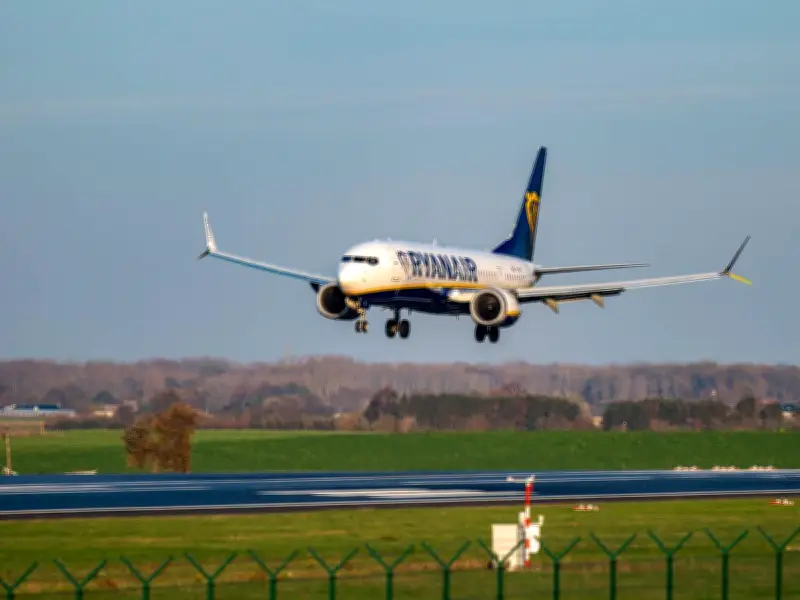
Ryanair is threatening to withdraw five aircraft from its Charleroi base and cancel 20 routes, affecting millions of passengers and around 150 jobs, if Belgium proceeds with plans to double its tax on airline tickets.
The budget airline could implement the move as early as this winter. Ryanair CEO Michael O'Leary stated during a press visit to the company's Dublin headquarters that the airline is not planning to completely close the Charleroi base. The Belgian federal government is considering doubling the airfare tax on flights exceeding 500 kilometers from next year, increasing it from €5 to €10. This would align the levy with that applied to short-haul flights, although the tax on short-haul flights is also set to rise to €11. Finance Minister Jan Jambon has confirmed he has no intention of reversing the decision.
As a result, Ryanair would remove five of its 19 aircraft currently operating out of Charleroi from this winter. Twenty routes would be scrapped—15 at Charleroi and five at Zaventem—representing a loss of two million passengers per year, Mr. O'Leary confirmed. Scaling back Charleroi operations would also put approximately 150 jobs at risk, though affected pilots and cabin crew, many of whom are foreign nationals, would be offered positions at alternative bases.
Mr. O'Leary emphasized Ryanair's desire to grow in Belgium. The airline aims to increase passenger numbers from 208 million in 2025 to 300 million in the coming years and wants to achieve some of this growth at Charleroi and Zaventem. However, for that to happen, the tax on airline tickets must be eliminated, and airport fees must be reduced. If the tax is not raised, no aircraft will be withdrawn from Charleroi, and the situation will remain unchanged. Should the tax be scrapped entirely, it would open the door to further expansion across Belgium.
Ryanair has proposed a growth strategy projecting nearly 50% more passengers in Belgium by 2030, pushing the total to 16 million. The Irish carrier would then reopen its base at Brussels Airport, a hub it continues to operate from but where it no longer stations any aircraft, and would even consider flights to and from Liège. This ambitious expansion plan will only come to fruition if all of Ryanair's demands are met, most notably a loosening of restrictions on night flights in Brussels. Conversely, any hike in the airline ticket tax would result in a scaling back of operations.
O'Leary confirmed that the closure of the Charleroi base is not under consideration. Normally, Ryanair would never close Charleroi, as it is one of its largest bases with significant investment over the last thirty years. However, in the long term, the airline could reduce the base to, say, 10 aircraft. O'Leary also touched on the soaring cost of aviation fuel due to the conflict in the Middle East. The airline has locked in 80% of its fuel requirements until next March at an average cost of $67 per barrel, while the current rate stands at $100 or above. The airline is not hedging for the following period yet, as it anticipates prices falling in the coming months, but acknowledges it could be wrong. If prices haven't fallen by September, the airline will start to worry.
With consumer uncertainty prevailing, O'Leary does not expect any fare rises this summer. Fares should remain stable, as the airline needs to incentivize people to travel by offering slightly lower prices than the 3% to 5% increase that had been forecast.