
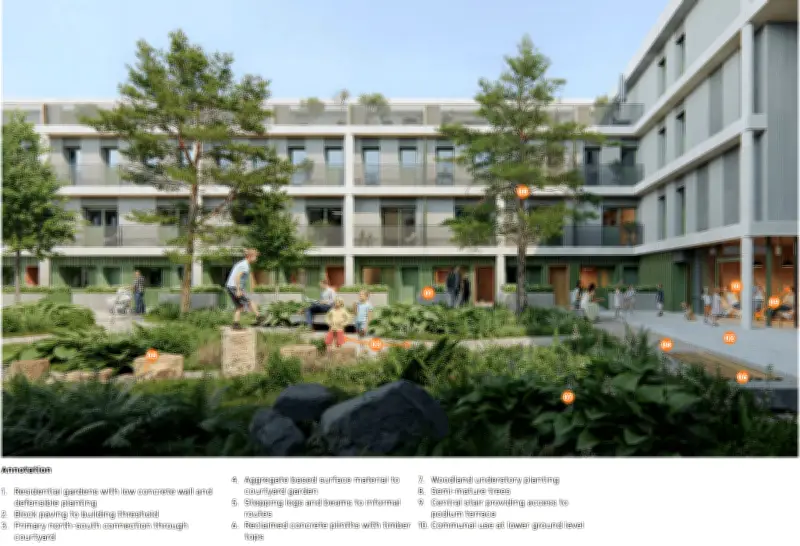
A multi-storey car park in West London is set to be demolished to make way for a new block of flats. The car park, located within the 5.22-hectare former Hayes Park business park, sits within the Metropolitan Green Belt. The proposed building will be four storeys high and will feature 16 one-bedroom flats and 36 three-bedroom flats, seven of which will be affordable, subject to viability reviews.
Design and parking details
Despite its four-storey height, the building's 'sunken' position will make it appear as three storeys from the south. Unlike most recent developments in the city, the block will offer one car parking space per property, including three disabled spaces. It will also include seven electric vehicle (EV) charging spaces and 97 cycle spaces.
Transport for London (TfL) raised concerns about the number of car parking spaces and requested a reduction in parking and an increase in EV charging points. However, the applicant demonstrated that providing more EV spaces would have been structurally unviable.
Council and public response
Hillingdon Council's highways department accepted the number of car parking spaces due to the significant lack of access to public transport near the site. No comments were raised by local residents, and no objections were received from other parties such as Heathrow Airport, Thames Water, or Historic England.
Although the site lies within the green belt, it falls under the definition of previously developed land. While the volume of building will increase by 54 per cent, it was ruled not to cause substantial harm to the visual or spatial openness of the green belt, making it an appropriate development.
Impact on heritage and contributions
The removal of the car park is seen as positive, but the four-storey block will cause a 'very low level of less than substantial harm' to the listed Gordon Bunshaft buildings nearby. This was considered to be outweighed by the public benefits of building new and affordable housing.
The developer has agreed to contribute £75,661 to fund enhanced or new health facilities in the borough to mitigate the impacts of the development. An additional £243,101 will be paid to mitigate impacts related to air quality, traffic, and active travel improvements.
As no publicly accessible open space can be accommodated directly on the site, a financial contribution of £69,500 is required for the enhancement of existing public open spaces in the Charville ward, which is identified as having a deficiency. An extra £61,708 will also be allocated to Hillingdon's carbon offset fund due to the shortfall in meeting the net-zero carbon target.




