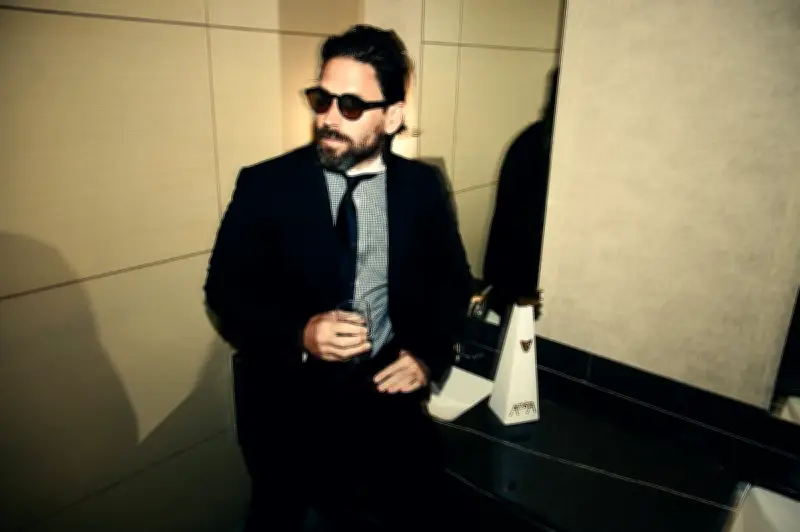
At Dovetale, 1 Hotel Mayfair, Douglas Blyde meets Frank Acosta, the Mexican-American founder of Acosta Tequila, a former New York milk delivery entrepreneur. The table was chosen to let Acosta observe the workings of hospitality: oysters being set, stems lifted, a jacket-clad figure adjusting course before a guest realizes they need something. From the corner of his eye, he catches the kitchen pass with a sign reading 'FOCUS'. Acosta noticed the work before admiring the room.
Someone once told him not to look at the finished product but at the work behind it. This may be the most telling thing he says. Acosta considers a room and sees the unpaid bill, the delivery window, and the person who ensured the milk did not run out. For him, luxury begins before the guest arrives and depends on people the guest will never meet.
He wore a sharply cut striped blue shirt with white cuffs and collar, open to reveal a gold crucifix. From a few feet away, he looked expensive, almost too neat. Then he began to talk, and the finish fractured in the best way. He is less slick in speech than in outline: fast, looping, funny, bruised, intense, self-interrupting, chasing his own argument before it bolts.

The bottle stood between them. He kept returning to the square stopper. Not packaging, in his telling, but evidence. It had taken time, money, and stubbornness. The bottle is angular, heavy, difficult, with a jaguar motif and a cap Acosta says is patented. He talks about patents as other men talk about vintages. Intellectual property, to him, is not paperwork but self-defense.
Acosta Tequila was founded in 2019 and made in Jalisco, Mexico, across four expressions: Joven, Reposado, Añejo, and Extra Añejo. The brand uses 100 percent Blue Weber agave, cooked for 42 hours in stone ovens rather than autoclaves, fermented with wild yeast, and aged in hand-selected Cognac barrels. There is no added sugar. This is not tequila built for the freezer door.
Acosta has not come to Britain to sell tequila to people who ask for the house pour. The UK range is billed from £134 to £691. These are not prices but provocations. If the liquid is ordinary, the bottle becomes a bauble. If it works, he may have pushed tequila into a more serious London conversation.
Britain, he believes, is due its tequila boom. Not shots, salt, and sticky floors, but Berkeley Square, Park Lane, and the King's Road—London addresses where money lowers its voice, and a bottle brought to the table must justify being lifted.
However, Acosta is not only selling tequila. He is selling revolt against modern luxury's favorite lie: convenience being mistaken for care. He hates QR codes, loyalty schemes masquerading as relationships, questionnaires replacing interviews, and the social cowardice of people who ask for samples, decks, and calls but cannot meet. Hospitality, he thinks, is being drained while everyone pretends a smoother app is the same as being looked after.
At moments, he sounds like a man trying to keep a match alight in a server farm. Amazon, AI, QR codes, and loyalty systems, to Acosta, are not innovations so much as small thefts from human exchange. 'I really strongly believe service is leaving this world,' he says.
This was not learned in a boardroom. Before tequila, Acosta built his name through milk. He co-founded Manhattan Milk, a New York delivery business supplying offices and homes with dairy, produce, and daily provisions. It sounds quaint until he describes the work: '36-hour days', staircases, loading rules, certificates of insurance, executive assistants who needed problems solved before they became visible. He learned hospitality from below: the door which might not open, the lift which might not work, the person on lunch.
'The last thing I want,' he says, 'is for them to worry about how much oat milk they need.' There is the Acosta thesis. Luxury is not a mood board but removing anxiety before anyone has to ask. It is answering WhatsApp messages from customers at 3 am. It is knowing what is needed before the room curdles.

To Acosta, celebrity tequila has become a holding pen for actors, models, singers, and athletes seeking agave glow without agave graft. He knows the investor question by heart: 'Who is your celebrity?' Fame offers borrowed speed, a ready-made audience, and something for financiers to point at. Acosta's answer is different. He is not selling proximity to stardom but proximity to the founder himself—a far harder proposition, and one which cannot rely on recognition alone.
His mind jumps to watches. He talks about Audemars Piguet and Swatch—not as a neat business case but as shorthand for the danger of making a high-luxury name brush against a mass object. Let too many people in through the wrong door and the brand thins. Stay too sealed and the next buyer never learns the language. His answer is not cheap tequila in expensive dress but expensive tequila which must earn the dress.
'I choose to build it with my hands,' he says. This might sound like founder froth if Acosta had not done the drudgery. He has run vans. He lost money during COVID when demand exploded and margins did not. He has been unpaid. He has slimmed businesses back to core clients. He still speaks like a man who knows what diesel costs and what 'a quart' of milk entails. His anger is practical.
His fascination is wood. Ask him about Reposado and he leaves tequila behind. He goes to France: Margaux, Libourne, Cognac, and Armagnac. In that order—the grand wine landscape, the merchant towns, the great spirit, then the more rural cousin which refuses to behave. He took the train from Paris to Bordeaux, met coopers and producers, tasted, listened, looked at barrels, studied oxidation, and tried to understand what aging actually does rather than what a label says it does.
The bottle is pitched as a tribute to Mesoamerican architecture, while the jaguar emblem nods to cultural symbolism and conservation work. The range runs from Joven through Reposado and Añejo to an Extra Añejo limited to 300 bottles, first laid down in 2019. That final release is best read as proof of ambition rather than volume.
His brand pillars, on paper, are familiar enough: heritage, taste, art, sustainability, jaguar preservation, 'Own the Night'. In person, they have more pulse. The jaguar is not simply a graphic. It became a test. Rather than put a predator on the bottle and call it purpose, he went to Brazil's Pantanal with a business partner from his milk days. He talks about piranhas, caimans, discomfort, fear, heat, travel, and the humiliating clarity which comes when a city man loses his usual protections.
'I wanted to put my money where my mouth is,' he says. 'If I said I want to save the jaguars, put my arse down there.' That lands better than most responsibility copy because it is not too neat. Acosta's speech has burrs. He knows this. Towards the end, he says he speaks from passion, and speaking from the heart 'can be interpreted as being a dick'. Then he adds, 'I'm not that.'
I believe him, though one can see how the misunderstanding happens. He is intense, funny, exhausting, charming, wounded, and unusually alert to the insults hidden in modern convenience. He can sound combative because he cares about things many glossy founders only pretend to care about: who answers, who carries, who pays, who shows up, who knows the back route, and who gets the delivery through.
His father was Frank too, a salesman, always moving, always lunching, conducting business through appetite and contact. Acosta jokes that his father must have rushed his mother out of hospital to get the name repeated. Beneath the joke sits a bruise: his father's Mexican inheritance, he feels, had to be muted to get through America. The son's tequila is partly an answer.
Tequila, then, is not just commercial territory. It is reclamation. In a category increasingly fronted by famous outsiders and global drinks money, Acosta wants a Mexican-American name on the bottle and a human being behind it. 'I don't see many Mexican-American people as the heads of this product,' he says. 'I wanted us to be proud.'
Still, pride does not excuse price. At the upper end, Acosta is asking to be judged beside watches, hotel rooms, Burgundy mark-ups, and the livid economics of Mayfair. If the liquid fails, the bottle becomes a table ornament with a receipt attached. If it succeeds, he may have found the room he wants: tequila not as party prop but as a luxury spirit with founder force behind it.
He understands imitation. Hence the complicated bottle, the cap, the patents, the jaguar, the squared geometry, the refusal to resemble the rest. 'Luxury is about complication,' he says. There, finally, is the provocation. In a drinks culture addicted to image, Acosta wants the back-end to matter: the invoice, the route, the stopper, the barrel, the person who replies after 5 pm because a bar manager is buried and another rep has vanished.
The price may repel as many people as it seduces. The bottle may prove brilliant or too pleased with itself. But Acosta is hard to brush aside. He is angry about the right things: dead service, borrowed fame, fake purpose, and human laziness dressed as progress.
The modern luxury drinks business asks, 'Who is your celebrity?' Frank Acosta's answer is better. A New York delivery man with a gold crucifix, a jaguar, a patent lawyer, a fear of sounding like a dick, and a square stopper heavy enough to outlive the evening. Not the celebrity the money men asked for. But possibly the more useful one.
Acosta Reposado, £265; Añejo, £425, available at amazon.co.uk.