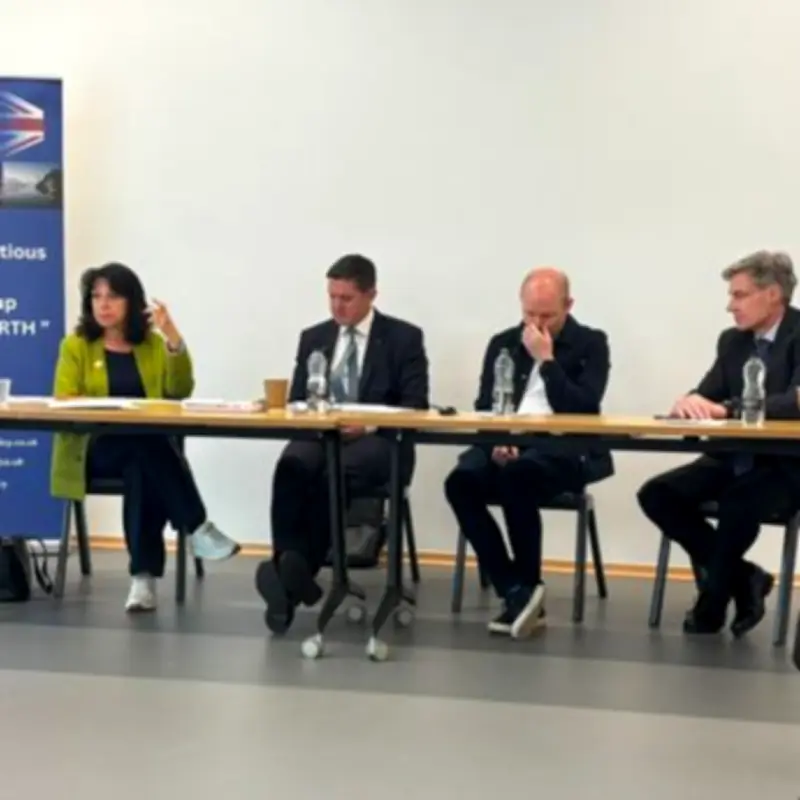
Leading North East figures have warned the region faces an "economic timebomb" due to economic inactivity among young people. A forum event at the Newcastle United Foundation heard from politicians, academics, and business leaders on issues facing the region's youth.
Alarming Statistics
The event, organised by the True North think tank, comes after a landmark report by former health secretary and Northumberland resident Alan Milburn that claimed young people in the North East risk becoming a "lost generation". According to the report, as many as one in six young people, 1.25 million nationwide, could be out of work or education by 2031. These individuals are classified as "NEET" - not in employment, education, or training.
Panel Discussion
Daniel Harrison MBE, former CEO of Newcastle-based charity True Potential and Trustee of the Harrison Foundation, chaired a panel of experts to discuss the crucial topic. He spoke alongside Andrew Foster, Managing Director of the Newcastle United Foundation; Baroness Julie Elliott, former Labour MP for Sunderland Central and now Chair of the Northern Powerhouse Partnership; and Paul Goldsmith, consultant neurologist and author of "The Evolving Brain (How to Thrive in a World We Weren’t Made For)".
Mr Harrison said: "With the first part of Alan Milburn's report being released, it's serendipitous that we're here today. The report uses language I agree with. One in eight 16-24-year-olds are NEET. They could form the third-largest city in the UK. We are facing a future economic timebomb. It is costing the country £125 billion per annum in welfare, economic inactivity and lost revenue. That is more than the UK Government spends on education - it's a fantastic amount of money which could be harnessed in another way.
"It's a huge cost for a country that has debt at its highest ever levels. The tax burden is the highest it has ever been and there is little optimism that is going to change. We have local and national government departments running in a deficit as well. You can see the strain on the middle generation - if we have more people not working above us and if we don't get this one million people younger than us working and contributing, we're going to end up in even more dire straits.
"The North East is in some of the worst positions - but I think there is ever the chance to grow. As a North East citizen, I think it is my responsibility - and everybody's here - to reverse the gulf, to tackle the problem head on and galvanise our youth into being productive individuals."
Different Perspectives
Baroness Elliott pushed back slightly on some of Mr Harrison's comments, pointing out his figures included people in work who received Universal Credit as a top-up, as well as people who were unable to work due to disabilities. She added: "I'm very passionate about the North East. It runs through everything I do. At the Northern Powerhouse Partnership, we're interested in key economic drivers that create growth, because it's growth that will create jobs. Alan Milburn's report really highlighted the growing scale of the challenge we face.
"Some of that goes back to our industrial legacy, and de-industrialisation. It isn't something that has just happened. Covid and the after-effects have had an impact on young people. I think it's had a dramatic impact and I don't think anybody has found the solutions. We need action from Government, but the solution can't just come from Westminster. It has to be businesses as well. Businesses play a key role."
Mr Milburn, who grew up in Newcastle’s West End and was the MP for Darlington, highlighted a sharp decline in entry-level jobs and apprenticeships, as well as the impact of factors like the Covid pandemic and social media contributing to a mental health crisis. However, he also said the wider problem was that the "institutions we built to support young people into adulthood are no longer fit for that purpose".
Neuroscience Insights
Dr Goldsmith, who has a PhD in developmental biology, has a particular interest in applying evolutionary neuroscience insights to the problems of modern life. He said: "A lot of the problems that we're talking about is because we don't understand the brain. It has undergone three million years of generational changes for a world that is very different to the one that we now face.
"In modern life we have the accelerator and brakes on together. Anxiety is a useful thing, it is something evolution has given us to keep us alive, it's like an alarm. We face a myriad of complex threats which play out over weeks and years - social media gives us many threats. In ancient times we calibrated the alarm - the best way to calibrate an alarm is exposure, but what do we do now? We do the opposite, we keep people away from work and school."
Local Challenges
Research for Mr Milburn's report heard from Newcastle residents who claimed that the youth provision available today is "nowhere near enough". One young man in Newcastle described how he had applied for "over, like, 60 to 70 jobs now" without success.
Andrew Foster, the MD of the Newcastle United Foundation, said North East youngsters had the talent to succeed, but accessing opportunities was more difficult. He said: "We believe talent is everywhere, but opportunity isn't always there for these young people. Our foundation wants to close the gap and help young people to connect that talent with opportunity.
"In our region we're seeing a lot of challenges. What we're seeing on the front line is too many people leaving school without a clear destination that is right for them, and chosen by them. For many, it's not about a lack of ability, it's about a lack of confidence, networks and the ability to get ahead. We're working hard to change their path with early and consistent engagement.
"We're in schools from primary, supporting people to understand what jobs are in our region. There's really good, high tech jobs that people don't know are here."
The True North think tank covers the North East and Cumbria and aims to close the economic and social gap between the region and other parts of the UK. Bosses said they planned to hold further, smaller workshops on the same topic in order to develop policies they can lobby Government to implement.