

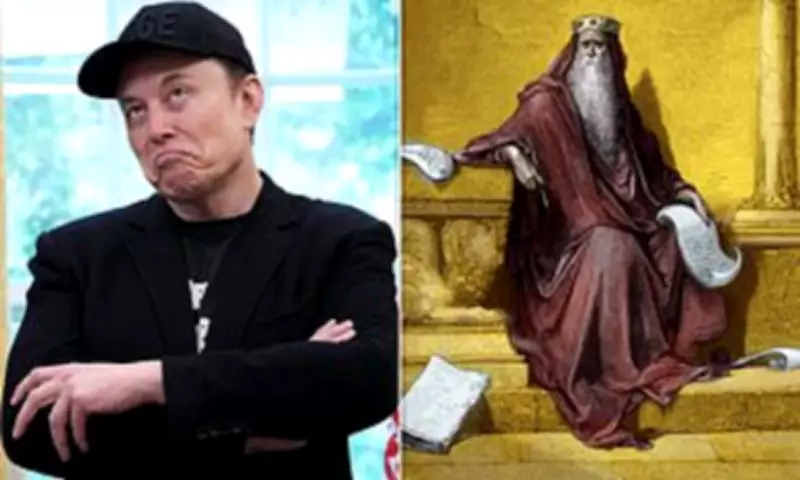
Elon Musk Echoes Ancient King Solomon: Why $852 Billion Can't Buy Happiness
In a poignant social media post that resonated across the globe, Elon Musk, the world's richest person, recently shared a timeless truth: "Whoever said 'money can't buy happiness' really knew what they were talking about." This reflection from the billionaire entrepreneur, whose personal fortune soared to an unprecedented $852 billion following SpaceX's acquisition of his AI firm xAI, struck a deep chord with his 234 million followers on platform X.
A Story as Old as Civilization Itself
Musk's modern lament finds remarkable parallels in ancient history. Nearly three millennia ago, King Solomon, renowned as the wealthiest monarch of his era, expressed similar sentiments in his biblical writings. Despite achieving extraordinary success in real estate development, possessing legendary intelligence that drew widespread admiration, and maintaining a royal household with 700 wives and 300 mistresses including the fabled Queen of Sheba, Solomon authored one of literature's most profoundly melancholic works: Ecclesiastes.
In this philosophical text, Solomon repeatedly declared "All is vanity," expressing profound dissatisfaction despite his unimaginable riches and power. The ancient king's perspective offers startling relevance today, suggesting that the relationship between wealth and contentment has perplexed humanity across civilizations and centuries.

The Modern Reaction to Musk's Revelation
Musk's post, viewed over 106 million times, generated diverse reactions from his massive audience. Some followers responded with variations of "Give me your money, let me try," while others correctly noted that poverty typically creates far more misery than extreme wealth ever could. Numerous respondents seized the opportunity to promote their religious beliefs, suggesting that only divine intervention through God, Jesus, or Allah could provide genuine happiness.
This widespread response reveals something deeper than mere commentary on a billionaire's tweet. It exposes a fundamental disappointment, even a potential crisis of worldview, among those who have pursued wealth as life's ultimate objective. For individuals who have sacrificed relationships, neglected simple pleasures, and dedicated their existence to financial accumulation, the realization that $852 billion cannot guarantee happiness represents a devastating blow to their entire value system.
The Psychology of Modern Discontent
Contemporary happiness research supports these ancient and modern observations. Economist Richard Layard has documented that despite Western societies becoming significantly wealthier than previous generations, depression rates have increased substantially. This paradox suggests that our cultural association between material acquisition and emotional fulfillment might actually contribute to our collective unhappiness.
Consider how modern advertising functions: it deliberately cultivates dissatisfaction with current circumstances to promote consumption. Commercial messages subtly whisper that our lives are inadequate, our possessions outdated, and our experiences insufficient. They promise that new products will deliver more exciting partners, more glamorous destinations, and more fulfilling existences. This systematic erosion of contentment serves economic growth but undermines personal wellbeing.
The Philosophical Dimensions of Happiness
The pursuit of happiness as a measurable objective raises complex ethical questions. Nineteenth-century philosopher Jeremy Bentham famously advocated for utilitarianism, suggesting that moral decisions should maximize happiness for the greatest number of people. While initially appealing, this approach reveals troubling implications upon closer examination.
Could surgeons ethically harvest organs from healthy individuals to save multiple patients? Should judges imprison innocent people to prevent violent riots? As the biblical figure Caiaphas declared while condemning Jesus, "It is better to have one man die for the people than to have the whole nation destroyed." These scenarios demonstrate how justice can crumble when reduced to simple happiness calculations.

Alternative Pathways to Fulfillment
Perhaps we need to reconsider our obsession with personal happiness as a primary life goal. Psychological research suggests that happiness often emerges as a byproduct of well-lived lives rather than as a direct achievement. Certain conditions support contentment—economic security, reasonable health, loving relationships, and meaningful work—but these elements don't guarantee happiness.
The fundamental problem with making personal happiness a central objective is that it encourages excessive self-absorption. Paradoxically, the most genuinely happy individuals typically demonstrate minimal concern for their own happiness. Attempting to manufacture personal contentment resembles trying to tickle oneself: the effort inherently undermines the desired outcome.
Ancient Wisdom for Modern Times
King Solomon's declaration "All is vanity" gains deeper meaning when understood in its original Hebrew context. The word translated as "vanity"—"hevel"—more accurately means "shortness of breath" or "vapor," emphasizing life's fleeting, ephemeral nature. Solomon recognized that when individuals center their lives entirely on themselves and their possessions, death represents the ultimate loss of everything meaningful.
Conversely, those who invest their hearts in purposes beyond themselves establish foundations that transcend mortality. This perspective enables living without fear, as one's center of gravity exists beyond personal limitations. As the late Oxford psychology professor Michael Argyle once observed, two reliable paths to happiness exist: religion and Scottish country dancing. The former redirects focus beyond the self, while the latter provides human connection and physical warmth.
Ultimately, both ancient wisdom and modern experience converge on a similar insight: genuine contentment emerges not from accumulating wealth but from cultivating meaningful connections, pursuing purposes beyond oneself, and appreciating life's simple, fleeting moments. Whether expressed through a billionaire's tweet or an ancient king's philosophical treatise, this truth continues to resonate across millennia, challenging our assumptions about what truly makes life worth living.





