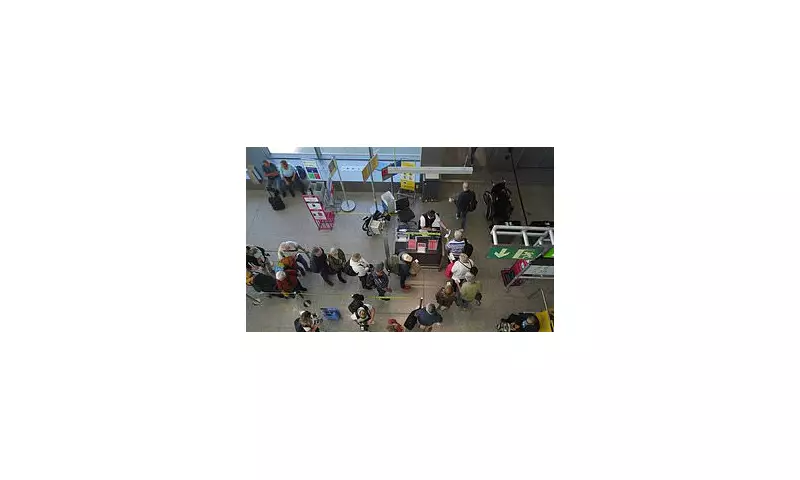
The familiar airport routine of navigating security, grabbing a quick meal, and then settling in to await your flight can be disrupted by a peculiar social phenomenon. For many travellers, the waiting period transforms into another queueing exercise as soon as boarding is announced, with clusters of passengers forming at the gate long before their designated group is called.
The 'Gate Lice' Phenomenon Captured on Social Media
This behaviour, colloquially termed 'gate lice' by frustrated travellers, has become a common sight in airports worldwide. Passengers who adopt a more relaxed approach, choosing to remain seated until their boarding group is called, often find themselves bewildered by the early queueing. The trend has sparked considerable discussion on social media platforms, with numerous videos capturing the phenomenon.
One holidaymaker, known as @ellamejones on TikTok, shared footage of eager passengers lining up prematurely. She captioned her video: 'People queuing up for a plane before their flight, even when the plane isn't here to then also sit in already allocated seats has to be one of the biggest universal mysteries.'

Another user, @elizamartinx, echoed this sentiment, posting a clip of an extensive queue and commenting: 'I'll never understand why people stand in long queues to board at the airport. Your plane seat isn't going to be taken.' She added that she prefers to 'chill' until the queue diminishes.
Travel Expert Explains the Psychology Behind Early Boarding
Lee Thompson, co-founder of group solo travel company Flash Pack, offers insight into this widespread airport behaviour. 'I completely understand why people do this,' he states. 'What's really going on is something I call carry-on FOMO.'
Thompson identifies multiple factors driving passengers to queue early. 'People are tired, anxious, often travelling with children, and desperate for their holiday to commence smoothly,' he explains. A primary concern for many is securing overhead locker space for their cabin baggage, ensuring storage near their assigned seat.
'They're worried about overhead locker space, whether they'll be sitting together, whether something will go wrong,' Thompson notes. He suggests that queueing can provide travellers with a 'sense of calm and control', acknowledging that he previously adopted this approach himself.
'The moment boarding is announced, that anxiety transforms into a surge,' Thompson describes. 'Everyone stands up simultaneously - even if the aircraft hasn't arrived yet.'
A Shift in Strategy: From Roller Bags to Relaxation
Thompson has since modified his travel habits, realising that 'the panic is mostly about luggage.' He now avoids rigid roller bags where possible, opting instead for a soft bag that fits beneath the seat. 'If your bag fits under the seat, you can sit back, relax, catch up on emails and board calmly at the end,' he advises. 'I find this time relaxing, useful for catching up on life admin!'
However, Thompson highlights that this strategy may prove less effective on budget airlines with more limited cabin space. 'If you board late on those flights, nine times out of ten they'll take your bag off you and place it in the hold,' he cautions. 'You've just added an extra hour, sometimes an hour and a half, to your journey on the other side waiting at baggage reclaim. In that situation, it's not rudeness or impatience, it's self-defence. It really is every man for themselves.'
Airlines Implement Technology to Manage Boarding Queues
In response to premature boarding attempts, airlines are deploying new technologies to streamline the process. American Airlines introduced innovative software in 2024 designed to address this issue. The system flags when a boarding pass is scanned before the passenger's group is called, emitting an alert to notify gate staff.
This enables workers to politely request that travellers rejoin the queue when their turn arrives. Such technological advancements are likely to be welcomed by passengers who prefer to wait for their designated boarding group, potentially reducing gate area congestion.

The Broader Context: From 'Gate Lice' to 'Aisle Lice'
Travel writer Meaghan Kenny has drawn parallels between 'gate lice' and another airport behaviour: passengers who rise immediately upon landing, sometimes before the seatbelt sign is deactivated. This trend, dubbed 'aisle lice', was recently examined by the Daily Mail.
Writing for Conde Nast Traveller, Kenny remarked: 'I would put them in the same category as people who, as soon as you land, jump up to grab their bags and try to get ahead of everybody. It creates chaos, and people can't see or hear what's going on. It's not like there's open seating on the plane, just relax, you'll get to your seat.'
The ongoing debate between eager boarders and relaxed travellers continues to unfold at airports globally, reflecting broader tensions in modern travel experiences between efficiency, anxiety, and social etiquette.