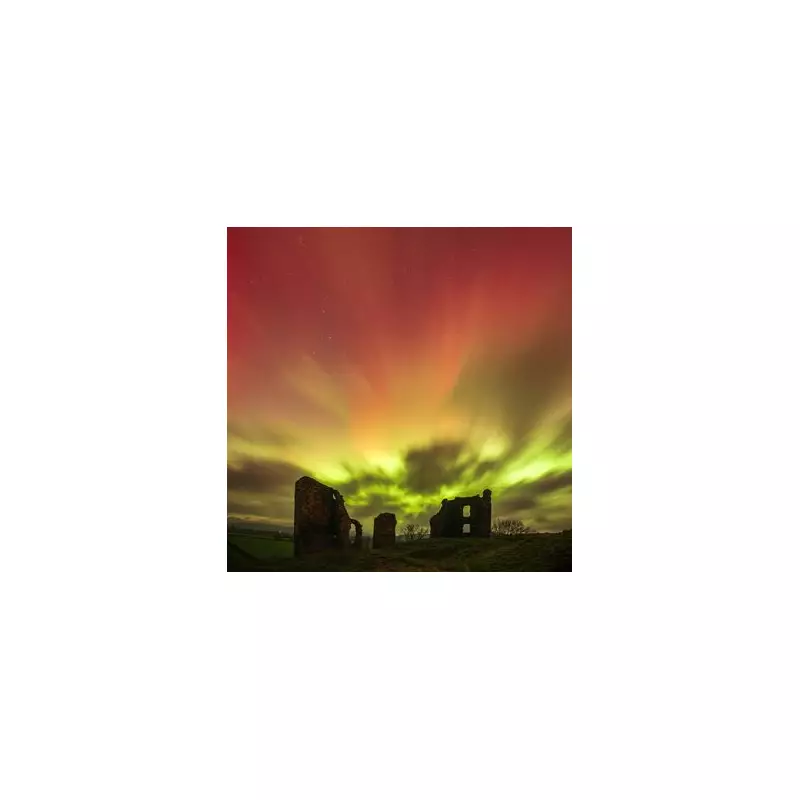
The Met Office has issued its latest aurora forecast for the United Kingdom, indicating that a significant Coronal Mass Ejection (CME) – a powerful solar storm – is expected to impact Earth this evening. This celestial event is set to push the mesmerising Northern Lights further south than their typical Arctic range, offering a rare spectacle for observers in specific parts of the country.
Severe Solar Storm Drives Aurora Southwards
Intense auroral activity has been developing over the UK since Monday, when a severe Coronal Mass Ejection collided with our planet at high velocity. This solar storm triggered stunning displays across the northern hemisphere, with its significant impact shifting the auroral oval unusually far south, even reaching states like New Mexico in the United States.
Across the United Kingdom, the lights have also migrated further south than normal, bathing certain regions in ethereal hues of red and green. However, visibility remains selective, with some areas offering better viewing conditions than others according to meteorological experts.

Monday's Display and Tonight's Expectations
On Monday evening, parts of Cornwall experienced the aurora's glow, alongside traditional viewing areas in Scotland and northern England. Scotland, particularly its northernmost territories, is no stranger to these luminous displays, but southern sightings remain exceptional.
The Met Office anticipates similar conditions tonight, though visibility will heavily depend on local weather patterns. While the exact timing of the next CME's arrival remains uncertain, forecasters believe it will likely affect largely the same geographical areas as previous nights.
Official Met Office Aurora Prediction
The national weather service provides this detailed forecast: "By the evening of 20 January UTC, auroral activity is expected to decline, though it may still be visible in parts of Scotland, Northern Ireland, and other similar latitudes with clear skies. Auroras are then forecast to return to background levels for the remainder of the period."
This suggests that the widespread spectacle witnessed on Monday will not continue with the same intensity into Tuesday. The aurora will likely be best observed from the UK's northernmost home nations between 6pm and 11.59pm tonight.
Viewing Conditions and Geomagnetic Thresholds
The Met Office's forecast further clarifies: "The aurora may continue to be visible in parts of Scotland and Northern Ireland Tuesday evening, but cloudy conditions will likely limit sightings." Crucially, forecasters emphasise that for the aurora to become visible further south across the UK, a solar storm would need to reach a Kp index level between 8 and 9.
A current red warning issued by the Met Office suggests tonight's activity will only reach approximately Kp7, meaning the display will likely remain confined to northern regions. The agency explains that activity between Kp8 and 9 is classified as "extreme" geomagnetic conditions.
Rarity of Southern UK Aurora Sightings
The Met Office elaborates on the geographical challenges: "As the UK is south of where the natural aurora belt occurs (Norway/Iceland/Greenland), it takes a severe or extreme geomagnetic storm (Kp8-9+) to bring the belt southwards directly over the UK. This is a very rare occurrence."
During more moderate to strong geomagnetic storms registering Kp6-7, the Aurora Borealis typically shifts southwards across southern Iceland or towards the Faeroe Islands. These auroras can sometimes be faintly visible from the United Kingdom because they occur at exceptionally high altitudes in the atmosphere.
Observers hoping to catch tonight's display are advised to seek locations with minimal light pollution and clear, unobstructed views of the northern horizon. While the main spectacle may be reserved for Scotland and Northern Ireland, those in northern England should remain vigilant for potential faint appearances if conditions prove exceptionally favourable.