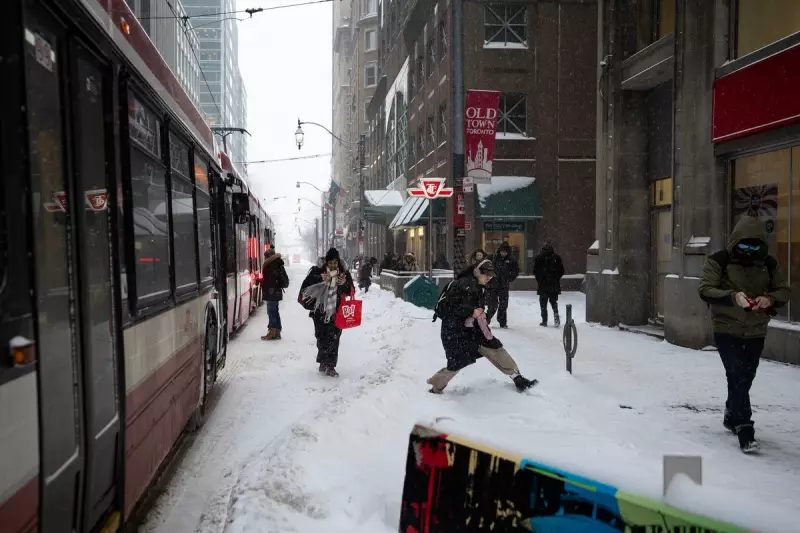
A major winter storm brought Southern Ontario to a standstill on Thursday, 15 January 2026, with heavy snowfall triggering widespread school closures and creating treacherous conditions for commuters.
Widespread Disruption Across the Region
Environment Canada issued warnings for significant accumulations, with the Greater Toronto Area, Kitchener, and Hamilton bracing for up to 30 centimetres (12 inches) of snow through the afternoon. The Ottawa region was forecast to receive up to 25 centimetres (10 inches), with conditions expected to ease by Thursday evening.
The meteorological agency also warned of northerly wind gusts reaching 60 kilometres (37 miles) per hour, leading to blowing snow, sharply reduced visibility, and dangerously cold wind chills as temperatures plummeted.

Transport Gridlock and Safety Warnings
The storm's impact on transport was immediate and severe. Provincial police responded to dozens of collisions and reports of vehicles stranded in ditches. Multiple road closures were enacted across the region, including ramps on Highway 403 near the Burlington and Hamilton border and sections of Highway 401 in eastern Ontario.
Authorities strongly advised the public to stay off the roads unless absolutely necessary. The travel chaos extended to the skies, where Toronto's Pearson International Airport implemented air traffic management procedures, impacting numerous arriving and departing flights. Travellers were told to check their flight status before heading to the airport.
Institutional Shutdowns and Political Response
In a rare move for the city, all schools in the Toronto, York, Peel, and Halton Region districts were closed for the day. Major universities, including the University of Toronto, Toronto Metropolitan University, and York University, also shuttered their campuses.
The severe weather prompted Ontario Premier Doug Ford and Toronto Mayor Olivia Chow to cancel their public engagements for the day. The widespread institutional closures and high-level cancellations underscored the storm's significant disruption to daily life across Canada's most populous region.