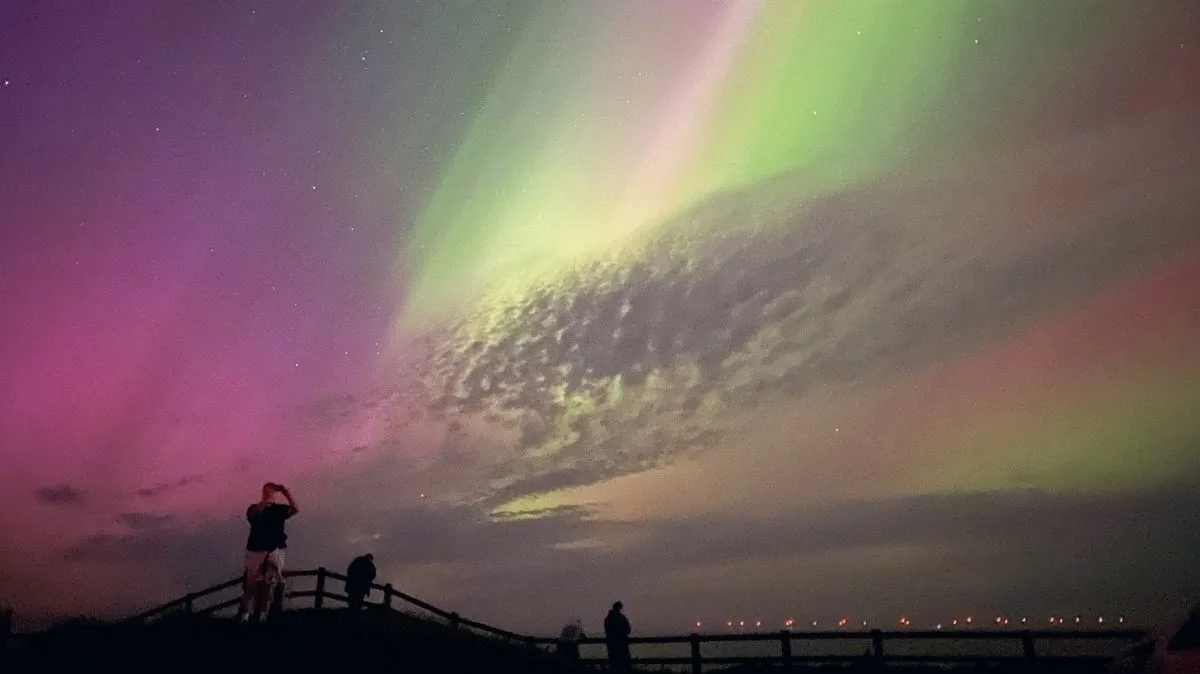
Northern Lights Return to UK Skies for Second Night Amid Cloud Concerns
Northern Lights Return to UK for Second Night

Brits across the nation are poised for another potential celestial spectacle as the Northern Lights are forecast to grace UK skies for a second consecutive evening. However, widespread cloud cover threatens to obscure the breathtaking auroral displays for millions of hopeful stargazers.

Geomagnetic Storm Activity Continues

The night sky was dramatically illuminated on Monday evening, with vivid auroral activity visible from the Scottish Highlands all the way down to Penzance in Cornwall. This remarkable display was triggered by a powerful G5 geomagnetic storm striking Earth – the highest possible classification for such solar events.

Tonight, the Met Office predicts continuing but slightly reduced activity with a G3 geomagnetic storm classification. This level of solar disturbance typically makes aurora borealis sightings possible across much of the United Kingdom, though visibility depends heavily on local weather conditions.

Cloud Cover Challenges Across the Nation

Current meteorological maps present concerning news for astronomy enthusiasts, showing extensive cloud blankets covering much of the country tonight. These conditions could significantly diminish viewing opportunities for the ethereal dancing lights that captivated so many observers just twenty-four hours earlier.

Some promising breaks in the cloud cover exist above parts of Cornwall, Devon, northern Scotland, and Northern Ireland – all regions that successfully witnessed Monday night's spectacular displays. Despite generally overcast conditions, sightings have already been reported through the Aurora detection application in diverse locations including Edinburgh, Glasgow, Lincolnshire, Birmingham, and even London.

European Observations and Technical Impacts

Continental European stargazers appear to have enjoyed better viewing conditions, with numerous aurora sightings reported across the Netherlands, Belgium, and Germany. The current G3 storm level carries potential technical implications beyond visual spectacle, possibly causing surface charging issues on satellites that could disrupt satellite navigation systems and low-frequency radio communications on the ground.

Optimal Viewing Locations and Techniques

Scotland and Northern Ireland represent the most promising regions for aurora observation tonight, though the Midlands and mid-Wales may also experience visible activity. AuroraWatchUK, the specialist forecasting service, indicates that auroral displays are likely to be visible across the UK under clear sky conditions.

Forecasters note that in some instances, the Northern Lights may not be distinctly visible to the naked eye. In such cases, stargazers can employ long-exposure photography techniques – a feature available on many modern smartphone cameras – to capture the subtle colours and movements of the auroral phenomena.

The Science Behind the Spectacle

Auroras are created when solar flares and coronal mass ejections from the sun collide with Earth's magnetic field. Our planet's magnetic defences deflect these charged particles toward the polar regions, where they interact with atmospheric gases to produce the luminous displays we recognise as the Northern and Southern Lights.

Tonight's geomagnetic activity represents the continuing effects of Sunday's substantial coronal mass ejection, which travelled through space for approximately twenty-four hours before reaching Earth on Monday. Although technically a residual component of the initial storm, the continuing disturbance remains classified as a strong geomagnetic event.

Measurement and Future Prospects

AuroraWatchUK reports significant electromagnetic activity with peaks reaching 634.6 nanoteslas. The current storm registers a Kp index of seven on the nine-point scale – a substantial measurement derived from the German Planetarische Kennziffer (Planetary Index) used to quantify geomagnetic disturbances.

The Met Office indicates that geomagnetic activity should return to background levels following tonight's events, making this evening potentially the final opportunity to witness these extraordinary celestial displays for the foreseeable future. Monday night's remarkable sightings included bright red skies over Moresby in Whitehaven, Cumbria, vibrant green illuminations above Fort William in Scotland, and stunning light shows across Shropshire – memories that many hope to replicate tonight despite challenging meteorological conditions.