Stargazers across the United Kingdom are in for a celestial treat this week, as the solar system's largest planet, Jupiter, makes its closest approach to Earth for 2026. The gas giant will be exceptionally bright and well-placed for observation, offering a prime viewing opportunity for amateur astronomers.
A Beacon in the Winter Sky
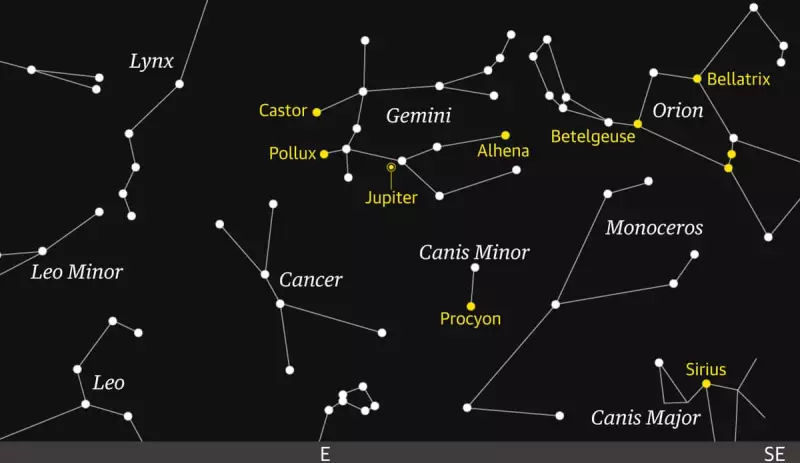
Jupiter will be impossible to miss in the night sky, outshone only by Venus. It is currently positioned within the constellation of Gemini, the twins. Skywatchers can locate it by looking for the brilliant point of light that forms a lopsided triangle with Gemini's two brightest stars, Castor and Pollux. The planet is visible from both the northern and southern hemispheres.
Despite being over 600 million kilometres away, Jupiter's immense size and highly reflective cloud decks make it a dazzling sight. With a diameter more than 11 times that of Earth, its reflective power ensures it dominates the evening sky. This week, it will be a mere 633 million kilometres distant from our planet.

How to Observe Jupiter's Details
While stunning to the naked eye, simple optical aids will reveal far more. A pair of modest binoculars, held steadily, should be sufficient to spot Jupiter's four largest moons: Io, Europa, Ganymede, and Callisto. These Galilean satellites appear as tiny, bright dots aligned near the planet.
For an even better view, small telescopes or binoculars with a magnification of 10x or higher will allow observers to discern Jupiter's distinctive cloud belts. These bands of contrasting colour in the planet's atmosphere become visible with a bit of magnification, transforming the bright dot into a world with discernible features.
The light we see from Jupiter this week has undertaken an incredible journey. Sunlight first took about 43 minutes to travel from the Sun to Jupiter. It then bounced off the planet's clouds and spent just over 35 minutes travelling the vast distance to Earth. When you look at Jupiter, you are seeing it as it was over an hour ago.
Prime Viewing Time and Location
For optimal viewing from the UK, look towards the eastern sky. On the evening of 9 January at 20.00 GMT, Jupiter will be prominently placed, as shown in astronomical charts. It will remain a highlight of the night sky for many weeks, but this period marks its peak brilliance and proximity.
This event underscores the dynamic nature of our solar system and provides a perfect, accessible opportunity for anyone to engage with astronomy. Whether you have a high-powered telescope or a simple pair of binoculars, stepping outside to find Jupiter is a rewarding experience that connects us to the wider cosmos.