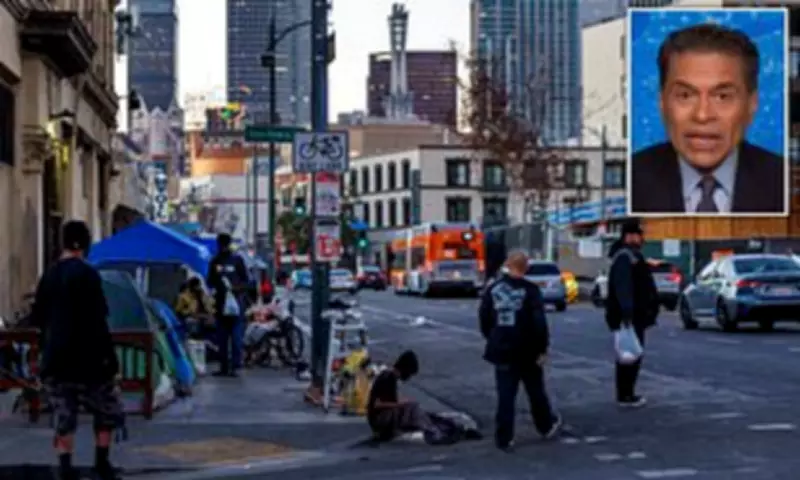
CNN Host Fareed Zakaria Delivers Blistering Critique of Democrat-Run Cities
CNN presenter Fareed Zakaria has launched a fierce attack on Democratic leaders in major American cities, accusing them of fiscal irresponsibility and failing to deliver on promises of affordability. During his Sunday programme, Fareed Zakaria GPS, the host argued that blue cities are "out of control," spending excessively while achieving diminishing returns for residents.
New York City: A Prime Example of Democratic Failure
Zakaria pointed directly to New York City as a glaring example of this trend. He highlighted Mayor Zohran Mamdani's recently proposed 9.5 percent property tax increase as evidence of misguided governance. "New York is really a prime example of a problem Democrats seem unwilling to confront," Zakaria stated. "Blue cities are out of control, promising more, spending more, delivering less, and pushing off the fiscal problems to some future day."
The host emphasised that rental assistance subsidies in New York have skyrocketed fivefold since 2020, from $263 million to a projected $1.34 billion in 2025. According to Zakaria, such subsidies have paradoxically driven up rental costs rather than alleviating housing pressures. "These only seem to have driven up the cost of rent as subsidies naturally do," he remarked.

Los Angeles: Billions Spent with Rising Homelessness
Turning his attention westward, Zakaria described Los Angeles as "another one-party metropolis wrestling with affordability and disorder." He noted that the city allocated $950 million this fiscal year to homelessness under Mayor Karen Bass, yet outcomes remain dismal. Official statistics reveal homelessness increased by 9 percent countywide and 10 percent within the city in 2023. Since 2015, homelessness has surged by 70 percent across the county and 80 percent in the city itself.
"All this amid public frustration, despite billions spent," Zakaria fumed. He cited an audit of $2.4 billion in city homelessness funding that found officials could not reliably track where the money went or what it achieved.
Chicago: Pension Promises and Political Unpopularity
Zakaria also targeted Chicago, where Mayor Brandon Johnson's approval ratings are "deep underwater." He warned that the city's pension promises are so substantial they threaten to bankrupt Chicago eventually. "What is the theory of good government here?" Zakaria questioned. "If the answer is keep adding programs, the city will keep producing unaffordability because unaffordability is what happens when government becomes a machine that grows faster than the society it governs."
A Call for Pragmatic Governance Over Rhetoric
Zakaria issued a direct challenge to Democratic city leaders: "For Democrats in city halls, there is a choice." He urged politicians to "stop governing as if the goal is to announce new entitlements, and instead make government work." His prescription includes safer streets, functioning schools, predictable sanitation, and, crucially, sufficient housing that the middle class can afford.
"New York City does not need more soaring rhetoric. It needs more homes," Zakaria asserted, summarising his critique of urban policy failures.
Political and Fiscal Context in New York
The backdrop to Zakaria's comments includes Mayor Mamdani's recent warning that New York's dire budget crisis could only be resolved through a property tax hike or increased rates for the wealthiest residents. However, the mayor lacks authority to raise property taxes without City Council approval, and Speaker Julie Menin has ruled out such a move. Similarly, Governor Kathy Hochul rejected Mamdani's proposed 2 percent tax increase on New Yorkers earning over $1 million annually.
New York's tax landscape is already among the nation's most burdensome. The state income tax rate stands at 10.9 percent for those making more than $25 million, the third-highest in the country. Combined with local taxes, the highest earners in New York City face a rate of 14.8 percent, surpassing even California's 13 percent. Meanwhile, California maintains moderate to low property tax rates despite its high income taxes, contrasting sharply with New York's approach.

Zakaria's monologue underscores a growing debate about urban governance, fiscal responsibility, and the tangible outcomes of progressive policies in America's largest cities.