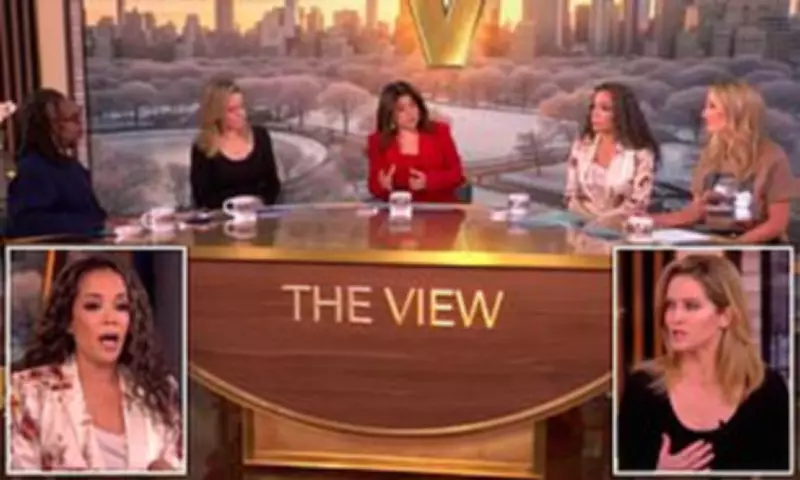
On Monday's episode of The View, co-hosts Sara Haines and Sunny Hostin engaged in a heated debate over the legality of recent joint US and Israeli military strikes against Iran. Hostin, a former federal prosecutor, launched a sharp critique of the operation, labeling it an "illegal war" and questioning President Donald Trump's strategic planning.
Hostin's Constitutional Challenge
Sunny Hostin opened the contentious discussion by declaring the strikes unconstitutional due to lack of congressional approval. "It's an illegal war. He didn't go to Congress. He didn't go to the UN. He didn't go before the American people, and that's why, at this point, only 27 percent of Americans approve of these actions," Hostin asserted.
She continued her criticism of the administration's approach, stating, "And I don't believe, I don't have any confidence that Donald Trump has any sort of plan. Maybe he has concepts of a plan, but he does not have any sort of plan," echoing a phrase that gained prominence during the 2024 campaign trail.

Haines' Historical Rebuttal
Sara Haines offered a pointed counterargument, rattling off a list of recent presidents who had similarly deployed military force without congressional authorization. "[Joe] Biden, [Barack] Obama, [Bill] Clinton, George H.W. [Bush], [Ronald] Reagan," she recited with apparent ease.
Haines redirected the focus toward institutional dynamics rather than individual presidential decisions. "So I would be more upset that Congress has ceded this power, than mad that the president didn't check with Congress," she concluded, highlighting a broader constitutional tension that has persisted for decades.
Earlier Tensions with Guest Host
The exchange followed another heated moment between Hostin and conservative guest host Elisabeth Hasselbeck, who was making a week-long return appearance to the program. Hasselbeck expressed support for Trump's decision to proceed with the strikes, prompting Hostin's sharp retort.
"I thought this president wanted to win a Nobel Peace Prize for peace. That is not what I'm seeing. I am not seeing America first," Hostin declared before directly addressing Hasselbeck. "I think people that voted for Trump, I was not one of them. I think you were. Those people wanted America first."
Haines' Defense of Intervention
At this juncture, Sara Haines intervened with a different perspective, focusing on the Iranian regime's human rights record. "The Iranian people are amazing, and they deserve to live outside of this leader and this regime, but they also have had media blackouts," she stated.
Haines detailed the regime's repressive tactics, noting, "Any dissidents, they could be killed. They'll just be killed." She specifically cited the use of "facial recognition software being used by Iranians to identify protesters and then further eliminate them" as evidence of systemic oppression.
While acknowledging uncertainty about the operation's duration and outcomes, Haines suggested potential benefits. "So I just don't think we know yet how long this lasts or what it looks like, but there are some benefits to this country if indeed it could go smoothly."
Operation Details and Context
The military campaign, designated "Operation Epic Fury," represents a coordinated effort between American and Israeli forces. President Trump confirmed the operation's objectives during a Monday briefing, stating its mission was "to thwart Tehran's nuclear development and a ballistic missile program, while carrying out a regime change."
Trump characterized the action as a necessary defensive measure, declaring, "This was our last best chance to strike – what we're doing right now – and eliminate the intolerable threats posed by this sick and sinister regime." He projected the operation could last four to five weeks or potentially "go far longer."
The president also acknowledged the human cost, confirming that "four American service personnel have lost their lives in the fighting." He vowed to continue the mission "with ferocious, unyielding resolve to crush the threat this terrorist regime poses to the American people."

Constitutional Framework
The debate between the View hosts touches on a longstanding constitutional tension in American governance. While Article I of the Constitution grants Congress the exclusive power to declare war, Article II establishes the executive branch and vests significant authority in the president as commander-in-chief.
This constitutional arrangement has enabled nearly every US president over the past eight decades to deploy military force without obtaining a formal declaration of war from Congress. The executive branch has frequently utilized Article II authority to bypass congressional approval requirements for military actions.
The discussion was abruptly concluded when moderator Whoopi Goldberg intervened to cut to commercial, leaving the constitutional debate unresolved but highlighting the complex legal and political questions surrounding military intervention without congressional authorization.