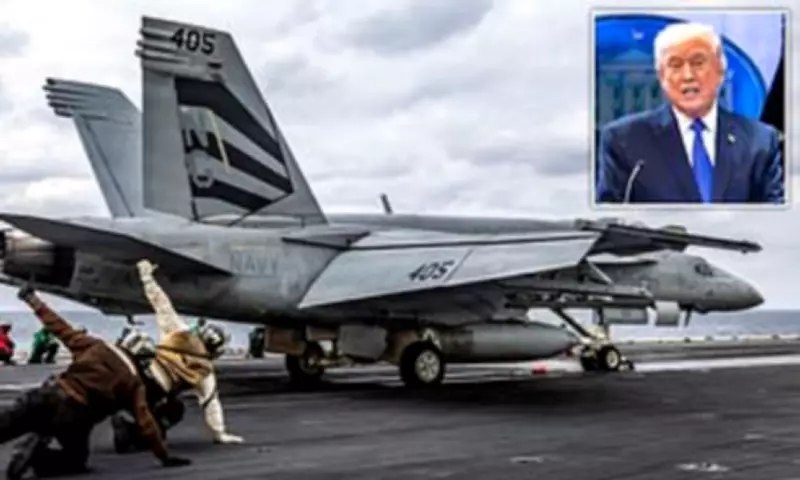
Trump's Supreme Court Fury Could Influence Iran Military Decision, Former Official Claims
Donald Trump's intense anger following the Supreme Court's decision to declare his tariff policies unconstitutional may significantly influence his choice to authorise a military strike against Iran, according to a former senior White House official. The president, who has been deliberating the issue with advisors for several days as the military deploys dozens of air and sea assets to the region, remains heavily focused on his presidential legacy.
Legacy Concerns and Diplomatic Frustrations
Trump, aged 79, has actively sought to negotiate a deal preventing Iranian nuclear enrichment in recent weeks but has encountered persistent resistance from the regime in Tehran. Former Commerce Secretary Wilbur Ross, who served during Trump's first term, believes the president is now more likely to order strikes against the Middle Eastern nation following this major blow to his most significant second-term policy initiative.
'I do not think he can absorb this loss and then be perceived as backing down on Iran,' Ross told The Wall Street Journal. However, despite recent successful targeted military actions in Iran and Venezuela, a current White House official informed the WSJ that Trump still prefers diplomatic solutions over warfare.

Targeted Strikes as Negotiation Leverage
On Thursday, indications suggested Trump was leaning toward authorising targeted and limited strikes against the Iranian regime rather than initiating full-scale war. Advisors believe such precision attacks could pressure the Islamic Republic into accepting a nuclear agreement. According to the Journal's reporting, these strikes would initially aim to decimate only military and government installations as a preliminary step.
Speaking at the inaugural meeting of his Board of Peace on Thursday, the president warned that the United States could bomb Iran if a satisfactory deal is not reached within ten days. A regional official noted this aggressive tactic would likely push Iranian negotiators away from talks for a significant period. Should this approach fail, Trump could then escalate to striking regime facilities in an attempt to remove the entire leadership structure.
Military Buildup and Strategic Calculations
While senior aides have repeatedly presented this plan to Trump, Oval Office discussions have largely concentrated on broader attack strategies. 'Only President Trump knows what he may or may not do,' White House spokesperson Anna Kelly told the WSJ. Trump boasted on Thursday about bringing peace to the Middle East, but subsequently threatened that if Iran fails to make a meaningful peace agreement, 'bad things [will] happen.'
'We may have to take it a step further, or we may not. Perhaps we will reach a deal,' Trump remarked regarding the stalled nuclear negotiations. 'You will discover the outcome over the next probably ten days,' he added. Trump last directed strikes against Iran during the summer. On June 19, the White House established a two-week window for the president to decide between continuing talks or taking military action.
Recent Military Actions and Regional Posturing
Three days later, he launched Operation Midnight Hammer, where US Air Force and Navy units attacked three nuclear facilities in Iran. Trump has frequently stated his desire to be the president who ends wars, but the newly formed board's meeting follows substantial US military buildup of air and naval assets in the Middle East in recent weeks. This deployment included moving aircraft carriers, fighter jets, submarines, and other resources to the region.
Iran nuclear talks stalled after the latest round of negotiations in Geneva, Switzerland, where the Middle Eastern nation requested additional time with minimal progress. On Friday, the president was compelled to improvise after the Supreme Court invalidated his signature trade policies.

Tariff Controversy and Presidential Outrage
'It is my Great Honour to have just signed, from the Oval Office, a Global 10% Tariff on all Countries, which will be effective almost immediately. Thank you for your attention to this matter!' Trump wrote on Truth Social on Friday evening. Trump previously threatened to impose a 10 percent tariff under Section 122 of the Trade Act of 1974, which grants presidential authority to implement temporary tariffs.
This trade law was designed to address short-term emergencies and does not establish long-term trade policies. The tariffs can remain effective for only 150 days without congressional approval. Trump's decision marks the first time a president has invoked Section 122. The White House confirmed the temporary import duty will take effect on February 24 at 12:01 AM EST.
Tariff Exemptions and International Agreements
The tariff excludes a wide range of goods, including:
- Energy products and natural resources
- Fertilizers and pharmaceuticals
- Certain electronics and vehicles
- Specific aerospace products
- Informational materials and accompanied baggage
Food products such as beef and tomatoes will be exempt to minimise consumer impact. The global tariff also excludes products from Canada and Mexico under the United States-Mexico-Canada Agreement. These countries maintain the lowest effective tariff rate globally but will still face taxes on steel, aluminum, and non-USMCA compliant goods. Certain textiles and apparel receive exemptions under the Dominican Republic-Central America Free Trade Agreement.
Judicial Criticism and Constitutional Conflict
The president launched scathing accusations that justices who overturned his signature tariffs are being swayed by foreign interests. In his furious condemnation, Trump claimed some conservative justices lack loyalty compared to those appointed by Democratic presidents and accused them of violating the US Constitution. He lamented the decision as nonsensical, asserting the Court acknowledged he can do anything as president except implement tariffs.
'I am permitted to destroy the country, but I cannot charge them a small fee,' Trump complained. 'I can do anything I want to them, but I cannot charge any money.' Three conservative justices joined all three liberal justices on the panel to rule against Trump on Friday, delivering a 6-3 decision that repudiated one of the president's most substantial economic proposals of his second term.