Trump's Supreme Court Showdown on Birthright Citizenship Faces Judicial Doubt
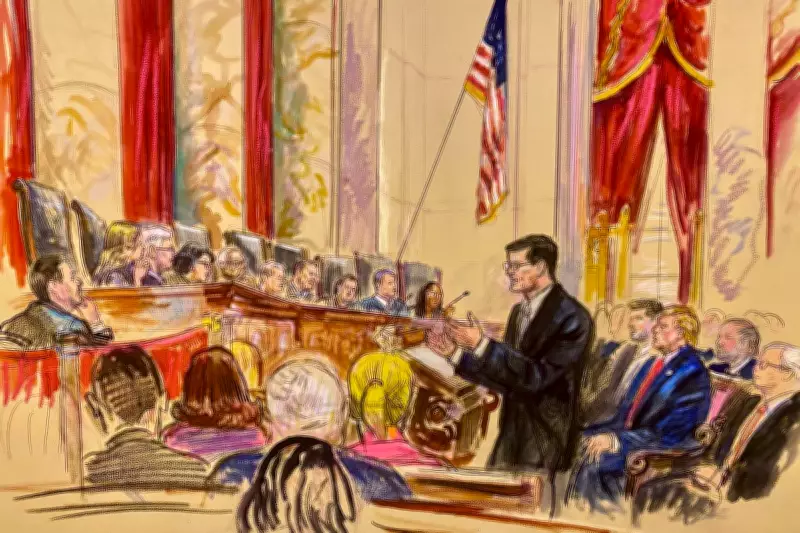
President Donald Trump's unprecedented appearance at the Supreme Court to defend his administration's challenge to birthright citizenship was met with profound skepticism from the justices, including three of his own nominees. The president's executive order, which seeks to reinterpret the 14th Amendment's citizenship clause, appeared to be on shaky legal ground during Wednesday's oral arguments.
A Historic Courtroom Confrontation
In a remarkable scene, Trump became the first sitting president to witness oral arguments at the nation's highest court. He abruptly departed the building midway through proceedings as his administration's solicitor general, D. John Sauer, struggled under intense questioning from the bench. The president later took to his Truth Social platform to vent his frustration with a single-word post labeling the country "stupid."
Trump's executive order represents a radical departure from over a century of legal precedent. The administration seeks to deny citizenship to children born in the United States if their mother was unlawfully present or held temporary legal status, and if the father was neither a U.S. citizen nor lawful permanent resident at the time of birth.

Constitutional Foundations Under Scrutiny
The 14th Amendment, ratified in the aftermath of the Civil War, contains one of the Constitution's most straightforward provisions: "All persons born or naturalized in the United States, and subject to the jurisdiction thereof, are citizens of the United States and of the state wherein they reside." This language was specifically designed to overturn the Supreme Court's infamous Dred Scott decision that denied citizenship to Black Americans.
Justice Neil Gorsuch, Trump's first appointee to the court, pointed out the absence of any reference to parental legal status in the historical debates surrounding the amendment's drafting. "The absence is striking," Gorsuch remarked, highlighting a fundamental weakness in the administration's argument.
Trump Appointees Express Doubts
Perhaps most telling were the reservations expressed by justices appointed by Trump himself. Justice Amy Coney Barrett interrupted Sauer's arguments at one point, saying "yeah, yeah, yeah, yeah, but what about the Constitution?" She suggested the administration's interpretation would create "a new kind of citizenship" that appeared unworkable.
Justice Brett Kavanaugh noted that Congress had codified the 14th Amendment's citizenship language in 1940 and 1952 with full understanding of its long-standing interpretation. Chief Justice John Roberts offered a pointed observation when Sauer argued that modern immigration patterns represented "a new world." Roberts responded: "It's a new world, but it's the same Constitution."
Legal Precedent and Potential Consequences
The Supreme Court established the current understanding of birthright citizenship in the landmark 1898 case United States v Wong Kim Ark, which held that the 14th Amendment grants citizenship to virtually everyone born in the country. This interpretation has stood for more than 125 years.
Plaintiffs challenging Trump's order warned of potentially catastrophic consequences if it were allowed to stand. Tens of thousands of newborns could be denied citizenship annually, potentially creating stateless children within mixed-status families and establishing uneven constitutional rights based on parental status.
Administration's Argument Stumbles
Sauer's presentation faced particularly difficult moments when Justice Gorsuch questioned whether Native Americans would qualify for citizenship under the administration's interpretation. After a hesitant response, Sauer admitted: "I think so? I'd have to think that through." This exchange highlighted the potential inconsistencies in the administration's legal theory.
Justice Elena Kagan delivered perhaps the most direct critique, telling Sauer: "The text of the clause, I think, does not support you. I think you're sort of looking for some more technical, esoteric meaning."

Broader Immigration Agenda at Stake
While a final decision on the birthright citizenship case is expected by June or July, this represents just one front in the Trump administration's comprehensive immigration agenda. The Supreme Court will hear another major immigration case later this month that could determine whether the administration can strip temporary humanitarian protections from tens of thousands of immigrants.
Outside the courthouse, protesters gathered to voice their opposition to the administration's policies, reflecting the deep national divisions over immigration that have characterized Trump's presidency. The court's eventual ruling will not only determine the fate of birthright citizenship but may also establish important precedents regarding executive authority and constitutional interpretation for generations to come.