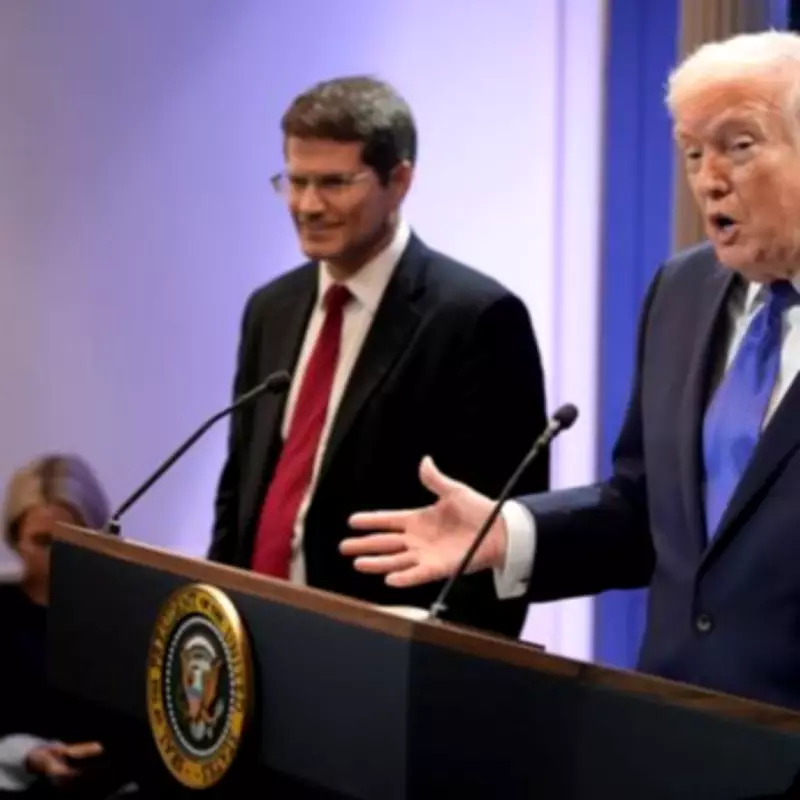
Former President Donald Trump unleashed a furious tirade against the United States Supreme Court following its landmark decision declaring his extensive tariff regime unlawful. In a press conference that quickly spiraled into what observers described as an unhinged rant, Trump branded the six justices who ruled against him as "unpatriotic" and "an embarrassment to their families."
Unprecedented Judicial Criticism
Trump's extraordinary outburst targeted the very court he had helped shape during his first term, with his comments directed at two of his own appointees who joined the majority opinion. The former president expressed profound disappointment with the ruling, stating he was "absolutely ashamed" of the justices for lacking "the courage to do what's right for our country."
He escalated his rhetoric further, accusing the court of being influenced by external forces without providing any substantiating evidence. "They're just being fools and lap dogs for the RINOs and the radical left Democrats," Trump declared, adding that the justices had shown "disloyalty to our Constitution."

Determination to Circumvent Ruling
Despite the legal setback, Trump vowed to pursue alternative avenues to maintain his tariff policies. He announced plans to implement a new 10% "global tariff" for approximately five months while conducting investigations to establish what he termed "fair tariffs" on other nations. "We're immediately instituting the 10% provision, which we're allowed to do," Trump asserted, claiming this approach would ultimately generate greater revenue than previous measures.
The former president acknowledged that some trade agreements negotiated under his tariff regime would become invalid following the Supreme Court's decision, though he declined to specify which ones. "Some of them stand. Many of them stand. Some of them won't, and they'll be replaced with the other tariffs," he stated ambiguously.
Background of the Legal Challenge
Trump's controversial tariff system was established last year under emergency powers legislation, imposing substantial import taxes on nearly every country worldwide. This marked the first time a fundamental component of Trump's agenda had reached the Supreme Court, despite his successful appointment of conservative justices during his presidency.
The legal challenges originated from multiple sources, including a coalition of twelve predominantly Democratic-leaning states and various small businesses representing diverse sectors from plumbing supplies to women's cycling apparel. These plaintiffs argued that the emergency powers statute contained no provisions authorizing tariffs and that Trump's application failed to meet established legal criteria.
Substantial Economic Implications
The financial consequences of Trump's tariff policies are considerable, with the Congressional Budget Office estimating potential economic impacts reaching approximately $3 trillion over the coming decade. Treasury Department data from December revealed that over $133 billion had already been collected through these import taxes.
Major corporations, including warehouse giant Costco, have initiated legal proceedings to reclaim tariff payments. Meanwhile, Trump has structured significant portions of his economic and spending policies around anticipated tariff revenues, warning that forced repayment could cost the U.S. Treasury "in excess of $3 trillion"—a scenario he described as potentially "devastating to the future of our Country."
Constitutional and Legal Context
The U.S. Constitution explicitly grants Congress authority over tariff implementation, but the Trump administration contended that a 1977 law permitting presidential regulation of imports during emergencies provided sufficient legal foundation. While previous administrations have invoked this legislation for sanction implementation, Trump became the first president to utilize it specifically for imposing import taxes.
Trump initially established what he termed "reciprocal" tariffs in April 2025, justifying them as necessary to address trade deficits he classified as national emergencies. These followed earlier duties imposed on Canada, China, and Mexico, ostensibly targeting drug trafficking concerns.

Although the Supreme Court's decision doesn't prohibit tariff imposition under different legal frameworks, it significantly restricts the speed and severity with which such measures can be implemented. The administration is expected to explore every possible loophole to avoid repaying collected levies while continuing its trade policy objectives.