Starmer's Legalistic Defence of UK Non-Involvement in Iran Strikes Divides Commons
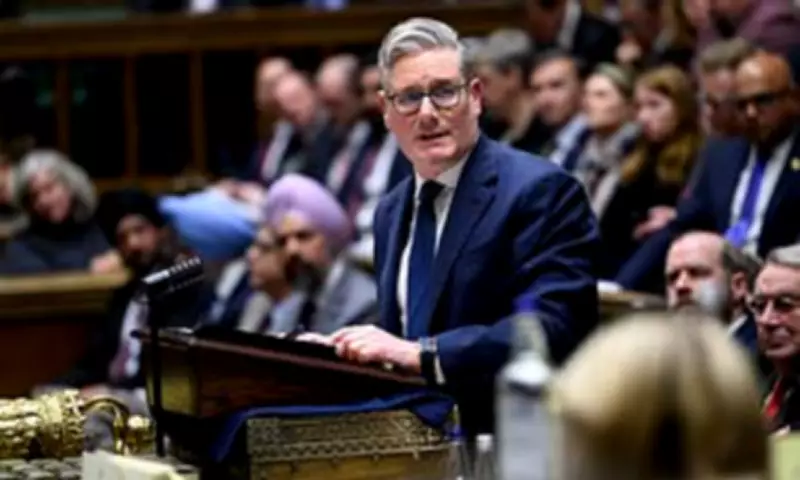
Attorney General Lord Hermer, the government's true leader on international legal matters, sat silently in the peers' gallery with a feline precision in his posture, observing proceedings from above. Below him at the despatch box stood his unhappy pupil, Prime Minister Sir Keir Starmer, whose furrowed brow displayed three distinct lines of tension as he entered the chamber.
The gravity of war had cooled the usual heckling atmosphere, cloaking the House of Commons in an unusual silence as officials installed a raised platform to assist Sir Keir's tired eyes with his notes. The Prime Minister remained on his feet for two hours, repeatedly emphasising that British forces were taking no part in what he termed 'offensive' strikes against Iran.
A Defensive and Legalistic Posture
Sir Keir's very opening assertion set the tone: 'The United Kingdom was not involved in the initial strikes.' This prompted disgust to ripple across the dark-suited Conservative benches, with one Opposition MP shouting 'Shame!' in response. However, Sir Edward Leigh, the Conservative MP for Gainsborough and a veteran opponent of Middle East military interventions, leaned back and picked his teeth, indicating at least some cross-party support for the Prime Minister's position.

The Prime Minister's tone remained flat, clerical, and dispassionate to the point of being described as bloodless by observers. Sir Andrew Mitchell, Conservative MP for Sutton Coldfield who seldom attacks prime ministers directly, called the performance 'anaemic and disappointing.' Many Tories appeared more accustomed to British premiers who would inhale the cordite of battle and fire off rhetorical salvoes.
Sir Keir carefully avoided any adjective or phrase that could be construed as stirring, appearing no more belligerent than the speaking clock during what one observer described as 'piglet in a perturbation.' Behind him sat his parliamentary private secretary in a glaringly yellow dress, providing visual contrast to the Prime Minister's muted delivery.
Legal Justifications and Contradictions
The Prime Minister repeatedly emphasised legal justifications, telling Parliament that the United Kingdom had not been involved in the strikes on Iran conducted by Israel and the United States. He prattled about travel advice and expressed pleasure that Britain was doing no more than Germany and France in response to the crisis.
His tone remained entirely defensive, alighting on reasons not to take action rather than advocating for any particular course. He kept mentioning the law, the law, the law, eventually averring that 'The law is what it is.' This prompted questions about who sets international law and how democratically accountable any international court might be.
Sir Andrew Mitchell noted that shadow Attorney General Lord Wolfson had reached a different legal conclusion from that of Lord Hermer, prompting a Labour voice to snap: 'Wrong lawyer!' This exchange highlighted the central question of whether government policy boiled down to one lawyer's opinion versus another's.
Contradictory Decisions and Evasive Answers
Sir Keir admitted he had not read Lord Wolfson's legal opinion but, like a child proud of baking its first batch of fairy cakes, boasted about having made two decisions. He expressed jolly pride in himself, even though these decisions had been contradictory: first refusing to let Americans use British air bases, then changing his mind once British personnel in Cyprus came under attack.
Conservatives repeatedly asked whether this meant Iran could now be bombed legally, but Sir Keir would not utter those words, instead peering at the benches opposite through the horizontal frame of his slightly smudged spectacles without providing clear answers.
Cross-Party Exchanges and Limited Enthusiasm
Sir Ed Davey, leader of the Liberal Democrats, focused his fire on 'tax exiles and washed-up old footballers' now coming under Iranian bombardment in Dubai, specifically naming the fiancée of Reform UK's Richard Tice. Mr Tice shouted that Sir Ed was 'pathetic and cowardly,' though given the pugnacious reputation of Mr Tice's sweetheart, it might have been more accurate to call Sir Ed a foolhardy maniac.

Defence Secretary John Healey, sitting near Sir Keir, passed a slip of paper up the back-benches to young Labour MP Uma Kumaran. Ten minutes later, Ms Kumaran asked Sir Keir a decidedly soft question, reading it off that same piece of paper. Labour MP Yasmin Qureshi made numerous squawks supportive of Sir Keir, while other Labour MPs and even independent Jeremy Corbyn were broadly supportive of the Government's position.
However, there was little vocal enthusiasm for Sir Keir's performance, with observers noting it is hard to cheer a dithery blinker who offers legalistic justifications rather than decisive leadership during international crises.