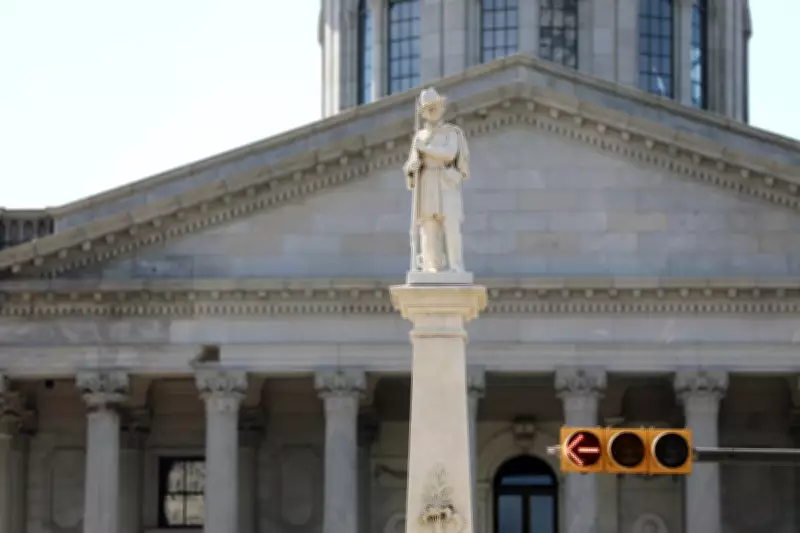
South Carolina Senate Approves Sweeping Monument Protection Legislation
The South Carolina Senate has passed a comprehensive bill that provides extensive protection for historic monuments, statues, street names, and building designations across the state. Approved by a vote of 31-7, this legislation represents a significant move to prevent the removal or alteration of nearly all commemorative structures and names.
Key Provisions and Controversial Bans
Under the newly approved proposal, local governments would be required to obtain approval from the General Assembly before removing any monument or changing its wording. The bill also includes a unique provision that explicitly bans the placement of QR code stickers on monuments. These codes, which could be scanned by smartphones to provide additional historical context, have been championed by some as a way to offer modern perspectives on figures whose legacies are now viewed critically.
Supporters of QR codes argue they could help contextualize historical figures like Confederate leaders or segregationists, whose original commemorations often used glowing language that doesn't reflect contemporary understanding. However, Republican sponsor Senator Danny Verdin successfully fought to keep the QR code ban in the legislation, arguing that "the nearer a person stands in time to the event, the more likely their description reflects the conditions, perceptions and meanings as they were actually understood when they occurred."

Expanding Protection Beyond Military Figures
South Carolina already has protections for monuments dedicated to the Confederacy and other military conflicts ranging from the American Revolution to the Persian Gulf War. The new bill significantly expands these protections to cover all historical figures, defined as any deceased person who "played a significant role in past developments."
This expansion closes what had been a legal loophole that left memorials to non-military figures vulnerable. Previously, monuments to individuals like former U.S. Vice President John C. Calhoun or segregationist Governor "Pitchfork" Ben Tillman might not have received the same protection from colleges or local governments as those honoring military personnel.
Partisan Divide and Historical Debate
The vote revealed a stark partisan division, with all supporting votes coming from Republicans and all opposing votes from Democrats. The debate on the Senate floor highlighted deep disagreements about how history should be remembered and commemorated.
Democratic Senator Margie Bright Matthews read disturbing quotes from Tillman advocating violence against freed slaves and from Calhoun defending slavery as necessary because African Americans "cannot be civilized." She challenged her colleagues, asking, "Do we want to be a state that continues to debate and defend the legacy of treason, racism and exclusion? You ought to be embarrassed about some of the stuff you want to preserve."
Legal Mechanisms and Potential Consequences
The legislation would allow any officially registered private historical group to sue if they believe a monument is not being treated according to the law. This represents a significant expansion from the current system, where only the state attorney general's office can initiate such lawsuits.
Democratic Senator Ed Sutton expressed concern about this provision, particularly for historic cities like Charleston. "The practical effect is the city is going to take a step back and say we're out of the history game," Sutton warned, suggesting Charleston could face numerous lawsuits from dissatisfied groups.
The bill also requires that any monument moved due to building renovations or road projects must be displayed in an area of equal or greater prominence.
Regional Context and Historical Precedent
South Carolina's monument protection law was first established in 2000 as part of a compromise that removed the Confederate flag from atop the state capitol dome. The flag had been raised there during the 100th anniversary of the Civil War in 1961.

Meanwhile, other Southern states are moving in different directions regarding historical commemoration. In Virginia, the new Democratic Governor Abigail Spanberger recently signed legislation ending special benefits for groups honoring Confederate memory, including a license plate featuring rebel general Robert E. Lee. Earlier this year, Virginia's General Assembly removed public recognition of a song with lyrics containing racial slurs that nostalgically recalled slavery days.
Differing Perspectives on Historical Interpretation
Preservation Society of Charleston President and CEO Brian Turner wrote to senators urging them to consider "the value in allowing for an evolution in how the lives of those in the past are told" as "our knowledge and understanding of history continues to evolve."
Democratic Senator Darrell Jackson, whose ancestors gained freedom through the Civil War, offered a personal perspective: "Since my ancestors were freed from bondage through the Civil War, I don't feel warm and fuzzy seeing a Confederate honored with a statue, and my story should be there too. History is usually a matter of who sees it, who tells it, who experiences it."
The bill now moves to the South Carolina House with approximately one month remaining in the legislative session. No other state with monument protection laws has implemented a ban on QR codes, making South Carolina's approach particularly distinctive in the ongoing national debate about historical commemoration.