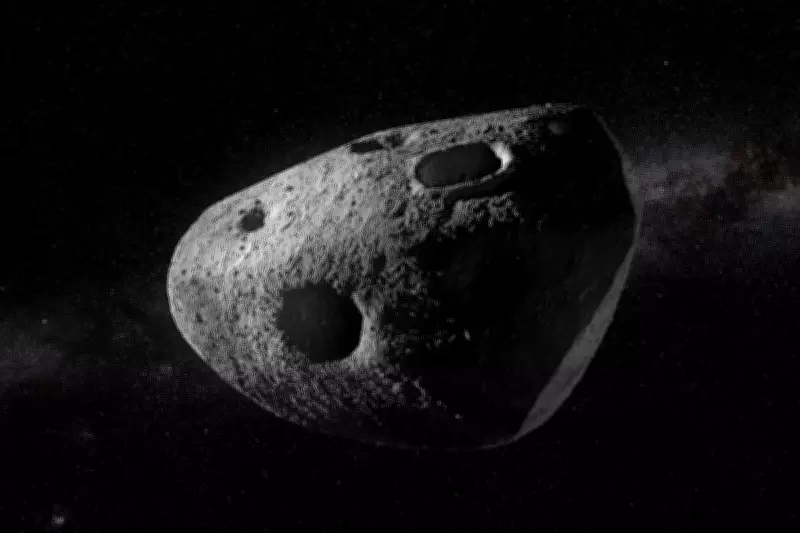
Asteroid Apophis to Make Historic Close Flyby of Earth in 2029, Visible Without Telescopes
An asteroid named after the ancient Egyptian god of chaos is set for a dramatic close encounter with Earth, but scientists assure there is no cause for alarm. Known as 99942 Apophis, this massive space rock will safely pass within an astonishing 20,000 miles of our planet in 2029, marking one of the closest approaches ever recorded for an object of its size.
A Rare Celestial Spectacle
NASA astronomers have confirmed that this flyby represents an exceptionally rare event, with an asteroid of this magnitude passing so near to Earth only once every few thousand years on average. At approximately 1,115 feet wide, Apophis will venture closer than many geosynchronous satellites orbiting our planet.
"Even though Apophis does not pose any immediate risk to Earth, an asteroid of its size passing so close to our planet is a very rare event," stated NASA officials. "Scientists across the globe are excited to use this opportunity to study Apophis in detail."

The European Space Agency has echoed this sentiment, noting that this will be the closest approach of an asteroid of this size that humans have ever been aware of in advance.
Visibility and Public Interest
Observers across the Eastern Hemisphere will be treated to a remarkable sight, as the asteroid will be visible without telescopes or binoculars, weather permitting. The timing of the flyby—scheduled for Friday, April 13, 2029, in many parts of the world—has already generated significant public interest and a touch of superstition on social media platforms.
"Do you expect the god of death to arrive on a regular boring Friday?" one Reddit user humorously questioned, while another commented: "I try not to be superstitious but come on!"
Scientific Missions and Research
NASA and the European Space Agency are preparing dedicated missions to capitalize on this unique opportunity. NASA has redirected its OSIRIS-APEX spacecraft to rendezvous with Apophis shortly after the flyby, while ESA is launching the Ramses mission to accompany the asteroid during its closest approach.
These missions aim to study how Earth's gravitational pull affects the asteroid, potentially causing surface landslides and altering its orbit and rotation. Researchers hope to gain valuable insights into the internal structure and physical properties of near-Earth objects.
Historical Context and Composition
Discovered in 2004 by astronomers Roy Tucker, David Tholen, and Fabrizio Bernardi at the Kitt Peak National Observatory, Apophis was initially labeled a potential impact threat for Earth in 2029, 2036, or 2068. However, extensive radar tracking has since ruled out any collision risk for at least the next century.
The asteroid's name, proposed by its discoverers, references the Greek name for the Egyptian god Apep, associated with evil and destruction. Tholen noted at the time that this "seemed like an appropriate name for such a potentially destructive asteroid."
Apophis is a stony-type asteroid composed of silicate materials mixed with nickel and iron. Formed approximately 4.6 billion years ago from primordial solar system material that never coalesced into a planet, it serves as a fascinating relic of our cosmic neighborhood's early history.
As anticipation builds for this unprecedented celestial event, scientists emphasize that while Apophis's close approach is historic, it poses no danger to Earth, offering instead a unique opportunity for scientific discovery and public engagement with astronomy.