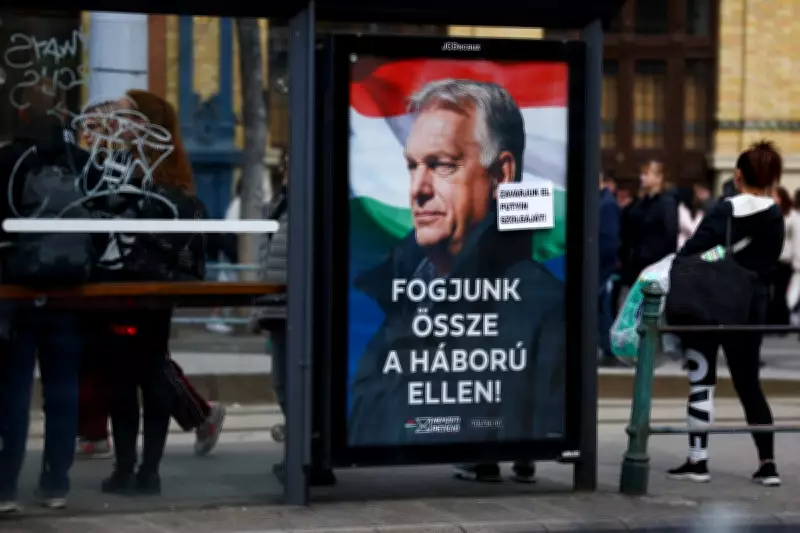
The Failed Gamble: Why Global Powers Backed Hungary's Orban
In a remarkable political alignment, both the United States and Russia placed enormous strategic bets on extending Viktor Orban's 16-year rule in Hungary. The recent election saw unprecedented foreign involvement, with Washington and Moscow deploying significant resources to support the incumbent prime minister. This unusual coalition between traditional adversaries underscores the profound ideological and geopolitical stakes they perceived in maintaining Orban's leadership.
Unprecedented Foreign Intervention in Hungarian Politics
European political history witnessed an extraordinary moment as Hungary approached its polls. For the first time, a sitting US vice-president actively campaigned for a candidate abroad, with JD Vance making a high-profile appearance in Budapest. Simultaneously, Vladimir Putin's administration launched an intense campaign of promises, concessions, and disinformation, accompanied by reports of Russian operatives working within Hungarian territory.
This coordinated effort emerged from a shared objective between Moscow and Trump-aligned Washington: preserving European Union divisions and demonstrating that right-wing semi-authoritarian governance could flourish within the bloc. Their mutual support for Orban represented a strategic convergence aimed at weakening European unity from both eastern and western directions.

Orban's Ideological Significance to Global Populism
Viktor Orban transformed Hungary into a beacon for the international populist right, crafting an ideological model that resonated across continents. His government championed traditional anti-immigration policies, national identity politics, and vigorous opposition to progressive cultural movements. What began with figures like Steve Bannon and Tucker Carlson promoting Hungary as an exemplar has evolved into formal political endorsement at the highest levels.
The recent CPAC Hungary conference, featuring Argentine President Javier Milei as headline speaker, demonstrated how Orban's political blueprint has gained international traction. This elevation from influencer admiration to formal political alliance made Orban's potential defeat particularly consequential for the global populist movement.
The Mechanics of Semi-Authoritarian Governance
Orban's administration perfected a model of governance that tested democratic boundaries while avoiding outright dictatorship. Through strategic alliances with oligarchs who acquired major media outlets and systematic control of state-owned media, the government achieved dominance over approximately 80 percent of Hungary's media landscape according to Reporters Without Borders.
This media control apparatus provided crucial lessons for international observers, particularly those within Trump's political orbit who envisioned implementing similar mechanisms to entrench their influence. Orban's Hungary served as a living laboratory for semi-authoritarian techniques that could potentially be adapted elsewhere.
Russia's Practical Interests in Hungarian Continuity
Vladimir Putin maintained particularly concrete reasons for supporting Orban's continued rule. Leaked diplomatic communications revealed the Hungarian prime minister describing himself as ready to serve Russian interests, while his government consistently obstructed European Union sanctions against Moscow and delayed crucial financial support for Ukraine.
A particularly revealing audio recording captured Hungarian Foreign Minister Péter Szijjártó offering to adjust EU sanctions lists according to Russian preferences. For the Kremlin, Orban represented their most reliable ally within European institutions, making his potential removal a significant strategic concern that could accelerate Western support for Ukraine.
The Shared Vision of European Fragmentation
The convergence between Russian and Trump-aligned American interests in Hungary stems from their mutual desire for a weaker, more divided Europe. Recent US national security documents explicitly identified European unity as contrary to American interests, marking a dramatic reversal of decades of transatlantic policy.

This vision imagines European nations as compliant partners rather than equal allies, with Hungary serving as proof that such relationships could be cultivated. Orban's electoral defeat therefore represents not merely a domestic political change, but a rejection of this broader vision for Europe's future.
The Hungarian Electorate's Decisive Response
Ultimately, Hungarian voters delivered a verdict that transcended national politics. By rejecting Orban's continued rule, they repudiated both the ideological model that captivated international populists and the geopolitical vision of a fragmented Europe. Their decision demonstrated that despite extensive foreign backing and sophisticated domestic political machinery, democratic processes could prevail against concerted external influence.
This electoral outcome carries implications far beyond Hungary's borders, challenging assumptions about the resilience of semi-authoritarian governance and the effectiveness of foreign political intervention in democratic processes.