Elon Musk's Unprecedented White House Odyssey: A Year of Chaos and Controversy
The year 2025 witnessed one of the most extraordinary and chaotic chapters in modern American political history, with billionaire entrepreneur Elon Musk at its very centre. From his initial appointment as a special government employee to his dramatic public feud with President Donald Trump, Musk's journey through the corridors of power was marked by unprecedented events, controversial policies, and a relationship that veered from bromance to bitter confrontation.
The Rise of DOGE: From Meme to Government Menace
What began as an internet joke evolved into one of the most controversial government initiatives in recent memory. The Department of Government Efficiency, or DOGE, emerged from Musk's summer 2024 proposal to eliminate what he termed "wasteful" federal spending. Despite lacking official departmental status—only Congress can establish genuine departments—Musk, having been a major Trump donor during the 2024 election cycle, promised staggering budget cuts approaching $2 trillion.
Following Trump's November 2024 election victory, Musk's radical cost-cutting vision gained serious traction through backroom discussions with key Trump aides Russell Vought and Stephen Miller. Rather than establishing a mere advisory committee, President Trump appointed Musk as a special government employee and granted his team control of the U.S. Digital Service. This move enabled Musk to embed staff members across numerous federal agencies, creating what critics described as a parallel power structure within the government.

The Human Cost of Radical Efficiency
The implementation of DOGE's agenda proved devastating for numerous government programs and international aid initiatives. Thousands of scientific and medical research grants were abruptly cancelled or frozen, directly affecting approximately 74,000 patients participating in clinical trials. Tens of thousands of federal employees faced layoffs or administrative leave, while the United States Agency for International Development saw 80% of its aid programmes terminated, nearly all staff placed on leave, and its offices shuttered.
The international consequences were particularly severe. AIDS patients across Kenya, Senegal, Sudan, and sub-Saharan Africa suddenly lost access to life-saving medications previously funded through the Bush-era PEPFAR programme. Non-governmental organisations in Ethiopia were forced to halt food distribution after payment systems ceased functioning. Hundreds of shipments containing anti-malaria drugs and other essential medical supplies destined for children in over 40 countries, including the Democratic Republic of Congo, experienced significant delays or complete cancellation.
Health economist Brooke Nichols estimated that these aid freezes resulted in nearly 250,000 adult deaths and more than 510,000 child fatalities, with projections suggesting up to four million additional deaths by 2030. One federal employee described the situation to ProPublica as "a heist" and "a hostile takeover by malicious actors of our entire government."
The Chainsaw Stunt and Early Bromance
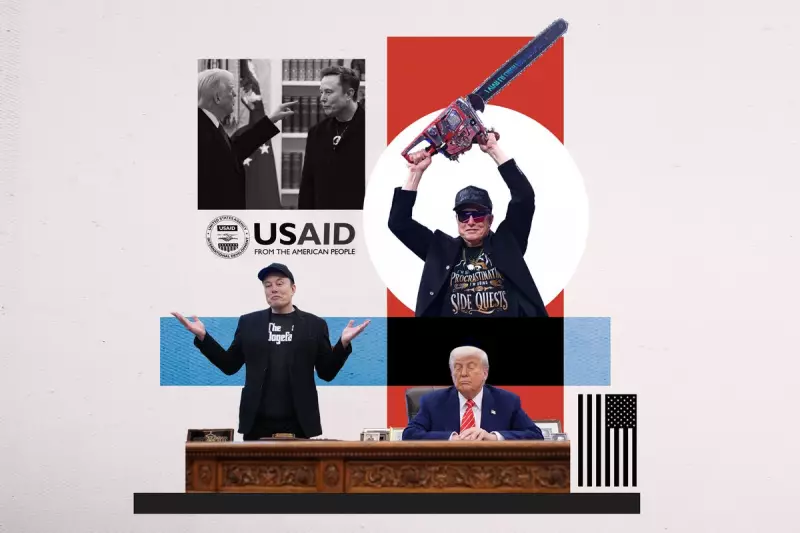
Musk embraced the controversy surrounding his actions with characteristic theatricality. At the Conservative Political Action Conference in February 2025, he famously brandished a chainsaw on stage, declaring "I am become meme. I'm living the meme." This provocative display became symbolic of DOGE's aggressive approach, though Musk later expressed regret, admitting his behaviour "lacked empathy."
During these early months, Musk and Trump appeared inseparable, with the tech mogul dubbing himself the "first buddy" while the president joked that "Elon won't go home. I can't get rid of him." Their relationship reached its zenith in March when Trump transformed the White House lawn into an impromptu Tesla showroom to counter slumping sales of the electric vehicles, which constitute a substantial portion of Musk's estimated $766 billion fortune.

The Relationship Unravels: Lawsuits, Boycotts and Black Eyes
As an engineer might anticipate, every action provoked an equal and opposite reaction. Lawsuits against DOGE multiplied rapidly, with multiple judges ruling that Musk and his associates had likely acted illegally. Public opinion, as measured by an NBC News poll in March 2025, showed that while a plurality supported DOGE's cost-cutting concept, most disagreed with its implementation strategy.
The backlash extended to Musk's business interests, with Tesla sales declining globally as customers boycotted the company. Tesla shares plummeted by more than half from their December 2024 peak of $479.86 to $217.80 by early April 2025, though they subsequently recovered. The company experienced vandalism incidents, including an alleged firebombing of a New Mexico showroom that Trump condemned as the work of "domestic terrorists."
Musk's favourability ratings similarly deteriorated, reaching -14% by April 1st. Within government circles, resistance mounted. A planned security briefing regarding America's China war plans was cancelled after news of Musk's involvement leaked to the press, raising serious questions about why a private businessman with significant Chinese interests and no official government position should access such sensitive military intelligence.
The Nuclear Feud: Epstein Allegations and Space Threats
The relationship reached its breaking point in early June 2025. Musk ignited the conflict with a social media post alleging that "@realDonaldTrump is in the Epstein files," referring to unpublished documents concerning the late sex offender Jeffrey Epstein. He followed this with an even more provocative claim: "Without me, Trump would have lost the election."
President Trump responded by expressing disappointment in Musk and threatening to withdraw SpaceX contracts. Musk retaliated by accusing Trump of "ingratitude," threatening to establish a new political party to challenge Republicans, and even suggesting he might "decommission" SpaceX's Dragon spacecraft—a move that would leave the United States dependent on Russia's Soyuz programme for International Space Station astronaut retrieval.
The financial repercussions were immediate, erasing approximately $34 billion from Musk's personal fortune and causing Tesla shares to drop by up to 15% on June 5th alone. The conflict escalated further in July when Trump suggested he might "take a look" at deporting the South African-born naturalised U.S. citizen.
Fragile Reconciliation and Future Prospects
Despite the acrimony, signs of reconciliation emerged in late 2025. Vice President JD Vance reportedly acted as an intermediary, facilitating communication between the two men. In November, Musk's associate Jared Isaacman was confirmed as NASA administrator after earlier rejection, with Musk celebrating the appointment on social media using heart and rocket ship emojis.
The two men were seen shaking hands at a September memorial service for conservative activist Charlie Kirk, though Trump downplayed the interaction's significance. By January 2026, Musk posted photographs of a "lovely dinner" with the president and First Lady Melania Trump at Mar-a-Lago, captioning the image with optimistic predictions for the year ahead.
Business interests continued to intertwine with political reconciliation. SpaceX stands to secure a $2 billion satellite contract as part of Trump's Golden Dome missile defence project, while the Pentagon announced plans to integrate Musk's Grok AI chatbot into military networks despite ongoing investigations into the technology's capacity to generate non-consensual synthetic imagery.
As Trump remarked aboard Air Force One in January 2026: "Elon's great. I say about Elon, he's 80 percent super genius, and 20 percent he makes mistakes. But he's a good guy. He's a well-meaning person." This characterisation perhaps best encapsulates the complex, tumultuous, and ultimately resilient relationship between two of the world's most influential figures during an unprecedented year in American politics.