

Mormon Women's Quilt-In Demonstrates Grassroots Political Engagement
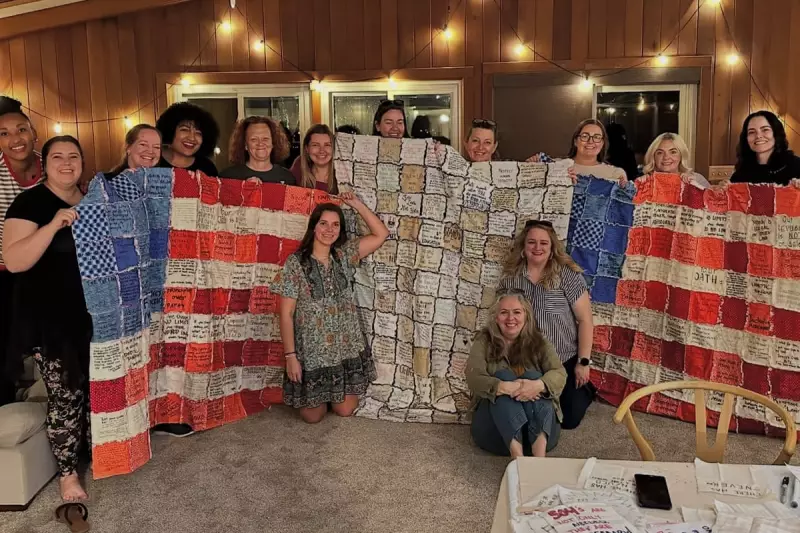
In a striking display of civic engagement, members of Mormon Women for Ethical Government gathered in Provo, Utah on 10 April 2025 for a unique "quilt-in" event. Participants sewed constituent messages into quilts destined for delivery to their representatives and senators, creating tangible expressions of political concern through traditional craft.
How Conservative Mormon Women Challenged Republican Redistricting
Emma Petty Addams, co-director of Mormon Women for Ethical Government (MWEG), represents an unexpected political force in Utah's conservative landscape. Growing up as a conservative Mormon in California's progressive San Francisco Bay Area, then identifying as Republican at largely liberal Stanford University, Addams developed early skills in navigating political divides. "I was oftentimes one of the most vocal, if not the only vocal, conservative in the room," she recalled. "I learned how to speak my mind in a way that was hopefully persuasive."
Today, Addams leads a bipartisan, faith-based organisation of 9,000 women primarily based in Utah, home to one of America's largest Latter-day Saint populations. The group's evolution from political disengagement to becoming one of Utah's most effective civic forces represents a significant shift in the state's political dynamics.

From Facebook Group to Legal Force
MWEG began as a Facebook group in 2017 when mostly conservative Mormon women, unsettled by Donald Trump's disparaging remarks toward women, minorities and refugees, sought a faith-based space to discuss presidential policies. Many members had not been politically engaged for years, including Addams herself, a classically trained piano teacher and mother of three.
"I didn't buy this idea that people were just kind of coming in and invading [the country]," Addams said, referring to Trump's comments about immigrants and refugees. "That wasn't at all what was happening from where I stood."
During the 2016 election, Trump won Utah, which has voted for every Republican presidential candidate since 1964. According to Pew Research Center, Mormons were among Trump's strongest supporters that year, with approximately 61% backing him. However, Trump's policies triggered what Jennifer Walker, MWEG's co-executive director, described as "a massive disconnect between political identity and religious identity" for many Mormon women in Utah.
The Redistricting Battle That Could Reshape Utah Politics
MWEG's first major political action involved suing the Utah state legislature for redistricting congressional seats to favour Republicans. In 2018, the group helped gather signatures to narrowly pass Utah's Proposition 4 with 50.34% of the vote, creating an independent commission to draw state and congressional maps using nonpartisan criteria.
However, in 2020, Republican lawmakers repealed Proposition 4 and redrew maps that split Salt Lake County – Utah's youngest and most diverse region – into four districts, diluting urban Democratic votes and entrenching GOP dominance. "You can do all this work as citizens toward good government, but there are still blockades in your way," Addams observed.
MWEG decided to sue, joining with co-plaintiffs the League of Women Voters of Utah to argue that the Republican-led state legislature violated Utah's constitution by altering a voter-approved proposition and repealing a ban on partisan gerrymandering. Addams acknowledged that signing onto the lawsuit was not easy for the then-small, volunteer-run organisation. "It would put a bit of a target on our backs," she said, but fighting for redistricting was necessary for fair representation in Congress.
A Landmark Legal Victory With National Implications
Last summer, MWEG and its partners achieved a significant legal victory that could reshape Utah's political landscape. The win requires state lawmakers to draw new maps that could potentially pave the way for a Democratic congressional seat in the 2026 midterm elections – Utah's first Democratic member of Congress since 2020.
"I live in a district that's likely going to become Democratic," Addams said. "I'll lose a Republican representative I respect, and I'm 100% OK with that if it means my neighbors get representative government."

Robert Shapiro, a Columbia University political scientist who studies public policy, suggested that Utah's political landscape, with many moderate voters among its sizable Mormon population, created conditions that made it easier for a cross-partisan group like MWEG to gain traction. "The model could conceivably extend beyond Utah," he observed. "The group's strength lies in the breadth of its membership – Mormon women spanning a wide range of ages and educational backgrounds."
Navigating Faith, Politics and Community Expectations
Addams and Walker acknowledge that MWEG's ethos sometimes conflicts with assumptions about their faith community, particularly within a church that is largely conservative, male-led and cautious about overt political engagement. However, Walker rejected the idea that the group stands in tension with the church.
"The church doesn't take political positions, but it has never asked individuals not to take civic stands," Walker explained. "The expectation is that we use our faith to inform our engagement and try to improve the communities around us."
As the group's profile has grown, some right-leaning Utahns have questioned its claim to nonpartisanship. The organisation has occasionally found itself in direct conflict with elected officials from within its own faith community, including Utah senator Mike Lee, a prominent Trump supporter and church member.
Future Challenges and Expanding Influence
Addams revealed that MWEG's next phase involves teaching women media literacy, conflict navigation and other skills to counter partisan divisions. The group is increasingly concerned about the expansion of executive power under the second Trump administration, including the deployment of the national guard during immigration crackdowns and efforts to end birthright citizenship.
"We need to re-establish Congress as the pre-eminent branch of government," Addams asserted, "the voice of the people and a bulwark against executive overreach, regardless of which party is in power."
The most immediate challenge comes from the Utah Republican party's push to repeal Proposition 4 outright, seeking approximately 141,000 signatures by 14 February to place the repeal on November's ballot. Donald Trump recently urged Utahns on Truth Social to repeal the proposition, arguing voters should get maps drawn by those they elect rather than "rogue judges or left-wing activists." Organisers had gathered around 56,000 signatures as of 26 January.
MWEG and other Utah civic organisations are working to raise awareness and discourage residents from signing the repeal petition. Walker emphasised that the group rejects binary political frameworks entirely. "What we pick is the constitution. What we pick is human dignity. What we pick are the rights and responsibilities of citizenship," she stated. "That's the side we're on, regardless of who it appears to benefit."
The story of Mormon Women for Ethical Government demonstrates how faith-based organisations can transcend traditional political divisions to advocate for ethical governance, with their recent legal victory potentially reshaping Utah's congressional representation and offering a model for bipartisan civic engagement nationwide.





