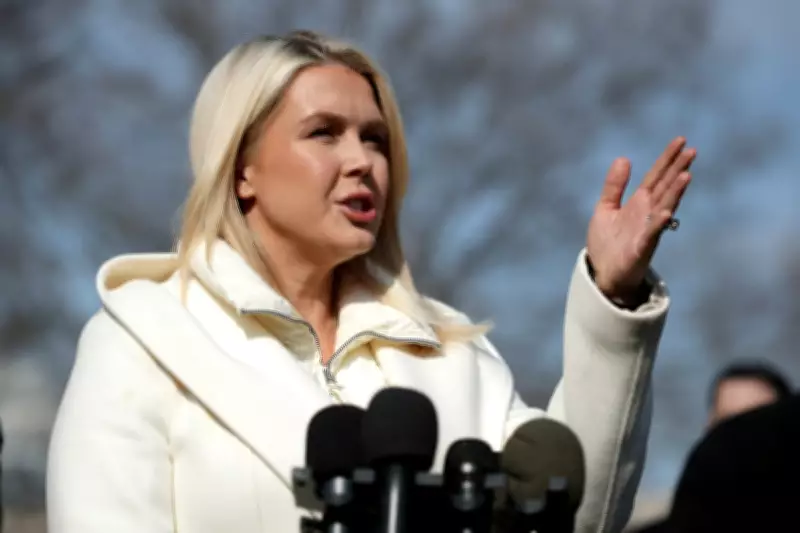
White House Press Secretary's Single Word Choice Ignites Constitutional Firestorm
White House press secretary Karoline Leavitt has found herself at the centre of a significant political controversy following her defence of President Donald Trump's recent comments about nationalising American elections. The press secretary's choice of a single transitional word during her Tuesday briefing has drawn intense scrutiny from both political opponents and constitutional experts across the United States.
The Controversial Qualification
During her exchange with reporters, Leavitt initially stated firmly that "The president believes in the United States Constitution". However, she immediately followed this declaration with the word "however" before elaborating on Trump's concerns about electoral fraud and irregularities in American voting processes. This linguistic pivot has become the focal point of widespread criticism, with many interpreting the qualification as undermining the initial constitutional affirmation.
Immediate Political Backlash
The reaction to Leavitt's remarks was swift and came from multiple directions. Democratic campaigner Melanie D'Arrigo highlighted the apparent contradiction by posting on social media: "The president believes in the United States Constitution, however ... [adds to the list of ways he's currently violating the Constitution]." This sentiment was echoed by numerous other commentators who argued that genuine belief in constitutional principles requires no qualifying statements.

House Democrat Jim McGovern underscored this point by sharing the dictionary definition of "however" alongside footage of Leavitt's comments, while Colorado representative Jason Crow, a military veteran, posted the same footage with a personal commitment to constitutional defence, stating: "I went to war three times to defend our country. I saw our fellow Americans give their lives to protect our rights & values. I swore a lifetime oath to our Constitution. I intend to keep it."
Trump's Election Nationalisation Proposal
The controversy stems directly from President Trump's recent suggestion that alleged electoral fraud necessitates nationalising election processes in certain states. During an Oval Office briefing on Tuesday, the president directed remarks toward Republicans, stating: "I want to see elections be honest, and if a state can't run an election, I think the people behind me should do something about it."
This proposal represents a significant departure from current American electoral practice, where elections are administered by approximately 10,000 separate jurisdictions across the country under state authority. The United States Constitution specifically delegates election oversight to individual states without federal interference, making Trump's suggested approach constitutionally problematic.
Constitutional and Practical Hurdles
Several substantial obstacles stand in the way of implementing such election nationalisation. The president possesses no direct authority to "take over" state elections and would require Congressional approval to alter the existing electoral framework. Furthermore, Trump's repeated claims about widespread fraud in the 2020 election have consistently failed to withstand legal scrutiny in American courts, with no successful challenges to the election's outcome.
Leavitt attempted to bridge these constitutional concerns by emphasising voter identification policies during her briefing, describing them as "a highly popular and common-sense policy that the president wants to pursue" through legislation applicable to all states. However, this policy focus has been largely overshadowed by the constitutional implications of the broader nationalisation proposal.

Broader Political Implications
The episode highlights ongoing tensions between federal authority and state sovereignty in American governance, particularly regarding electoral processes. It also reflects the persistent debate about election integrity that has dominated American politics since the 2020 presidential contest. As constitutional scholars examine the implications of Trump's remarks and Leavitt's defence, the controversy continues to generate discussion about the balance between addressing perceived electoral issues and maintaining constitutional frameworks that have governed American democracy for centuries.