House of Representatives Blocks Attempt to Restrict Trump's Iran Military Authority
The United States House of Representatives decisively rejected a War Powers resolution on Thursday, which sought to impose constraints on President Donald Trump's capacity to conduct military operations against Iran. This legislative effort was introduced in response to a recent aggressive strike launched by Trump in coordination with Israel over the weekend, targeting top Iranian military figures.
Bipartisan Opposition and Support in Close Vote
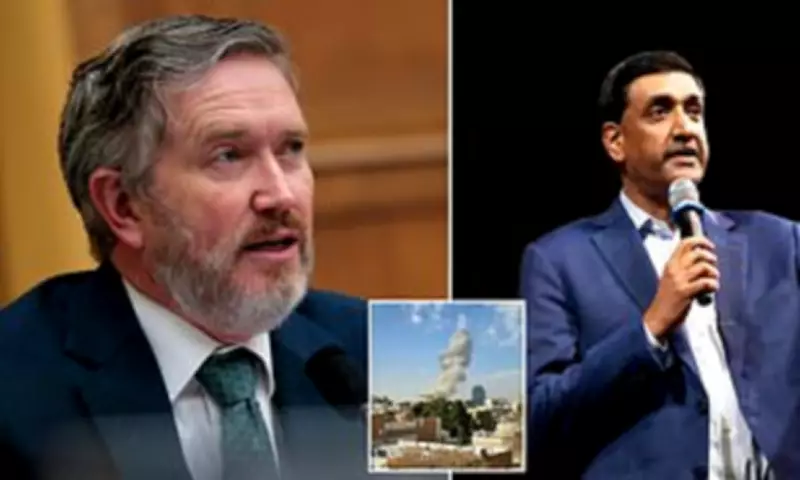
The resolution failed with a vote of 212-219, reflecting a deeply divided Congress. Notably, two Republicans broke ranks to support the measure, while four Democrats voted against it. The proposal was championed by Congressman Thomas Massie, a Republican from Kentucky, and Ro Khanna, a Democrat from California, who argued it was necessary to provide a crucial check on presidential power and prevent unauthorized military engagements.
House Republican Speaker Mike Johnson strongly opposed the resolution, telling reporters on Capitol Hill that passing it at this juncture would be "a terrible, dangerous idea." His stance underscored the political tensions surrounding the issue.

Senate Also Fails to Pass Similar Measure
This House vote followed a similar failure in the Senate on Wednesday, where a war powers resolution was defeated 47-53, falling short of the simple majority required. In that vote, Democrat John Fetterman voted against the resolution, and Republican Rand Paul supported it, highlighting cross-party complexities.
The Senate measure was advocated by Democratic Senators Tim Kaine of Virginia, Adam Schiff of California, and Chuck Schumer of New York, alongside Republican Senator Rand Paul of Kentucky. Kaine emphasized the need to avoid repeating past mistakes from conflicts in Iraq and Afghanistan, stating, "We owe it to those in uniform, their families, and all Americans to not make the same errors."
Public Opinion and Presidential Approval Decline
A new Daily Mail/J.L. Partners poll revealed that President Trump's approval rating has dropped to 44 percent, down four points since Friday and marking his lowest recorded rating in Daily Mail tracking to date. This sharp decline coincides with growing American unease over the escalating Middle East conflict, which has already claimed the lives of six U.S. troops.
Additionally, a Reuters/Ipsos survey published on Sunday found that 43 percent of Americans disapprove of Trump's attack on Iran, with 29 percent undecided. Approximately half of respondents believe the president is too willing to use military force to advance U.S. interests, and 56 percent view his readiness to deploy military power as excessive.
Key Arguments from Lawmakers
Senator Chuck Schumer criticized the conflict as having "no clear objectives, no plan, and no authorization from Congress," asserting that Congress has a duty to rein in Trump's belligerence. Adam Schiff argued that if the president believes war is justified, he must formally make his case to Congress, rather than acting unilaterally.
Rand Paul highlighted constitutional principles, noting in a statement on X that "the constitution conferred the power to declare or initiate war to Congress for a reason, to make war less likely." Meanwhile, Thomas Massie, known for his libertarian views and advocacy on issues like the Jeffrey Epstein files, remarked pointedly, "PSA: Bombing a country on the other side of the globe won't make the Epstein files go away."
Trump's Justification and Warnings
In an eight-minute speech from his Mar-a-Lago resort in Florida on Saturday, President Trump defended his actions, stating he ordered a "major" strike on Iran after nuclear negotiations broke down. He described the objective as defending the American people by eliminating imminent threats from what he called a "vicious group of very hard, terrible people" in the Iranian regime.
Trump reiterated that Iran must never obtain a nuclear weapon and acknowledged the potential for American casualties, saying, "The lives of courageous American heroes may be lost and we may have casualties. That often happens in war." He framed the mission as noble and necessary for the future, citing Iranian regime actions and domestic repression, including the mass murder of protesters.

Videos of Iranians expressing gratitude to Trump circulated widely after the attacks, adding a layer of public reaction to the complex geopolitical landscape.