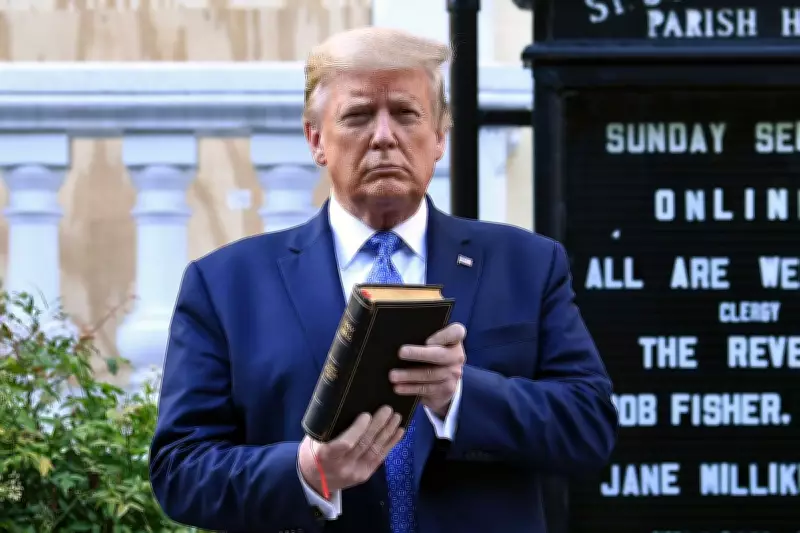
Trump's Bible Reading Ignites Controversy Over 'If My People' Passage
President Donald Trump has joined hundreds of participants in a week-long marathon reading of the entire Bible, an event that has thrust a particular scriptural passage into the spotlight of contemporary political and religious debate. The passage, from the seventh chapter of 2 Chronicles in the Hebrew Bible, carries significant weight in discussions about America's identity as a nation.
The Polarising Verse from Ancient Scripture
The fourteenth verse of 2 Chronicles 7 states: "If my people, which are called by my name, shall humble themselves, and pray, and seek my face, and turn from their wicked ways; then will I hear from heaven, and will forgive their sin, and will heal their land." This passage originates from the reign of King Solomon approximately three thousand years ago, during the dedication of the first temple in Jerusalem. In its original context, it represents God's promise of restoration to ancient Israel if future generations repent after sinning.
Trump read this passage via video from the Oval Office as part of the America Reads the Bible marathon, with most readings taking place at Washington's Museum of the Bible. Organizers specifically invited Trump to participate, with Bunni Pounds, founder of Christians Engaged, noting "It's a powerful statement that he decided to read that passage."

Historical and Contemporary Significance
For decades, this Chronicles passage has been prominently featured at National Day of Prayer events, which occur annually on the first Thursday in May. The verse has been recited at countless rallies, services, and gatherings often centered on the contested belief that America was founded as a Christian nation that must repent and return to God.
Historical uses of the passage include:
- President Dwight D. Eisenhower taking his 1953 oath of office with his hand on a Bible opened to 2 Chronicles 7
- President Ronald Reagan quoting the passage in his 1984 National Day of Prayer proclamation
- A speaker referencing it at the 2024 Republican National Convention
The National Day of Prayer, while officially nonsectarian, has historically attracted substantial participation from evangelical Christians, with the "If my people" verse becoming a staple of these observances.
Criticism of Contextual Interpretation
Brian Kaylor, a Baptist pastor and president of Word&Way, argues that the passage is frequently misused. "This verse is not about the United States," Kaylor explains. "It's a promise made to one particular person in one particular moment. It doesn't really work to pull it out of context and apply it to whatever you want to."
Kaylor identifies the passage as "a popular verse among Christian nationalists" that has taken on increasingly partisan and polarizing tones in an increasingly diverse nation. He notes its use often accompanies promotion of the belief in a Christian America, despite the passage's specific historical context.
Broader Participation in Bible Reading Event
The Bible-reading marathon features numerous prominent figures beyond Trump. Mike Huckabee, U.S. ambassador to Israel and Baptist pastor, is reading from Genesis where God promises to bless those who bless Abraham—a passage popular among evangelicals who believe in biblical mandates to support Israel.
David Barton, whose Wallbuilders organization promotes belief in America as a Christian nation, will read from Nehemiah about rebuilding Jerusalem's walls—the passage that gave his organization its name. The event includes many Republican politicians, celebrities, and pastors, reflecting the evangelical voting bloc's crucial role in Trump's electoral base.
Trump's participation comes shortly after he posted an AI-generated photo depicting himself as Jesus, further blending religious and political symbolism that has characterized his rallies. These events often feature Christian and national symbols alongside songs like "God Bless the USA" and merchandise with slogans such as "Jesus is my savior, Trump is my president."
The controversy surrounding Trump's Bible reading highlights ongoing tensions between religious interpretation, political identity, and historical context in American public life.