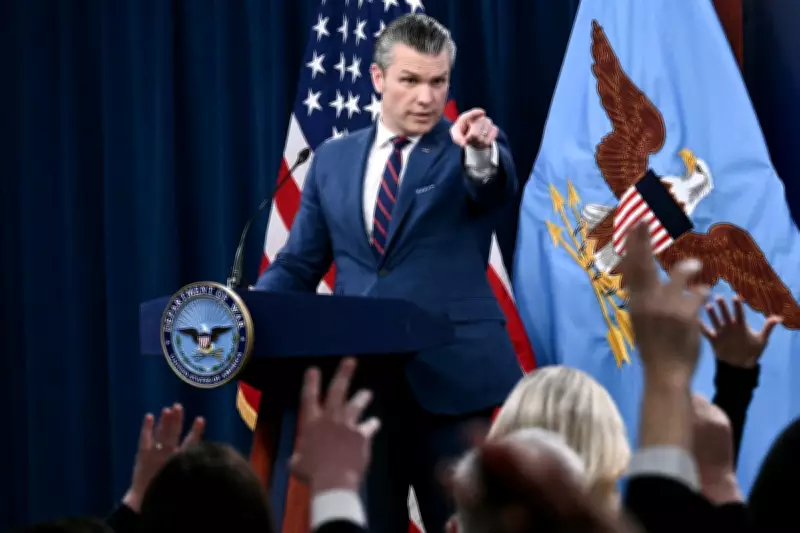
Hegseth Confronts Mounting GOP Opposition to Iran Military Action
Defense Secretary Pete Hegseth has launched a vigorous campaign to counter rising anti-war sentiment within Republican ranks, as former Congresswoman Marjorie Taylor Greene leads a vocal revolt against the Trump administration's strikes on Iran. The defense chief's prominent role as the administration's public face on this conflict highlights deepening fractures within the conservative movement over foreign policy.
Hegseth's Reassurances Amid Growing Skepticism
During his first press briefing alongside Chairman of the Joint Chiefs of Staff General Dan Caine, Hegseth appeared animated as he sought to convince war-weary Republicans that the current conflict differs fundamentally from previous Middle Eastern engagements. "We set the terms of this war from start to finish," Hegseth declared, emphasizing that American ambitions remain "realistic, scoped to our interests and the defense of our people and our allies."
The defense secretary explicitly rejected comparisons to past military interventions, stating: "No stupid rules of engagement, no nation-building quagmire, no democracy-building exercise, no politically correct wars. We fight to win, and we don't waste time or lives." Hegseth further insisted this conflict does not constitute a regime change war, though he acknowledged "the regime sure did change, and the world is better off for it."

MTG's Vocal Opposition and Vance's Silence
Marjorie Taylor Greene has emerged as the most prominent critic from the right, accusing the White House of betraying Trump's base through its Iran policy. In direct appeals to Vice President JD Vance and Director of National Intelligence Tulsi Gabbard, Greene demanded they break their silence regarding the strikes.
"You cannot be silent. Americans are dying," Greene wrote in a social media post. "This is not what we campaigned for and this is 100% what we said would not happen. We said, I said, you said: NO MORE FOREIGN WARS AND NO MORE REGIME CHANGE."
Vance's current silence stands in stark contrast to his previous vocal opposition to Middle Eastern intervention. Last Thursday, just one day before Trump ordered strikes on Iran, Vance told reporters aboard Air Force One: "The idea that we're going to be in a Middle Eastern war for years with no end in sight – there is no chance that will happen." The White House has denied rumors that Vance was excluded from war planning after expressing reservations.
Broader Conservative Criticism and Polling Concerns
The administration faces mounting criticism from multiple conservative factions:
- Representative Thomas Massie has become the House GOP's most vocal critic of Israel's influence on American foreign policy, stating the Iran threat concerns "the dollar, oil, and Israel" rather than Iranian freedom
- On Real America's Voice, Curt Mills of the American Conservative lamented that neoconservatives like Secretary of State Marco Rubio and Senator Lindsey Graham appear to be steering Iran strategy
- Prominent blogger Matt Walsh derided the White House's messaging as fundamentally confused regarding war objectives and justification
Recent polling reveals significant unease within Trump's base. A Reuters/Ipsos survey conducted Sunday found that nearly one in four Republicans believe Trump is too eager to employ military force, with 43 percent characterizing the Iran strikes as a mistake. This data suggests Hegseth faces an uphill battle in convincing the party's core supporters that this conflict aligns with "America First" principles.
Strategic Implications and Future Challenges
Hegseth's status as the administration's primary spokesperson on Iran matters reflects both the sensitivity of this issue within Republican circles and the administration's recognition that traditional conservative foreign policy voices face credibility challenges with the MAGA base. The defense secretary must navigate between:

- Reassuring isolationist-leaning Republicans that this differs from "endless wars" they previously opposed
- Maintaining sufficient military pressure to achieve administration objectives in Iran
- Managing internal tensions between intervention-skeptical figures like Vance and Gabbard and more hawkish administration elements
As anti-Israel sentiment grows among younger MAGA Republicans and confirmation of close U.S.-Israeli coordination in recent hostilities fuels existing suspicions, Hegseth's messaging challenge becomes increasingly complex. The defense secretary's ability to articulate a coherent, persuasive case for continued military action may prove crucial to maintaining Republican unity as the Iran conflict develops.