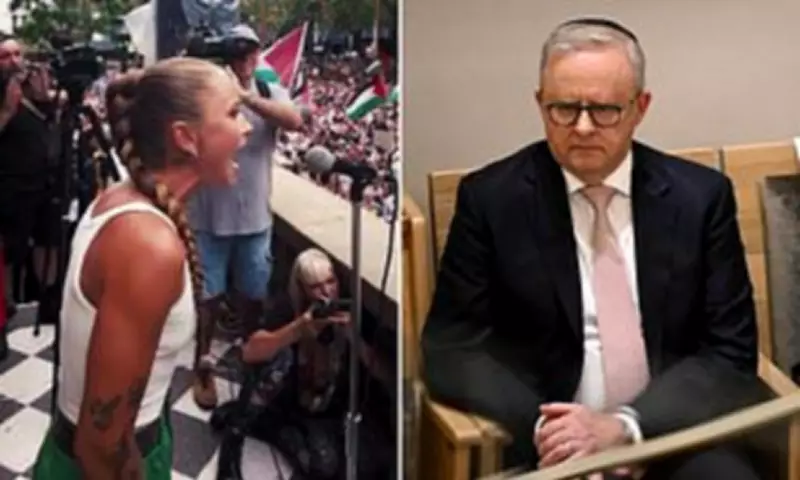
The Australian government under Prime Minister Anthony Albanese has publicly defended the legacy of Grace Tame as a child-protection advocate, even as mounting calls emerge for the former Australian of the Year to be stripped of her honour. This follows controversial comments she made at a pro-Palestine rally in Sydney, where she led chants that have sparked significant political and community backlash.
Sunrise Panel Sparks Intense Debate on Tame's Honour
The issue came to the forefront during a live political panel on Sunrise on Tuesday morning. Host Nat Barr highlighted the growing pressure on Tame after she led chants of 'globalise the intifada' at a protest against the visit of Israeli President Isaac Herzog. Barr pointed out that this phrase is considered offensive by the Jewish community and is under review by the NSW government for potential banning under hate speech laws.
Barr directly questioned Housing Minister Clare O'Neil on whether Tame should lose her Australian of the Year award. In response, O'Neil declined to support any move to strip the honour, instead emphasising Tame's profound impact on child protection in Australia.

O'Neil Condemns Language But Praises Tame's Advocacy
'We must remember that every single child in our country is safer today because of her willingness to talk about traumatic incidents of sexual abuse from her childhood,' O'Neil stated. 'That has got to be a part of the discussion here.' However, she strongly condemned the language used by Tame at the rally, describing references to an 'intifada' as deeply distressing to Jewish Australians.
'I also feel very strongly that no Australian today should be on our streets using words like "globalise the intifada",' O'Neil added. 'We need to put ourselves in the shoes of Jewish Australians and understand that those words are heard by this community as saying that violence against Jews should be encouraged, and that is not the right thing to say today or any day in our country.'
O'Neil noted that Jewish Australians 'have just been subjected to the worst terrorist attack in Australian history' and echoed the Prime Minister's call for the nation to 'turn the temperature down'. She stressed, 'We do not want to see global conflicts brought to our streets here in Australia. We are a peaceful, harmonious community and we need to act like it.'
Cross-Party Reactions and Legal Considerations
Nationals Senate leader Bridget McKenzie agreed that Tame's award recognised her bravery in exposing child sexual abuse, but suggested consequences for her comments should still be considered. 'Miss Tame was awarded her Order of Australia as a result of bravely telling her personal story of sexual abuse. That hasn't changed,' McKenzie said.
'But removing a little badge from her lapel won't change the fact that she is a leader, particularly with young women, and has a lot of influence.' McKenzie raised the possibility that police may need to examine whether Tame's actions amounted to inciting hatred toward Jewish Australians, citing rising fears within the community.
She added, 'President Herzog's visit should be a time of healing… and what we've seen on our streets unfortunately reinforces that global perspective that our country is not safe for Jewish people, which is absolutely not the truth.'
Details of the Sydney Rally and Tame's Statements
At Monday night's rally outside Sydney Town Hall, Tame accused Israel's leadership of responsibility for civilian deaths in Gaza. She alleged President Herzog had engaged in 'incitement to genocide' and had 'signed his name on bombs that were used to kill innocent women and children.'
Tame also criticised Australia's treatment of pro-Palestine demonstrators, describing the country as 'a so-called democracy that punishes peaceful protesters like us but welcomes a war criminal with open arms.' She then led the crowd in chanting: 'From Gadigal to Gaza, globalise the intifada!'
This phrase has now become the focal point of a growing political row, with the NSW government actively reviewing whether it should be covered under tougher hate speech legislation. The controversy highlights the delicate balance between free speech, community harmony, and the recognition of advocacy work in Australia's public discourse.