

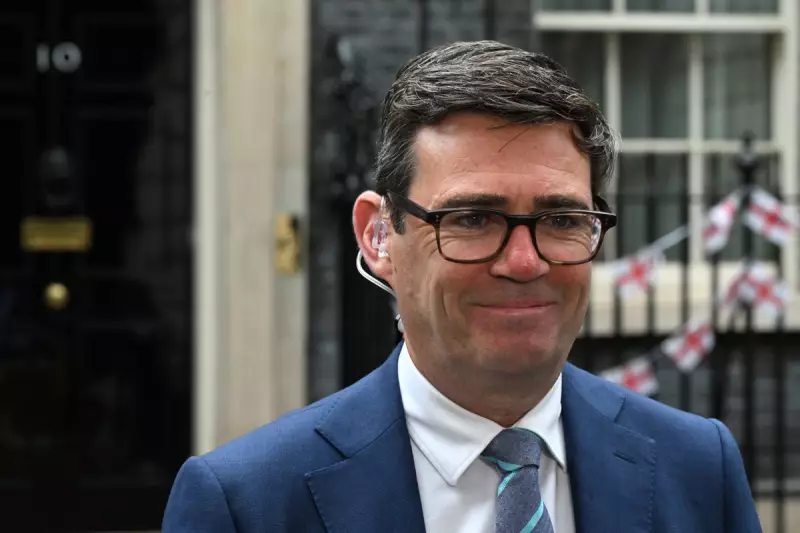
Westminster Insiders Question Burnham's Leadership Credentials
As speculation mounts about Andy Burnham's potential return to the House of Commons, Westminster insiders are openly questioning his political standing and leadership ambitions. The Greater Manchester mayor, who is reportedly considering a by-election bid following the departure of former Labour minister Andrew Gwynne, faces significant scepticism about whether he represents anything more substantial than a friendly face with a distinctive northern accent.
The Complex Pathway to Downing Street
For many within the Labour Party, the prospect of Burnham sweeping down from his northern power base to challenge Keir Starmer's leadership remains a comforting fantasy rather than a realistic political prospect. The pathway to Downing Street would require Burnham to clear multiple formidable hurdles: first securing selection as a parliamentary candidate, then winning election to the Commons, subsequently gaining sufficient nominations to launch a leadership challenge, and finally emerging victorious in any contest against the incumbent prime minister.
Labour MP Sam Rushworth, representing Bishop Auckland, articulated the prevailing sentiment among Starmer loyalists when he emphasised the prime minister's demonstrated statesmanship during recent international events. "This week's events highlight both the volatility of the world and Keir Starmer's demonstrable skills as a statesman," Rushworth stated. "Surely, it would be mad to change prime minister when we need steadiness and stability in the national interest."

Multiple Obstacles to Parliamentary Return
Even if Burnham were to secure the Labour nomination for the Gorton and Denton by-election vacated by Gwynne, he would face immediate challenges from the party's National Executive Committee. The NEC, where Starmer supporters maintain a majority, could refuse to endorse his candidacy on several grounds. They might insist he honour his commitment to serve a full term as Manchester mayor until 2028, or argue that the party cannot afford the financial and political cost of triggering a mayoral by-election in Greater Manchester.
Furthermore, there exists a genuine concern that a Reform candidate could potentially win such a contest, creating additional pressure against allowing Burnham's departure from his current role. The NEC might also invoke gender balance considerations, given the current numerical advantage held by male Labour MPs over their female colleagues.
Electoral Challenges and Political Mathematics
Should Burnham overcome these initial obstacles, he would then confront the challenging electoral landscape of contemporary British politics. Bookmakers currently give Reform a forty percent chance of winning the by-election before candidates have even been announced, while the constituency's substantial Muslim population - representing approximately thirty percent of voters - creates potential for vote-splitting between Labour and alternative parties such as the Greens, Workers Party, or pro-Palestinian independents.
The by-election would present voters with an unusual dilemma: supporting the Labour candidate would effectively constitute a protest vote against the current Labour government, given Burnham's stated intention to challenge Starmer's leadership from within Parliament. This creates the paradoxical campaign message of "Vote Labour, Get Keir Out," a confusing proposition for traditional Labour supporters.
Westminster Reception and Leadership Prospects
Assuming Burnham successfully returns to Westminster, he would likely face resentment from parliamentary colleagues who might view him as a grandee attempting to swan into Parliament and claim leadership without having endured the recent parliamentary battles. While eighty-one disaffected MPs might theoretically support a leadership challenge in the absence of alternatives like Angela Rayner or Wes Streeting, there is no guarantee Burnham could secure the necessary nominations to formally launch such a contest.

His previous record in leadership elections - having contested two and lost both - suggests victory is far from assured. Although Burnham remains popular among party members, this support may reflect two potentially fragile claims: first, that success as a city mayor translates directly to effectiveness as prime minister, and second, that members project wishful qualities onto him precisely because he remains unavailable as a current leadership option.
Policy Substance and Economic Positioning
The most substantial obstacle to Burnham replacing Starmer may concern policy substance rather than political mechanics. Burnham's advocacy of proportional representation, citizens' assemblies, and abolishing party whips appears somewhat peripheral to the central challenges facing the Labour government. His economic positioning, which involves questioning fiscal orthodoxy and suggesting greater freedom from market constraints, carries uncomfortable echoes of Liz Truss's brief premiership.
In a recent speech to the Institute for Fiscal Studies, Burnham provocatively repeated his phrase about the country being "in hock to the bond markets," a formulation that implies Chancellor Rachel Reeves exercises excessive caution and that he would resist market pressures more assertively. This represents dangerous political territory at a time when Starmer has demonstrated steady leadership on the international stage, maintaining firm but non-antagonistic relations with international partners during delicate diplomatic moments.
Other potential leadership contenders within the Labour Party, including Rayner, Streeting, and Shabana Mahmood, have recognised the importance of maintaining government unity rather than undermining it from within. Even Lucy Powell, Labour's deputy leader, has publicly urged loyalty and cohesion. As Westminster continues to question precisely who Andy Burnham believes himself to be, the mayor may need to heed this advice and reconsider whether now represents the appropriate moment for his political ambitions.





