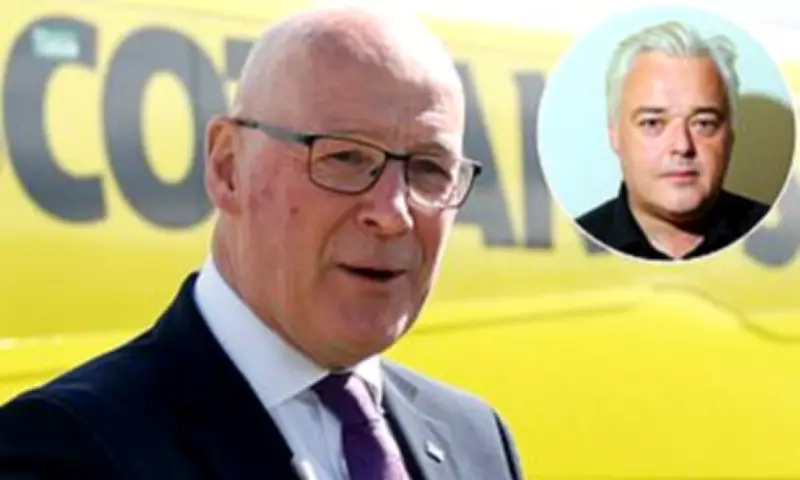
John Swinney has finally abandoned any pretence of caring about democratic principles. For years, the First Minister sought to convince the public that he and the SNP represented a new form of politics, bringing decision-making closer to the people. That notion has now been thoroughly discarded.
As Scots prepare to vote in the seventh Holyrood election on Thursday, it is clear that Mr Swinney's concern for the nation's democratic health has always been performative. In an interview published on Monday, the First Minister made it unequivocal that, despite only a minority of Scots supporting independence, his first act in government—if returned to office—would be to push for a second vote on breaking up the United Kingdom.
When asked whether he would expect immediate talks with Prime Minister Sir Keir Starmer, Mr Swinney replied that this would be necessary because 'there has to be a recognition of the democratic wishes of the people of Scotland'. Aides had earlier indicated he would pursue Indyref2 even if his party required Green support to form a majority.

Selective Recognition of Democracy
Mr Swinney's commitment to recognising 'democratic wishes' appears erratic. Neither he nor any SNP government colleague has ever acknowledged that Scots' democratic wish in 2014 was to remain part of the UK. The referendum defeat was ignored, with Mr Swinney, former First Minister Nicola Sturgeon, and other senior figures insisting that voters actually supported independence.
For nearly 12 years, the SNP has promised supporters a second referendum that the Scottish Government lacks the power to deliver and that most voters do not want. Meanwhile, standards across public services have plummeted. Scotland's NHS is in crisis, literacy and numeracy among children are unacceptably low, and costs for major projects like new hospitals and ferries have spiralled out of control under incompetent ministers.
It remains possible that tactical voting by the Unionist majority could remove the SNP from office. That would serve the country's best interests—the SNP's track record makes that case overwhelmingly—and would benefit the party itself.
Internal Party Strains
Speak to a Scottish Nationalist in the thick of campaigning, and they will describe a party bursting with confidence and ideas. However, former SNP politicians tell a different story. Over recent years, several ex-ministers and senior Nationalists have disclosed their belief that the party needs time out of power to refresh.
One formerly high-ranking SNP figure said: 'At the 2024 general election, we were selling a message about how this was people's chance to finally get rid of the Tories after 14 years. Obviously, the first part of that message was they're Tories and that always plays with our voters, but the second part was that they'd been in power so long that we all needed a break. We've just hit 19 years, and it's clear we're tired.'
Yet Mr Swinney blunders on, claiming his party has answers to problems created under its watch. A stark illustration of the gap between reality and SNP rhetoric is the announcement of a plan for the first 100 days of an SNP government—ignoring that the first 100 days occurred in 2007, with almost 7,000 days of SNP rule since.
Caretaker Leadership
Even if Mr Swinney scrapes a majority this week, he is unlikely to remain long. Until Mr Yousaf resigned in 2024, Mr Swinney was planning to retire from frontline politics. Since returning, he has sought to persuade the country he is back for the long run, but colleagues consider him a caretaker.
Waiting in the wings are two ambitious young SNP politicians: Housing Secretary Mairi McAllan, said to be Mr Swinney's preferred successor, and Stephen Flynn, the SNP's Westminster leader, who is on track to win a Holyrood seat on Thursday. Pugnacious and politically astute, Mr Flynn divides opinion—some see him as the party's brightest hope, others as arrogant and uncooperative.

Tensions are already mounting between allies of Ms McAllan and Mr Flynn. One struggles to find a Scottish Government source with much good to say about Mr Flynn, while praise for Ms McAllan flows freely. Party insiders agree that Mr Swinney must clarify a succession strategy soon after the election. One senior MSP warned: 'If he does not make clear how the next generation can advance, the next generation will just get up and advance on him.'
Next week, Mairi McAllan and Stephen Flynn will sit together on the SNP benches, each with an eye on the prize of becoming Scotland's next First Minister. If Mr Swinney wins this election, he aims to plunge Scotland deeper into constitutional chaos. But the bitterness and division he plans to foment may soon be eclipsed by a brutal battle to replace him.