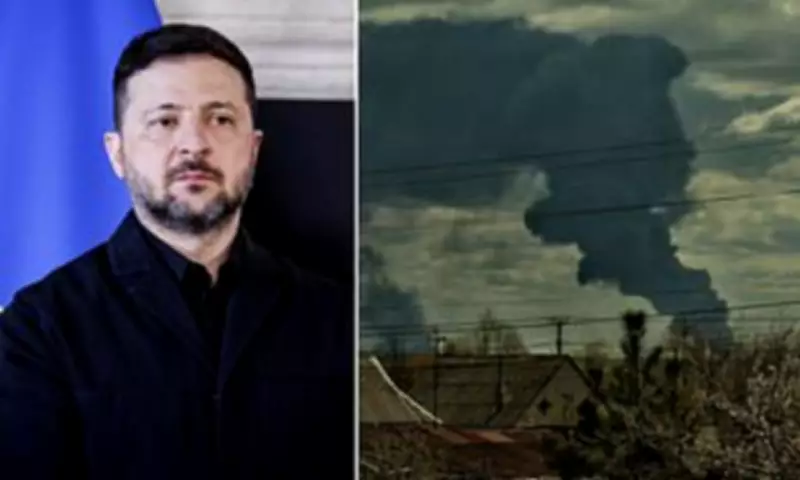
On the 40th anniversary of the Chernobyl disaster, Ukrainian President Volodymyr Zelensky accused Russian President Vladimir Putin of 'nuclear terrorism' following overnight drone attacks that killed three people. In a social media post marking the occasion, Zelensky stated that Russia, through its invasion, was 'again bringing the world to the brink of a man-made disaster'. He emphasized that Russian drones regularly pass over the Chernobyl site, with one having struck its protective shell last year. 'The world must not allow this nuclear terrorism to continue, and the best way is to force Russia to stop its reckless attacks,' he added.
Escalating Threats to Nuclear Safety
In January, the Chernobyl power plant lost its external power supply after a series of Russian attacks on Ukraine's energy infrastructure. Serhiy Beskrestnov, a Ukrainian expert in electronic warfare, warned at the time that missiles targeting energy infrastructure were landing dangerously close to nuclear reactors—some within 300 metres. He cautioned that if a Russian strike were to miss its target, it could trigger a catastrophic disaster.
Last February, a Russian drone attack on the plant significantly damaged a radiation shelter covering one of the reactors, sparking fears of a radioactive leak. Zelensky reported that a Russian attack drone 'with a high-explosive warhead struck the shelter protecting the world from radiation at the destroyed 4th power unit of the Chornobyl Nuclear Power Plant.' The shelter was damaged, but the fire was extinguished. This cover is critical for preventing radiation release following the 1986 nuclear disaster, which sent a radioactive cloud across Europe.

The Legacy of Chernobyl
The explosion at the Chernobyl nuclear power plant remains the worst civilian nuclear disaster in history, fundamentally altering global perceptions of nuclear energy. Thousands are estimated to have died from radiation exposure, though the precise human toll varies. Some 600,000 clean-up workers, known as 'liquidators', were exposed to high levels of radiation. A 2005 UN report projected 4,000 deaths in the three worst-affected countries, while Greenpeace estimated in 2006 that the disaster caused close to 100,000 deaths.
Recent Attacks and Casualties
Russian strikes across Ukraine on Sunday killed three people and wounded at least four others. In the northeastern Sumy region, a drone attack killed two civilians, according to the head of Sumy's regional military administration. 'The enemy struck civilians in the territory of Bilopillia community—near one of the settlements, less than five km from the state border with the Russian Federation,' Oleg Grygorov said in a Telegram post, identifying the victims as men aged 48 and 72.
In the central-eastern city of Dnipro, drone and artillery attacks killed one person and wounded four more, according to the region's military administration head Oleksandr Ganzha, who added that homes and vehicles were damaged. The Ukrainian air force reported that Russia launched 144 drones overnight, with 124 intercepted.
Earlier on Sunday, the Moscow-installed governor of Sevastopol in Russian-annexed Crimea said a man was killed in a vehicle during a Ukrainian drone attack that damaged several homes and a dance school. The governor claimed Russia shot down 43 drones in the attack. On Saturday, Ukrainian authorities reported at least eight deaths in Dnipro, which endured 20 hours of continuous Russian strikes.