For men of a certain age, raised in the drab, grey Britain of the 1950s and early 1960s, Paris in 1968 represented a kind of utopia: a stylish, perilous world that came alive at night, its streets filled with cheap hotels, dive bars, jazz clubs, small-time crooks and pimps, bouncers and drug dealers, actors and chancers, gangsters and girls. It was also a world of glamour, brought vividly to life by Edward Chisholm, a young writer who has lived in Paris since 2012. And no one in 1968 was more glamorous than Alain Delon, France's most famous film star, with his extraordinary good looks, a taste for bad company, and a shady past, always surrounded by a bevy of beautiful actresses. Intriguingly, Delon is today a style icon for Generation Z, celebrated on social media and in magazines for his effortless cool.
Behind the star's hypnotic eyes and glittering beauty, however, lay a sense of danger. He played killers and cops: how much of it was real? In this remarkable book, utterly gripping over 400 pages, high-end novelised non-fiction takes a big leap forward. This astonishing story also deserves a lavish television treatment in due course. Chisholm has studied an encyclopedic amount of files on the mysterious murder of a young Yugoslav man, Stefan Markovic, who was beaten, shot, and then dumped by the side of the road in the Parisian suburbs in 1968. Markovic was a good-looking young chancer from Belgrade who made a few francs hustling pictures of holidaymakers, honeymooners, and especially beautiful women.
Eventually, he worked his way into Delon's circle as a part-time bodyguard, associate, and general helper. He was never as valued as he wanted to be by the star, who refused to help him get a work permit and certainly did not pay him. But a huge amount of second-hand glamour rubbed off on him, helping his own pursuit of actresses and film stars. He also had a brief but intense affair with Delon's wife Nathalie, which strikes this reviewer as a pretty risky career choice for anyone who valued a long life. In fairness, it only started after Delon told Nathalie he was divorcing her.

As he researched more deeply into what was known as the Markovic Affair, Chisholm became more amazed by what he found. The murdered Markovic in a plastic sheet, a legendary film star, blackmail, orgies, spies, a web of rumour and intrigue that dragged in Claude Pompidou, the prime minister's wife. He has spoken to former spooks, retired cops, and former journalists, and combed through acres of archive material, including thousands of police documents, letters, and diaries. Skilfully, he links the murder with the seismic upheavals going on in a France still scarred by memories of war, occupation, and betrayal. Here we witness the end of the old regime of Charles de Gaulle and the election of Georges Pompidou, the riots of 1968 when the streets of Paris were transformed by student revolutionaries, all set against the huge power of French cinema.
Movies were absolutely central to post-war French life. There were more cinema screens in Paris than in any other city, and the French New Wave, led by Francois Truffaut and Jean-Luc Godard, revolutionised cinema in the 1960s. France was modernising, and cinema was a chief medium. The new guard was rebelling against the shame of the war, the guilt of occupation and betrayal. The central characters in their films were drifters and poets, young people, crooks, and grifters. Like the audience, they stayed up all night, talking, drinking, and sleeping with each other. Into this landscape comes Alain Delon, absurdly handsome, enigmatic, and with a very dodgy military record. He was fiercely ambitious, and Chisholm charts his ruthless pursuit of stardom. His films were fatalistic and detached, superb thrillers, part of a rich crop of post-war gangster flicks. More than an actor, he became an icon, a living representative of the new France, where wealth was acquired and pleasure ruthlessly pursued.

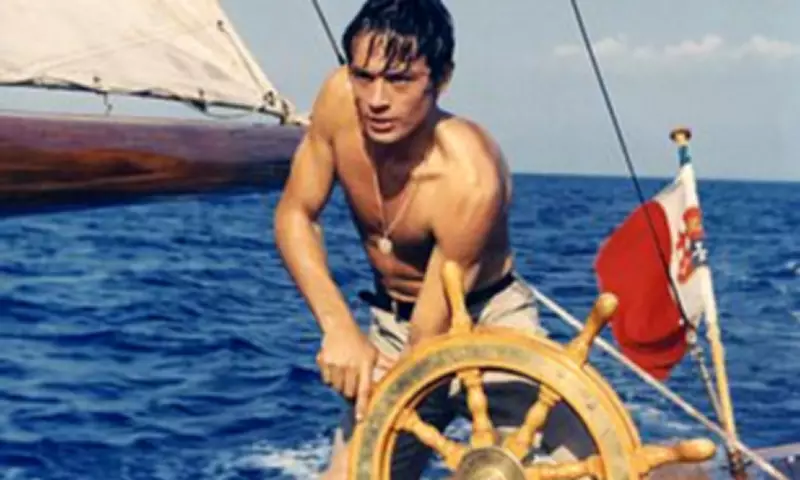
The film that shot Delon to fame was Plein Soleil, a version of Patricia Highsmith's The Talented Mr. Ripley. Although originally given a bit part, he schemed his way into taking the lead, playing Tom Ripley, bronzed and shirtless in the Italian sun, stylish, treacherous, and murderous. Is this life imitating art? Or art imitating life? He might look like an angel, but underneath lies something much more threatening, a dark star with menace. The premiere was in 1960 and a huge success. From then on, there was no looking back.
The investigation into Markovic's murder ran for seven years, and by the end involved rumours of compromising photographs featuring senior politicians, and the rich and powerful taking part in orgies. Unofficial branches of the French secret service were asking questions. A rent boy came forward, claiming to have pictures of Delon in gay orgies. It was never proved and was dismissed by Delon, though Claudia Cardinale, his co-star in the Visconti masterpiece The Leopard, said the queues outside his hotel room were of men and women alike. Delon would take his pick, she recalled.
When the investigation grew too wide and too dangerous, it was shut down. But who killed Markovic, and what was the true nature of his relationship with the film star? Was he blackmailing Delon? Had friendship soured into jealousy? Did the actor just want rid of the troublesome Yugoslav, and drop a remark? Was organised crime involved? Markovic left a note: 'If I get killed it is 100 per cent the fault of Alain Delon and his godfather Francois Marcantoni.' Marcantoni, a Corsican, was a big-time gangster and a former Resistance leader, well known to Delon. Both men were held and questioned, but there were no convictions, although the plastic sheeting that covered Markovic's corpse was linked to Marcantoni.
In France, the ripples of the affair deepened the Delon myth. He carried on making remarkable films, but age was no friend to a man whose beauty was part of his legend. And though Markovic was denied justice, he at least never had to age. A remarkable book about an extraordinary time.