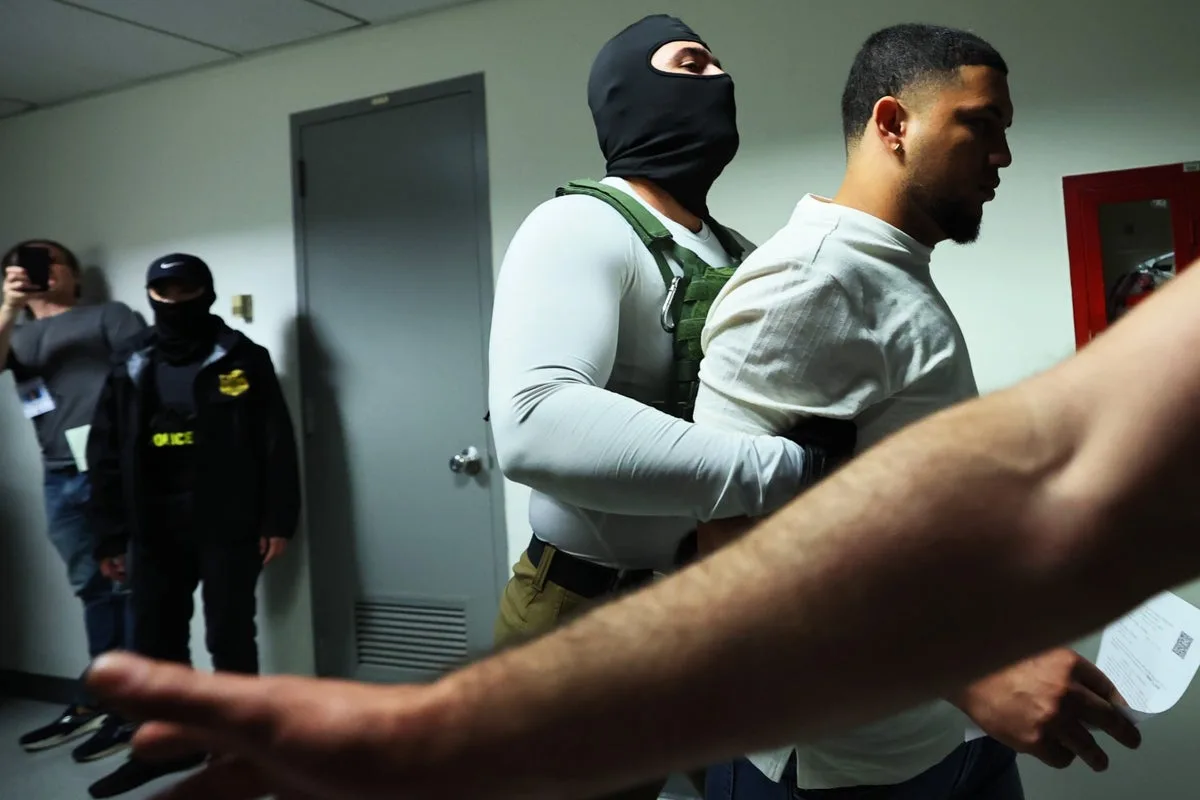
Donald Trump’s administration has reportedly instructed immigration enforcement officers to reduce arrests inside courthouses and cease entering homes without a warrant, stepping back from two controversial policies that have sparked violent and chaotic scenes in the president's mass deportation campaign.
Policy Shift at ICE
Immigration and Customs Enforcement field offices across the country were verbally instructed by their superiors that they should no longer enter homes unless they have a judicial warrant, two Homeland Security officials told NBC News. Last year, ICE’s then-acting director Todd Lyons told officers to rely on the agency’s own permissions to enter a person’s home — rather than seek a warrant from a judge. Homeland Security then issued a lengthy press release defending the policy.
Drop in Courthouse Arrests
ICE’s alleged instructions also led to a sharp drop in the number of arrests inside immigration courthouses. Last month, a top federal prosecutor admitted that the government was wrongly relying on policy that didn’t exist to let agents cuff thousands of immigrants the moment they left their hearings, The Independent previously reported. After widespread opposition from lawyers, judges and members of Congress, ICE now appears to be ending those arrests entirely.
Unlike federal courts, immigration courts and the judges who run them operate under the control of the Department of Justice and, ultimately, the president. In more than 70 immigration courts around the country, immigration judges determine whether immigrants can be deported or granted a form of legal status like asylum. But after Trump took office, the Justice Department’s Executive Office for Immigration Review told judges to grant motions from government lawyers to immediately dismiss immigrants’ cases, making them easy targets for arrest and removal.
The top federal prosecutor in Manhattan — which emerged as a major flashpoint for courthouse arrests over the last year — repeatedly expressed “regret” in a letter to a federal judge last month, saying that his office mistakenly defended an ICE memo that “does not and has never applied” to immigration court arrests. U.S. Attorney Jay Clayton blamed ICE and the agency’s legal team, which “specifically informed” his office that a Trump-era memo “applied to immigration courthouse arrests,” according to Clayton. “Based on our discussions with ICE today, this regrettable error appears to have occurred because of agency attorney error,” Clayton wrote.
Legal Challenges Persist
Immigrant advocacy groups suing ICE over those kinds of arrests are now asking a judge to block them altogether, saying there is “no evidence that the agency engaged in reasoned decision-making when enacting this dramatic change in policy. “Hundreds of real people — with families, schools, medical appointments, jobs and lives — arrived at immigration courts to attend mandatory hearings only to be summarily arrested by ICE agents outside the courtrooms as they left pursuant to ICE’s unreasoned policy,” they wrote Thursday. “The harms resulting from the new policy have been immediate and severe: absent limitations on who ICE will arrest, each and every noncitizen must now make a choice to either attend their mandatory hearings and face unlawful arrest resulting in loss of employment, family separation, and the interruption of medical care or live with in absentia removal order hanging over their heads,” they said.
A separate federal lawsuit from a group of civil rights and immigrant organizations has also demanded a stop to ICE’s “home invasion policy.” Officers were relying on an internal administrative document — drafted and signed by ICE officers themselves — to arrest people inside their homes. In an op-ed for The Wall Street Journal, the agency’s general counsel James Percival suggested that “illegal aliens” are not protected by the Fourth Amendment, which protects against unreasonable search and seizure. “Under federal immigration law, officers may issue an administrative warrant, which means that the probable-cause finding is made by an executive-branch officer rather than a judicial officer,” he wrote. But the Fourth Amendment “exists precisely to prevent government agents from breaking into people’s homes without any judicial process or oversight,” according to Brooke Simone, staff attorney at Lawyers for Civil Rights and one of the attorneys leading the lawsuit.
In February, a group of House Democrats told Homeland Security that “ICE does not have the authority to overturn any law, let alone one of the foundational constitutional rights enshrined in the Bill of Rights.” “You must rescind this memo and adhere to the requirements of the Fourth Amendment by ensuring your agents obtain a judicial warrant prior to making any non-consensual entry into a private residence,” they added.
Notable Cases and Continuing Controversies
Critics have pointed to the case of ChongLy “Scott” Thao, who was dragged from his house at gunpoint in his underwear. Thao is a U.S. citizen, and the man ICE officers intended to arrest was already in prison. In another case, agents forcibly entered the home of Liberian immigrant Garrison Gibson without a warrant. A federal judge later ruled that his arrest violated his Constitutional rights and ordered his release. Their arrests both took place in Minnesota, where violent immigration raids, volatile protests and the killings of two U.S. citizens by federal agents forced out Border Patrol’s commander-at-large and culminated with Trump’s firing of Kristi Noem as DHS Secretary. Border Patrol now only assists with ICE arrests when requested and no longer conducts “roving patrols,” one DHS official told NBC News.
But other controversial immigration arrests are still in place, including during routine check-ins at ICE offices. ICE also continues to hold immigrants in detention without bond even if they don’t have any criminal records after several federal court rulings upheld the policy. Those legal challenges are ongoing.






