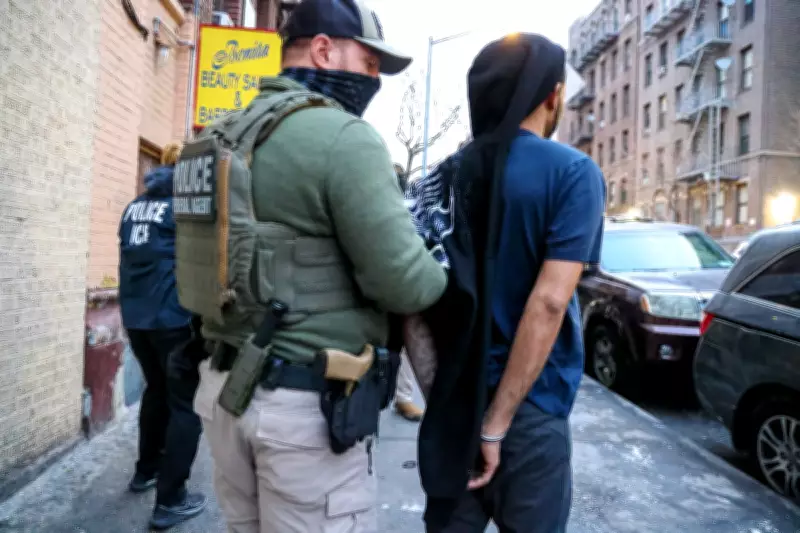
Newly released government data reveals that nearly half of migrants arrested by Immigration and Customs Enforcement officers in early 2026 had no criminal records, contradicting Trump administration claims of a tactical shift toward prioritizing dangerous individuals.
Contradiction Between Rhetoric and Reality
Between January 24 and March 10, approximately 41 percent of those arrested by ICE had no criminal charges whatsoever, according to data obtained through a Freedom of Information Act request by the Deportation Data Project and analyzed by The Independent. This period followed the fatal shootings of two U.S. citizens in Minnesota that sparked nationwide outrage and prompted administration officials to promise more targeted enforcement.
Administration Promises Versus Enforcement Reality
After the deaths of Alex Pretti and Renee Good, President Donald Trump declared that immigration enforcement needed a "softer touch" and would focus on dangerous individuals. Border czar Tom Homan reinforced this message in a late January press conference, stating "the prioritization are going to be criminal aliens, public safety threats and national security threats."

However, Homan added the significant caveat that "if you're in the country illegally, you're never off the table," suggesting that non-criminal immigrants remained vulnerable to enforcement actions regardless of administration rhetoric about prioritization.
Detailed Breakdown of Arrest Statistics
The data reveals a complex picture of who was being arrested during this period:
- 41% had no criminal records whatsoever
- 29% had pending criminal charges
- 30% had existing criminal records
Notably, the data does not specify the exact nature of criminal charges for those with records, making it difficult to assess how many represented serious threats versus minor infractions.
Historical Context and Violent Crime Statistics
The recent data contrasts sharply with broader patterns in immigration enforcement. Internal data obtained by CBS News found that less than 14 percent of the nearly 400,000 immigrants arrested by ICE in the previous year had violent criminal charges. This suggests that even among those with criminal records, the majority were arrested for non-violent offenses.
Quota System Driving Non-Criminal Arrests
Many of the arrests of individuals with no criminal records appear connected to a quota policy implemented by administration officials. White House Deputy Chief of Staff Stephen Miller, who also serves as a homeland security adviser, established an ambitious goal of 3,000 ICE arrests per day in 2025.
This quota placed immigration enforcement officials under immense pressure to meet daily targets, resulting in thousands of arrests of people with no criminal records or pending charges. The policy effectively incentivized quantity over quality in enforcement actions, despite public statements emphasizing the targeting of dangerous individuals.
Human Impact of Enforcement Practices
The data reflects numerous human stories that emerged during this period of intensified enforcement:
- A U.S. citizen child recovering from cancer was sent to Mexico after her undocumented parents were deported
- A five-year-old boy was placed in an immigration detention center with his father after the man's arrest
- A mother from Honduras with no arrest record was detained along with her four children
- Thousands of people with minor infractions, such as traffic violations, were deported from the United States
Administration's Public Messaging Strategy
From the beginning of President Trump's mass deportation agenda, officials consistently asserted that they were targeting the "worst of the worst" criminal elements. White House Press Secretary Karoline Leavitt regularly displayed photos of migrants with criminal records during press conferences, while the president shared graphic stories of citizens killed by undocumented immigrants during his State of the Union address.
However, the newly released data suggests that the reality of enforcement actions diverged significantly from this public narrative, with a substantial portion of arrests affecting individuals with no criminal history.

The Independent has requested comment from Immigration and Customs Enforcement regarding the discrepancy between administration statements and enforcement data, but no response had been received at the time of publication.