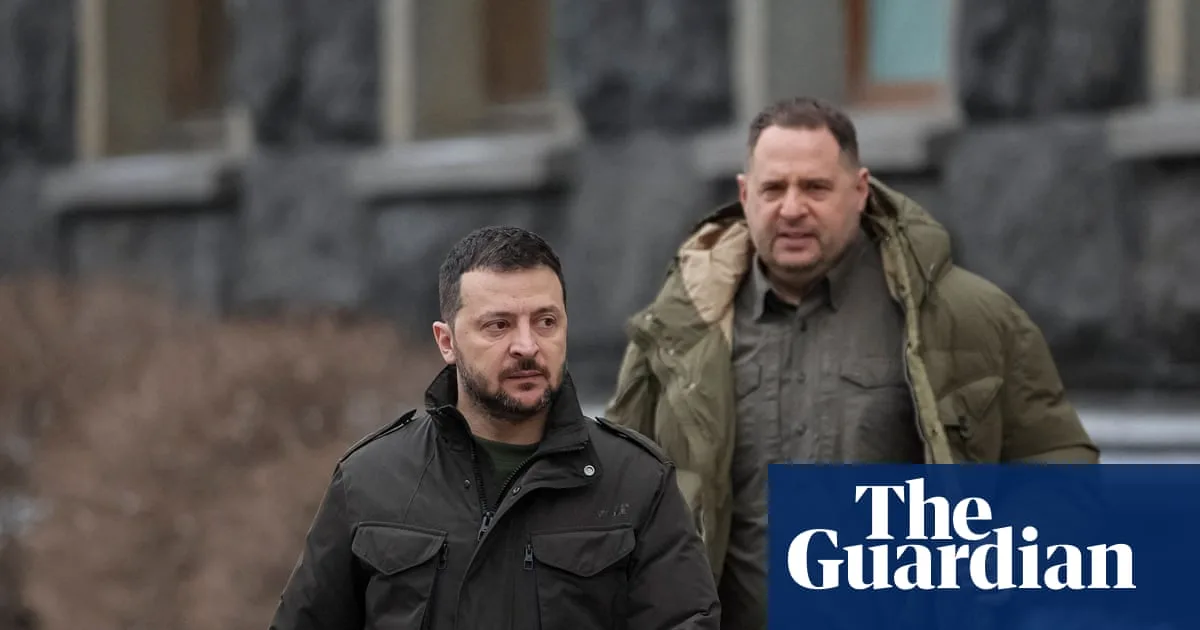
The Ukrainian political establishment is bracing for significant upheaval following the sudden resignation of President Volodymyr Zelenskyy's most trusted adviser and chief of staff, Andriy Yermak. The departure, confirmed on Friday, came after anti-corruption investigators searched his apartment in a widening probe that has sent shockwaves through the country's wartime leadership.
The Untouchable Enforcer's Downfall
Andriy Yermak, who began his career as an intellectual property lawyer before becoming a B-movie producer and eventually Zelenskyy's personal lawyer, had risen to become what many described as the second most powerful figure in Ukraine. When his friend achieved a stunning political victory in the 2019 presidential election, Yermak transitioned seamlessly into politics, first serving as a foreign policy adviser before assuming the role of chief of staff a year later.
During the full-scale war years, Yermak appeared untouchable, growing ever closer to the president and managing Ukraine's most sensitive foreign policy channels. He maintained regular communication with national security advisers from allied nations and led the delegation responsible for peace negotiations with Russia. Beyond his diplomatic duties, Yermak functioned as Zelenskyy's chief political enforcer, frequently issuing directives to ministers and embodying the president's will throughout the government apparatus.
A Complex Legacy of Control and Resentment
Within Ukrainian elite circles, Yermak inspired mixed reactions. While few expressed genuine affection for the powerful aide, many acknowledged his formidable work ethic and ruthless political manoeuvring with what could only be described as grudging respect. Some observers argued that the extraordinary level of control he exercised, though unusual in democratic systems, found justification within the context of wartime necessity.
Yermak's role as a lightning rod for criticism often served to shield President Zelenskyy from direct political attacks. His management of access to the president became legendary in political circles, with reports suggesting only five or six individuals enjoyed direct contact with Zelenskyy, all of whom Yermak reportedly attempted to systematically marginalise.
One notable survivor of Yermak's power plays has been military intelligence chief Kyrylo Budanov, who withstood multiple alleged attempts by Yermak to remove him from office. Others who crossed the powerful chief of staff or developed popularity that threatened the status quo found themselves abruptly dismissed from their positions.
The Investigation That Toppled a Titan
Even as anti-corruption authorities conducted searches of Yermak's residence on Friday, most political analysts assumed he would survive the scandal. A widespread understanding had developed that Zelenskyy would protect his most loyal associate at virtually any cost. However, the investigation threatened to dominate media coverage and escalate into a full-blown political crisis amid growing public frustration with corruption issues.
Although Yermak hasn't faced formal charges, the Ukrainska Pravda outlet reported that investigators removed several laptops and mobile phones from his apartment for detailed analysis. The scandal had already substantially damaged Zelenskyy's approval ratings before the resignation announcement.
Kyiv-based political analyst Volodymyr Fesenko suggested that Yermak likely made the decision to resign independently rather than following a direct order from Zelenskyy. "For Zelenskyy, it would have been a hard decision to take," Fesenko explained. "He understood the political need but was psychologically dependent on Yermak. I think Yermak understood that if he goes down, he'll bring Zelenskyy down with him, and decided to sacrifice himself to save Zelenskyy."
Consequences for Wartime Governance and Peace Efforts
Yermak's departure represents what experts describe as a "mini-revolution" in Ukraine's political and governance systems. As the central figure in Zelenskyy's power structure, his absence creates a significant void at the heart of Ukraine's wartime administration. The chief of staff had been instrumental in numerous critical areas, including managing the delicate relationship with former army commander Valerii Zaluzhnyi, widely perceived as Zelenskyy's most formidable potential political challenger.
The resignation could profoundly impact both domestic governance and Ukraine's negotiating position in potential peace talks with Russia, where Yermak had led the Ukrainian delegation in discussions with American officials. His extensive network of contacts with international security officials and deep involvement in negotiation strategies leave considerable expertise gaps that his successor must urgently address.
Olena Prokopenko, senior fellow at the German Marshall Fund, highlighted Yermak's role as an information gatekeeper, noting that he controlled not only the president's external contacts but also the information that reached Zelenskyy's desk. This concentration of power now presents both challenges and opportunities for the Ukrainian leadership.
President Zelenskyy is expected to announce a replacement imminently, with most speculated candidates coming from his inner circle. However, analysts suggest that whoever assumes the position will unlikely wield comparable influence to Yermak, at least initially. This transition comes at a precarious moment for Zelenskyy, whose presidential term has been extended beyond its planned conclusion due to the impossibility of holding elections under martial law.
The power vacuum could either weaken Zelenskyy's administration, particularly if the corruption investigation yields further damaging revelations, or alternatively inject fresh perspectives and more collaborative decision-making processes that many critics have long advocated. As Prokopenko observed, "There's a very strong demand in Ukrainian society for the revision of the social contract between the president and the people, and for restructuring the relationship between president and the cabinet and parliament."
As Ukraine navigates this significant political realignment, the international community watches closely, aware that internal stability remains crucial to the country's defence against Russian aggression and any future negotiated settlement to the conflict.




