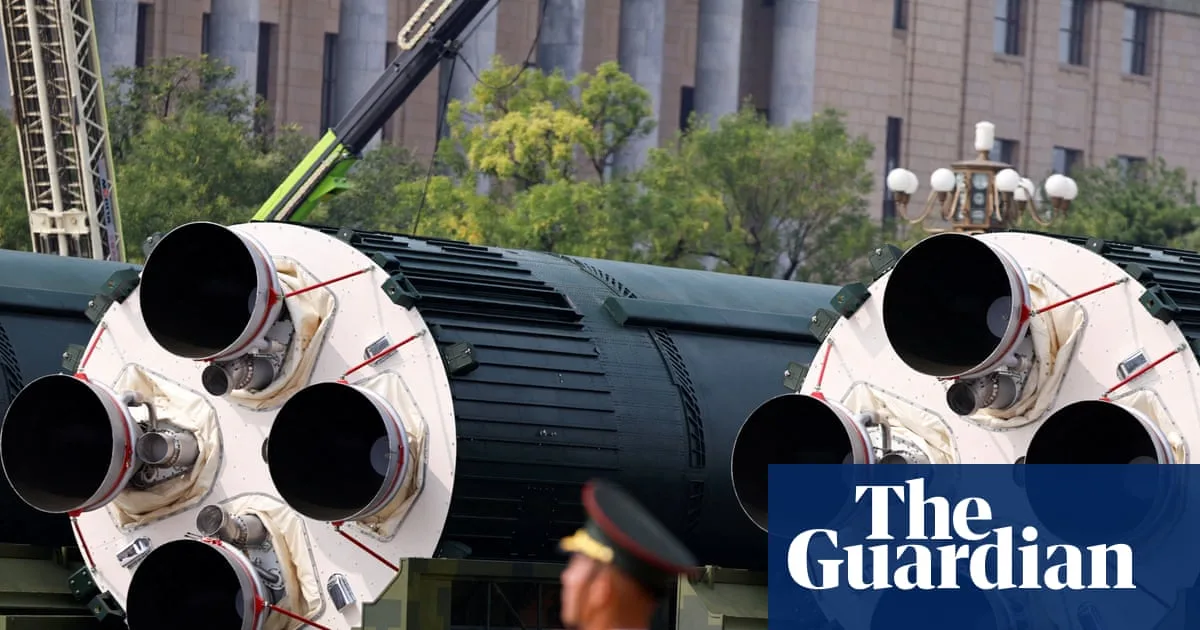
US Accuses China of Massive Nuclear Buildup Amid Fears of New Arms Race
The United States has levelled serious accusations against China, claiming it is dramatically expanding its nuclear arsenal and conducting secret nuclear tests. This development comes amid heightened global tensions and fears of a new arms race, following the expiration of the New Start treaty earlier this month.
Diplomatic Clash at Geneva Conference
At the Conference on Disarmament in Geneva, Christopher Yeaw, the US assistant secretary of state for arms control and non-proliferation, delivered a stark warning. He asserted that China has been engaged in an unprecedented, deliberate, rapid and opaque nuclear weapons buildup. Yeaw emphasised that despite China's public claims to the contrary, its expansion efforts are massive and lack any transparency regarding intent or ultimate goals.
In response, Chinese ambassador Shen Jian firmly rejected these allegations, stating that Beijing firmly opposes the constant distortion and smearing of its nuclear policy by certain countries. He insisted that China would not engage in any nuclear arms race with any nation, maintaining a defensive posture.
New Start Treaty Expiration and Its Implications
The lapsing of the New Start treaty on 5 February has created a significant void in international arms control. This treaty, which restricted the US and Russia to 1,550 deployed nuclear warheads each, was the last major agreement between the world's top nuclear powers. Washington now views its expiration as an opportunity to negotiate a better agreement that includes China, arguing that the previous limits are no longer relevant due to alleged violations by Russia and China's rapid advancements.
Yeaw highlighted that Russia has surpassed the treaty's limits, while China is fast approaching them. He projected that Beijing is on track to have the fissile material necessary for more than 1,000 nuclear warheads by 2030, a figure that underscores the scale of the buildup.
Allegations of Secret Nuclear Tests
Adding to the tensions, the US has doubled down on claims that China conducted secret nuclear tests. Yeaw provided detailed allegations, citing data from Kazakhstan that indicated a 2.75-magnitude underground explosion on 22 June 2020, with an estimated yield equivalent to a 10-tonne nuclear explosion. He accused China of preparing further tests with larger yields, using these claims as a basis for potential US resumption of nuclear testing.
Ambassador Shen dismissed these accusations as groundless, arguing that Washington is using them as a pretext to resume its own testing programs. Independent analyses, such as a report from the Center for Strategic and International Studies, have not found conclusive evidence of such explosions, noting no unusual activity at China's Lop Nur testing site.
Geopolitical Context and Future Negotiations
The current situation marks the first time in decades that there is no active treaty to curtail the deployment of the world's most destructive weapons. This has sparked fears of a renewed arms race, with both superpowers potentially ramping up their nuclear capabilities. Despite the diplomatic friction, a US state department source revealed that a preparatory meeting with Chinese delegates occurred in Washington shortly after New Start's expiration, with a more substantive session scheduled in Geneva.
Yeaw reiterated that the US is not abandoning arms control efforts but aims for a world with fewer nuclear weapons through improved agreements. However, the path forward remains uncertain, as China has rejected calls for trilateral talks, deeming them unfair and unrealistic given the disparity in arsenal sizes compared to the US and Russia.
As global powers navigate this delicate landscape, the accusations and counter-accusations highlight the deepening rift in nuclear diplomacy, with significant implications for international security and stability.






