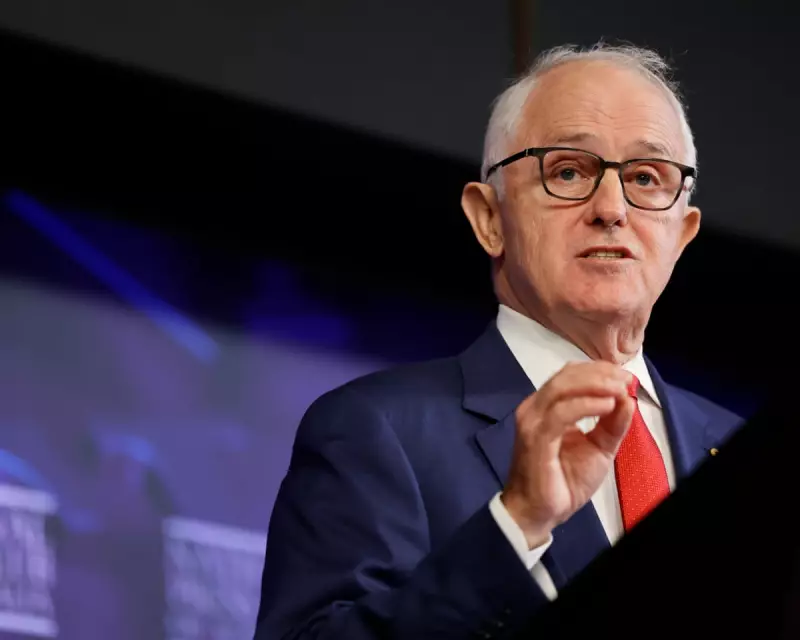
Former Australian Prime Minister Malcolm Turnbull has issued a stark warning to the current government, urging Prime Minister Anthony Albanese to publicly acknowledge the profound transformation in global politics under what he describes as the "bully" presidency of Donald Trump. In an exclusive interview, Turnbull argued that Australia can no longer afford to pretend that the international landscape remains unchanged.
A Call for Clear-Eyed Analysis
Turnbull pointed to a recent speech by Canadian Prime Minister Mark Carney at the World Economic Forum in Davos as a model for the kind of honest assessment required. Carney warned that the US-led global order is experiencing "a rupture," not merely a transition, and called for an end to invoking the "rules-based international order" as if it still functions effectively.
"I thought Mark Carney's speech in Davos was outstanding ... and yes, I think the Australian prime minister needs to give a similar speech, which is essentially acknowledging that the world has changed," Turnbull stated during an appearance on Guardian Australia's Full Story podcast. He expressed concern that the Australian government has yet to provide the same level of rigorous and honest analysis of the current geopolitical reality.

The Reality of 'Great Power Rivalry'
Carney's address, delivered before Trump retreated from threats regarding Greenland, framed the new dynamic as "a system of intensifying great power rivalry where the most powerful pursue their interests using economic integration as coercion." Turnbull believes this analysis directly applies to Australia's situation and requires a formal governmental response.
The former Liberal leader, who served as PM from 2015 to 2018, has been a consistent critic of Australia's deepening reliance on the United States, particularly highlighting the contentious $368 billion Aukus security pact initiated by his successor, Scott Morrison. While acknowledging that Albanese has been correct to avoid constant commentary on Trump's actions, Turnbull insists the time is now ripe for a definitive statement.
Explaining the Alliance in a New Era
"Carney doesn't comment on everything Trump does either. But what you need to do is to give a speech. This is a good time to do it," Turnbull advised, suggesting the post-Australia Day period as an ideal moment. He emphasised that such an address must tackle the core paradox facing the nation: why Australia is intensifying its commitment to the US alliance at precisely the moment American leadership is explicitly urging allies to become more self-reliant.
"Australians can see that the United States under Trump is not the United States we'd grown up to know and respect and work with, and they'll be looking to their leader to explain how we deal with that and how we relate to that," he argued.
The 'Bully' Dynamic and the Need for Pushback
Central to Turnbull's argument is the characterisation of Trump's negotiating style. He asserts that the US president operates as a "bully" who only engages in genuine negotiation "when there is pushback." He cited the example of Trump backing down on threats towards Greenland, which he partly attributes to firm responses from Carney and other European leaders.
"We can't keep on pretending nothing has changed. And there is a tendency in Canberra to do that," Turnbull cautioned, clarifying that he is not advocating for public insults or "sledging" but for a sober recognition of this altered dynamic.
Government Reception and Broader Implications
The call for a new strategic narrative has found some resonance within government circles. Federal Treasurer Jim Chalmers described Carney's Davos speech as "stunning" and confirmed it had been widely disseminated and discussed among ministers.

"The powerful point that he made is that a lot of the old certainties are breaking down. We see that in escalating trade tensions, the Russian invasion of Ukraine, discussions in Nato, you see it in behaviour on markets," Chalmers told the ABC. He echoed the sentiment that Australia's interests are best served by managing differences through cooperation and within the frameworks of international law and institutions, even as those frameworks face unprecedented strain.
Turnbull's comments are informed by his own direct experience with the Trump administration, notably a 2017 confrontation where he successfully pressured the US to honour a prior agreement to resettle refugees from Nauru. His intervention underscores a growing debate within Australia about how to navigate a world where traditional alliances are being tested and redefined by unpredictable American leadership.