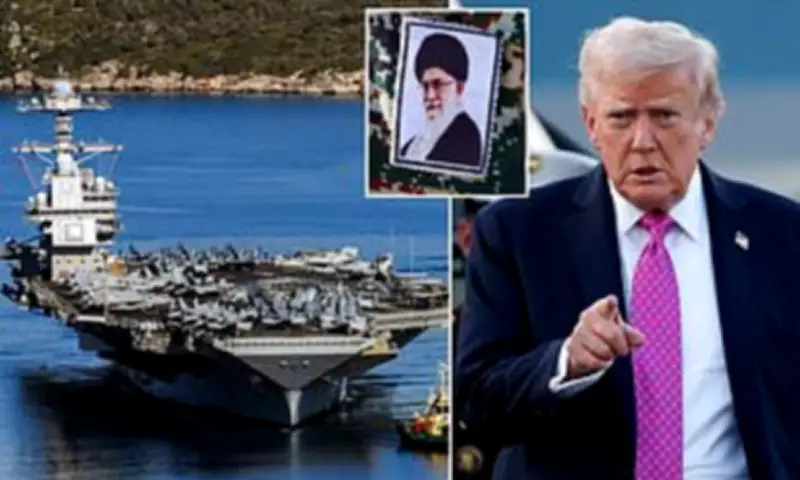
Trump Issues Stark Warning on Iranian Missile Development During State of the Union
President Donald Trump delivered a grave warning this week, asserting that Iran is actively manufacturing weapons capable of striking American soil in the near future. During his Tuesday State of the Union address, Trump declared that Tehran is 'working on missiles that will soon reach' the United States, while vowing to prevent what he called the 'number one sponsor of terrorism' from obtaining nuclear weapons.
Massive Military Buildup on Iran's Doorstep
The president has ordered one of the largest U.S. military deployments in decades to the Middle East, positioning overwhelming force near Iran as negotiations continue about Tehran's nuclear program. This buildup includes two aircraft carrier strike groups comprising approximately 15,000 personnel, over a dozen ships, hundreds of aircraft, and likely submarine support. Thousands of additional troops and numerous military assets are stationed throughout the region, though some evacuation reports have emerged.
The administration's aggressive posture was underscored by Trump advisor Dan Scavino's ominous social media post featuring B-2 stealth bombers preparing for takeoff to Metallica's 'Enter the Sandman' around midnight on Thursday. This display signals what many interpret as a predetermined choice toward military action.

Diplomatic Efforts Amid Escalating Tensions
Despite the military escalation, diplomatic channels remain open. Recent meetings in Geneva, Switzerland, between Steve Witkoff, Jared Kushner, and Oman's Foreign Minister Sayyid Badr bin Hamad Al Busaidi, who serves as chief Iran negotiator, have shown some signs of progress. Additional negotiations are scheduled for Friday, offering a potential path toward de-escalation.
Vice President JD Vance, who participates in the Iran negotiations, attempted to reassure the public, telling the Washington Post: 'The idea that we're going to be in a Middle Eastern war for years with no end in sight—there is no chance that will happen.'
Congressional Concerns and War Powers Debate
The escalating situation has left Congress deeply concerned about potential military conflict. Democratic Congressman Seth Moulton, a four-tour Iraq War veteran, expressed grave doubts: 'Trump is preparing to attack Iran and draft America into an Iraq War 2.0. What does he think he will achieve, and at what cost? So far, we have no idea.'
Moulton further warned that if Trump initiates another war and Congress fails to intervene, 'then it's time for the American people to hold both accountable.' He noted the troubling continuity of lawmakers who supported the Iraq War still serving in Congress.
Historically, Congress has ceded some wartime authority to presidents for short, targeted campaigns, allowing commanders-in-chief to bypass formal war declarations. However, the current situation has reignited debates about executive power. The Senate narrowly passed a war powers resolution in January following Trump's successful order to capture former dictator Nicolas Maduro, but the legislation now faces bipartisan opposition and is stalled in the House.
Intelligence Assessments and Regime Change Rhetoric
While Trump warns of imminent Iranian missile threats, U.S. intelligence presents a more measured assessment. The Defense Intelligence Agency (DIA) concluded last year that Iran might require until 2035 to develop a 'militarily viable' intercontinental ballistic missile (ICBM)—weapons capable of traveling thousands of miles through space before delivering warheads to distant targets.
The DIA report specifically states: 'Iran has space launch vehicles it could use to develop a militarily-viable ICBM by 2035 should Tehran decide to pursue the capability.' These satellite launching systems could eventually support advanced payloads, including nuclear weapons.

Trump has openly discussed regime change in Iran, telling reporters recently that removing Ayatollah Ali Khamenei 'would be the best thing that could happen.' This rhetoric, combined with the military buildup, has created what Republican Congressman Thomas Massie criticized as contradictory to 'America First' principles. Massie argued Tuesday: 'We don't need to be doing it. We took out their nuclear capability, and we don't need a long and protracted war in the Middle East.'
Select Congressional Briefings and Ongoing Uncertainty
This week, CIA Director John Ratcliffe and other senior Trump administration officials conducted classified briefings for select members of Congress regarding the Iran situation. Despite these updates, fundamental questions remain unanswered about the administration's ultimate objectives and strategy.
The convergence of massive military deployment, diplomatic negotiations, intelligence assessments, and congressional war powers debates creates a complex landscape where the potential for miscalculation remains high. As negotiations continue alongside military posturing, the international community watches closely to see whether diplomacy or conflict will define the next chapter in U.S.-Iran relations.