

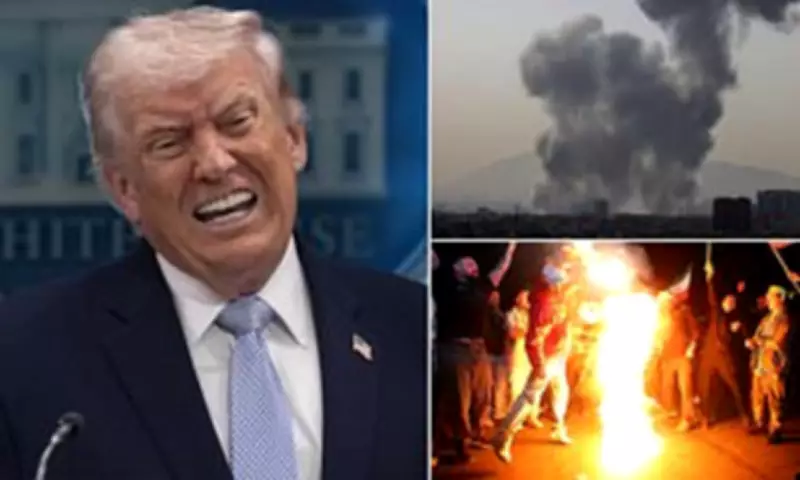
Trump Proclaims Victory as US and Iran Agree Two-Week Ceasefire
President Donald Trump declared a "total and complete victory" on Wednesday as the United States agreed to a two-week ceasefire with Iran, just hours after warning that "a whole civilisation" would perish. The President dramatically scaled back his earlier threats to conquer Iran "in one night," instead lauding the bombing campaign as a resounding success from both a "military standpoint and from every other standpoint."
Regime Persists Despite Military Onslaught
However, six weeks after coordinated US and Israeli strikes began targeting Iran, resulting in the death of Ayatollah Ali Khamenei, the Islamic Republic's regime remains fundamentally intact. Oil prices have surged dramatically worldwide, America's relationships with NATO allies have deteriorated significantly, and a new hardline Supreme Leader—Mojtaba Khamenei—now holds power in Tehran. Iran's military continues to operate despite claims of its total destruction.
Peace talks held in Pakistan on Saturday collapsed, with both sides blaming each other for the lack of progress. Disagreements centered on control of the Strait of Hormuz and Iran's nuclear program. Tehran proclaimed "victory in the field" and asserted this would be "consolidated in political negotiations," while accusing the US of failing to gain their trust after 21 hours of discussions. US Senator JD Vance stated Iran refused to commit to halting nuclear weapons production.

Global Economic and Political Fallout
The Islamic Republic, though battered, survives with its "axis of resistance" largely operational. Its closure of the Strait of Hormuz has caused worldwide economic disruption, while retaliatory attacks on Middle Eastern neighbors have shocked the US and shattered regional stability illusions. Republicans now fear electoral consequences in the upcoming midterms as America remains entangled in a foreign conflict Trump promised to avoid.
Following initial strikes on Tehran on February 28, Trump told Iranians: "When we are finished, take over your government. It will be yours to take. This will be probably your only chance for generations." Yet on Monday, he praised Iran's new leadership as "smarter, sharper, far less radical" before criticizing the UK and other allies.
Assassination and Succession
The US-Israeli surprise attack that eliminated Ayatollah Ali Khamenei culminated decades of intelligence gathering that penetrated the regime's core. Mossad operatives reportedly hacked Tehran's traffic camera network to surveil the 86-year-old leader and his entourage for years prior to the assassination. Khamenei's body was discovered in the rubble of his compound, ending his 36-year reign marked by domestic repression and support for proxy groups.
Despite hopes that Khamenei's death would end the regime, Iran swiftly appointed his son Mojtaba as successor through the Assembly of Experts, backed by the Islamic Revolutionary Guard Corps (IRGC). Mojtaba, a hardline cleric viewed as more extremist than his father, has not been seen or heard from since his March 8 appointment, leading to speculation about his control or even survival. Iranian state television admitted he was wounded, with some reports suggesting he lost a leg and remains comatose.
Strategic Stalemate and Continuing Conflict
Trump has repeatedly cited regime change as his primary war objective, urging Iranians to revolt and claiming the goal had been achieved. "The one regime was decimated, destroyed, they're all dead. The next regime is mostly dead," he stated last month. However, the regime has been emboldened by successfully crippling the global economy through the Strait of Hormuz blockade.
While key commanders have been eliminated, the IRGC has delegated authority to local leaders, enabling continued resistance. Iran has also surprised the US with missile and drone attacks across the Middle East, targeting Israel, the UAE, Kuwait, Saudi Arabia, Qatar, and Bahrain. As the ceasefire begins, prospects for genuine regime change appear diminished, with widespread protests failing to materialize and initial invasion rumors unrealized.

NATO Fractures and International Relations
Trump has consistently criticized NATO allies for refusing unconditional support, plunging relations to their lowest point since the alliance's 1949 formation. He labeled NATO a "paper tiger" and threatened withdrawal after member nations declined to reinforce the Strait of Hormuz. "They didn't want to join the fight to stop a Nuclear Powered Iran," Trump wrote on March 20. "COWARDS, and we will REMEMBER!"
These tensions represent a significant victory for Moscow and Beijing, with Trump stating Vladimir Putin recognizes NATO's ineffectiveness. He reserved particular criticism for the UK and Prime Minister Keir Starmer, mocking Starmer's offer to send "two broken-down aircraft carriers" and imitating him at a White House lunch. Trump expressed being "disappointed" and "very surprised" by Britain's response, with analysts suggesting the relationship may be "irreparably" damaged.
Economic Consequences and Domestic Politics
The Strait of Hormuz closure has triggered global energy price spikes, raising fears of a worldwide economic crisis. The passageway, handling 20% of daily global oil flow, remained blocked from February 28 until the ceasefire. In the UK, concerns about a cost-of-living crisis similar to 2022's emerge, while US Republicans anticipate midterm election repercussions due to rising inflation.
International Energy Agency head Fatih Birol warned the situation is "more serious than the ones in 1973, 1979 and 2022 together," noting developing nations face particular risks from higher oil, gas, and food prices. US inflation reached 3.3% annually, its highest in two years, with gasoline prices exceeding $4 per gallon nationally.
Trump initially described the war as a "short-term excursion" and claimed oil prices were "artificially up." On Wednesday, he suggested a "joint venture" with Iran in the Strait of Hormuz, potentially involving tolls up to $1 million per ship—dubbed the "Tehran Tollbooth" by Bloomberg.
Military Assessment and Proxy Networks
While failing to topple the regime, US forces have targeted Iranian military capabilities, hitting over 12,300 targets by April 1 according to central command. Trump asserted Iran's radar is "100% annihilated" and its navy "gone," yet Iran maintains the Strait blockade and continues attacks on US allies. His claim that "there's nobody even shooting at us" preceded the downing of US F-15E and A-10 aircraft, requiring a daring rescue operation for stranded troops.
Trump vowed to "ensure that Iran does not obtain a nuclear weapon," with intelligence indicating knowledge of uranium stockpile locations but no current bomb-making capability. Iran's proxy network has weakened, with Hezbollah facing Israeli attacks and Lebanese government pressure, Hamas diminished by previous conflicts, and Houthis maintaining relative strength in Yemen.
As the ceasefire commences, questions remain about what has truly been achieved beyond temporary respite, with the Iranian regime enduring, global alliances strained, and economic uncertainty looming large.





