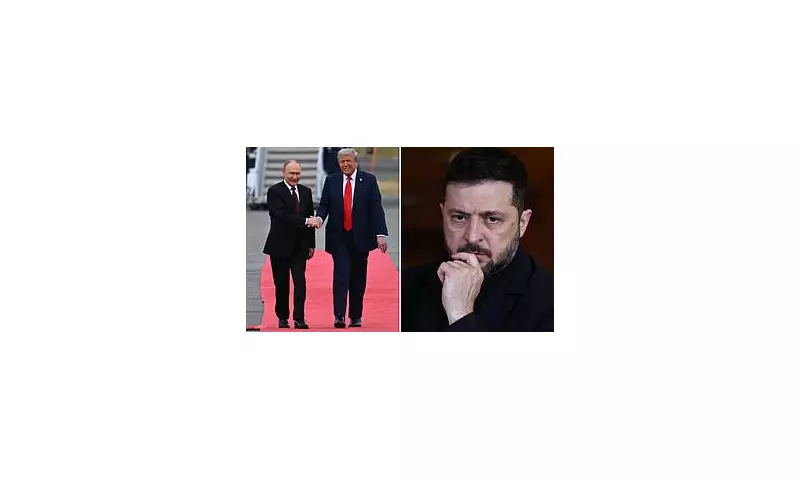
In a move that has sent shockwaves through diplomatic circles, former President Donald Trump has reportedly accepted Russia's key demand for the United States to formally recognise Ukraine's eastern provinces as belonging to the Kremlin.
A Controversial Bargain for Peace
The reported agreement, which emerged on Friday night, would see the US accede to Moscow's territorial claims in exchange for a Russian ceasefire and a commitment to further negotiations. This development aims to secure a lasting peace after nearly four years of devastating conflict, but it comes at a significant political cost.
This stance represents a severe blow to Ukraine and its European allies, including Britain. Hamish de Bretton-Gordon, a former British Army commander, did not mince words in his criticism, accusing Trump of 'peddling Russian lines' in a statement to the Mail.
He condemned the position as a 'complete affront to Ukraine,' adding, 'Yet again President Trump only seems interested in the Russian position. He conveniently forgets, time and again, that it was Russia who invaded Ukraine and it is Putin that is an indicted war criminal.'
Defiance from Kyiv and Military Realities
In a show of resilience, Ukrainian President Volodymyr Zelensky indicated on Friday that he remains determined to uphold his country's established red lines in any negotiations, a position firmly backed by Britain and other partners.
'Our partners are impressed how Ukraine keeps fighting in the pursuit of peace,' Zelensky stated. 'The president of Finland briefed me on the conditions Russia is putting forward. And now we are preparing for a meeting with the American side to discuss the steps needed to make peace a reality.'
He emphatically declared, 'Our work goes on, our struggle goes on. We have no right to fall short, no right to retreat. If we lose our unity, we lose everything.'
Meanwhile, the Kremlin's position appears uncompromising. Russian President Vladimir Putin has stated readiness for serious discussions but has simultaneously threatened to continue fighting, demanding a complete withdrawal of Ukrainian troops from the Donbas region. Putin has also demanded Mr Zelensky is removed from office before Russia would sign any peace agreements, labelling the Kyiv government as illegitimate.
The Path to Negotiation and Stalled Progress
A US delegation is now set to travel to Moscow for talks about ending the conflict. The team is reported to include President Trump’s peace envoy Steve Witkoff, US Army Secretary Dan Driscoll, and Mr Trump’s son-in-law Jared Kushner. Following the Moscow talks, Mr Driscoll is expected to visit Kyiv.
This is not the first time the Trump White House has adopted a pro-Russian stance, having been forced to back down on previous occasions following fierce criticism.
Despite the political manoeuvring, the situation on the ground remains grim. While Putin maintains that Russia has battlefield momentum, its gains in eastern Ukraine have come at a heavy cost in manpower. Analysis from the US-based Institute for the Study of War suggests that at the current rate of advance, it would take Moscow almost two more years to seize the rest of the Donetsk region.
The institute reported, 'Data on Russian forces’ rate of advance indicates that a Russian military victory in Ukraine is not inevitable, and a rapid Russian seizure of the rest of Donetsk Oblast is not imminent. Ukrainian forces have proven effective at constraining Russian advances and conducting successful counteroffensives, particularly when well-staffed and well-equipped.'