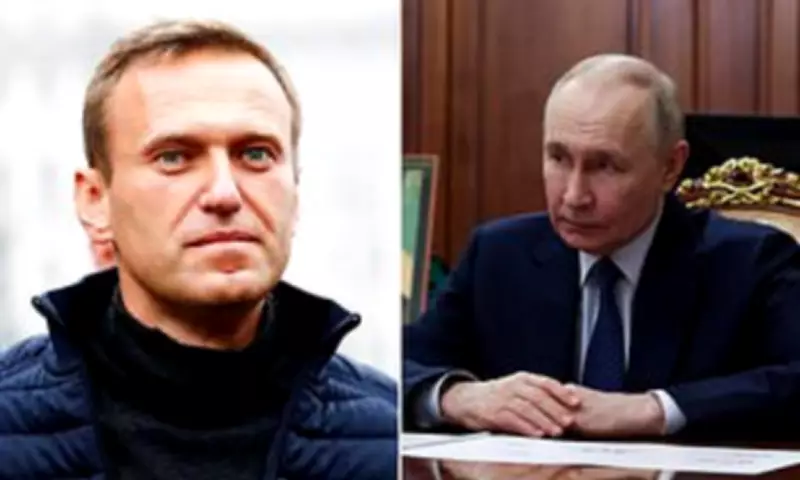
Navalny's Final Court Appearance and Sudden Death
In the last images of Alexei Navalny, appearing via video link from his Arctic penal colony in February 2024, the Russian opposition leader appeared thin and hollow-eyed, yet he maintained good spirits, even joking with the judge about needing more money. Barely a day later, he died on the floor of his prison cell, vomiting as he did so. What many suspected from the start has now been confirmed: this was no 'natural' death as reported by Russian authorities. Instead, it was a murder of particularly bizarre and grotesque nature, involving an extraordinarily powerful neurotoxin derived from South American poison dart frogs.
Covert Analysis Reveals Exotic Poison
Material from Navalny's body was covertly obtained by his family and allies, smuggled out of Russia, and analysed in separate laboratories across different countries. Both analyses identified the neurotoxin epibatidine, which does not occur naturally in Russia and causes respiratory failure in tiny doses. This discovery raises two chilling questions. First, why use such an exotic method of murder? Second, why allow it to be discovered at all?
Putin's Previous Assassination Attempt and Navalny's Return
Prior to his death, Vladimir Putin had already ordered Navalny's assassination once before, in August 2020. A team from Russia's secret service, the FSB, poisoned him with Novichok—the same chemical agent used against Sergei Skripal in Britain. Navalny survived only because his plane made an emergency landing, and Russian doctors, unaware of the deliberate poisoning, treated him. Putin allowed Navalny and his family to leave for Germany to recover, possibly hoping he would stay there and that the publicity would sow paranoia among his enemies in the West.

Navalny bravely returned to Russia in January 2021 and was sentenced to decades in prison through a series of show trials reminiscent of the 1930s. If the Kremlin wished to kill him while imprisoned, easier options existed, such as beatings by guards, starvation, or neglect leading to physical deterioration. Instead, Putin—with the order likely coming directly from him—chose a uniquely theatrical and gruesome method, reflecting pure sadistic pleasure.
Navalny's Significance and Putin's Message
Navalny was not merely another critic; he was a lawyer turned investigator whose reports on corruption targeted Putin's inner circle. He represented an alternative path for Russia, one that was broadly pro-Western and law-governed, contrasting sharply with the corrupt fusion of secret police, organised crime, and crony power defining the country. Putin's murder of Navalny was a final show of disrespect, hatred, and contempt, aimed at killing not only a man but also an alternative future for Russia.
Like historical figures such as Ivan the Terrible, Putin desires the deaths of his enemies to be special, revealing much about his state of mind. The risk of the means of death leaking may have been intentional, as with Navalny's earlier escape to Germany. If so, the message is blunt: if Russia cannot be loved, it will be feared, encapsulated in the Russian proverb, 'Beat your own, so that others fear you.'
International Response and Symbolism
The findings were revealed at the Munich Security Conference, a location heavy with symbolism. It was here in 2007 that Putin declared the post-Cold War order over, signalling Russia's confrontational path. To Putin, Europe is now saying: we see you, we understand your chemical weapons, and we recognise what you represent. This announcement highlights Russia's breach of the Chemical Weapons Convention by developing such toxins.
For sceptics within the US, where commitment to European security cannot be taken for granted, this serves as a reminder to figures like Donald Trump of the pernicious nature of Putin's regime—a threat to individuals as well as nations. Dr Bob Seely MBE, author of The New Total War, underscores the gravity of this revelation in understanding modern geopolitical conflicts.