

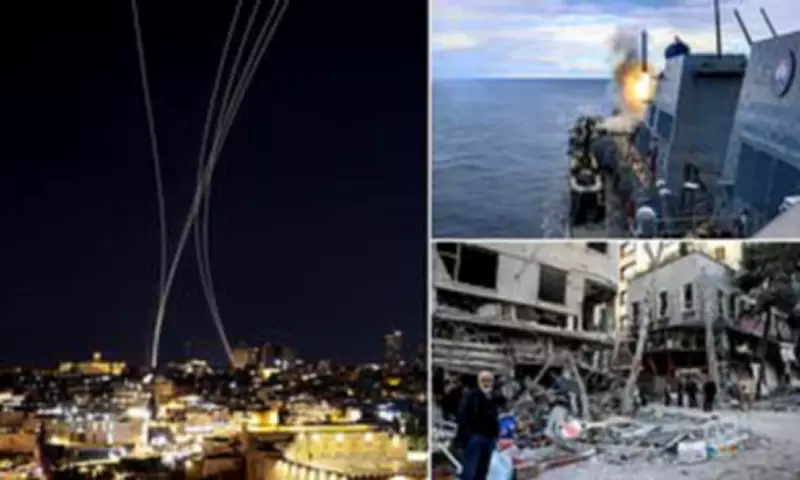
Iran Issues Dire Warning as Middle East Conflict Intensifies
Iran has issued a stark warning that the "gates of Hell will open more and more" upon the United States and Israel, vowing to unleash continuous punitive attacks in an escalating regional war. Ali Mohammad Naini, a spokesperson for the Islamic Revolutionary Guard Corps (IRGC), delivered this chilling message on Iranian state television during the fourth day of the roiling conflict, which began on Saturday following deadly US and Israeli airstrikes on Iran.
Regional and Global Ramifications Unfold
The war has rapidly engulfed the entire Middle East, with Iranian retaliation targeting nearby Western military bases, including a British RAF base in Cyprus on Sunday. Iran has also lashed out at its Gulf neighbours, threatening to plunge the region into an inescapable spiral of violence. In a move that sent shockwaves through global energy markets, Iran threatened to "burn every ship" passing through the Strait of Hormuz, a critical chokepoint for global fuel routes, further driving oil and gas prices upward.
European countries received a stern warning from Iran not to intervene in the ongoing conflict, after Britain, France, and Germany indicated they might take "defensive action" to protect their Middle East interests. Iran described any such involvement as an "act of war" and complicity with aggressors.

Military Escalations and Casualties Mount
Further escalating tensions, Israel launched a ground invasion of Lebanon and carried out additional strikes on key Iranian targets, including the nation's presidential office and the National Security Council building in Tehran. The Israeli military stated that it struck and dismantled facilities within the leadership compound of the Iranian regime overnight, with numerous munitions dropped on these strategic sites.
Israel also deployed troops to multiple locations in southern Lebanon, describing the move as a "forward defence" measure rather than a full ground operation, aimed at preventing attacks from Hezbollah. In response, the Lebanese army redeployed soldiers from several border positions due to safety concerns, citing Israeli escalation.
The Iranian Red Crescent reported that US and Israeli strikes have so far killed 787 people nationwide, with attacks hitting 153 cities and over 500 locations across Iran in more than 1,000 incidents. Strikes have also damaged Iran's Natanz nuclear enrichment plant, as confirmed by the International Atomic Energy Agency (IAEA), though Iran has refused to negotiate on its nuclear programme with the US.
Economic and Security Fallout Widens
The conflict's impact has reverberated across global markets, with European stock markets sliding and natural gas prices soaring. Frankfurt's DAX index shed 2.0 percent, the Paris CAC 40 lost 1.8 percent, and London's FTSE 100 retreated by 1.4 percent. The Dutch TTF natural gas contract shot up more than 33 percent, following a nearly 40 percent increase on Monday after Qatar halted liquefied natural gas production due to Iranian attacks on processing facilities.
In the United Arab Emirates, debris from a drone interception caused a fire at the Fujairah Oil Industry Zone, though authorities contained the blaze with no injuries reported. Fujairah is a key oil trading hub in the Middle East, highlighting the vulnerability of regional infrastructure.
Amid Iran's retaliatory campaign, Qatar thwarted attacks on Hamad International Airport, downing missiles with defensive measures. A spokesperson confirmed that Qatar had not been in contact with Iran since the start of the strikes, underscoring the isolation and complexity of the conflict.
As the war continues, with US President Donald Trump suggesting it could last "far longer" than initial estimates of up to five weeks, the region braces for further turmoil, with Iran's threats and actions signalling a protracted and devastating confrontation.






