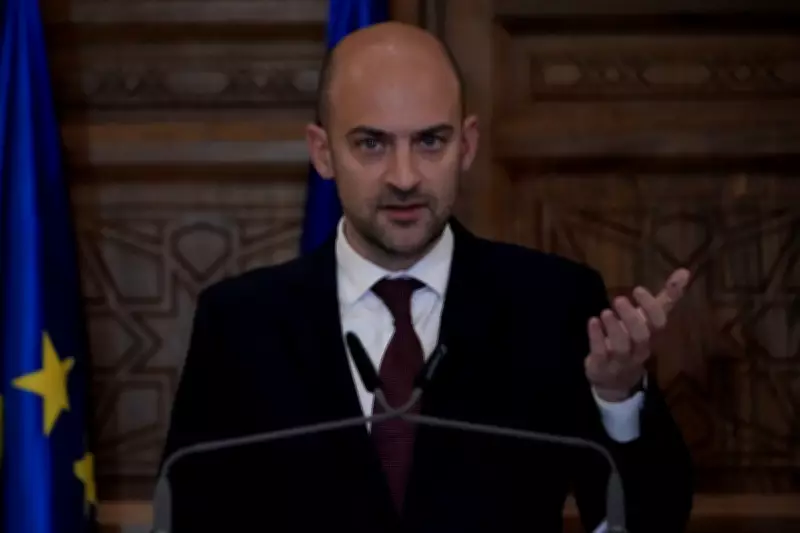
France has issued a direct appeal to Iran-backed groups operating across the Middle East, urging them to demonstrate the utmost restraint should regional tensions between Iran and the United States intensify further. The call for caution was made by French Foreign Minister Jean-Noël Barrot during a diplomatic visit to Beirut on Friday, following his earlier stops in Syria and Iraq.
Diplomatic Warnings Amid Escalating Tensions
Minister Barrot emphasized that if the situation deteriorates into a broader regional escalation, it is imperative for all factions supported by Iran to exercise what he termed the "greatest restraint" throughout the entire region. His statement came after holding substantive talks with Lebanese political leaders, where he underscored the severe risks of military conflict.
"That would profoundly destabilize the Near and Middle East," Barrot warned explicitly. He stressed that a military escalation represents a grave danger that must be avoided at all costs, noting that such an outcome would serve neither the interests of the regional nations nor those of France itself.

Context of Indirect Nuclear Talks
The French minister's remarks arrive at a particularly sensitive diplomatic moment. Concurrently, the United States and Iran have been engaged in indirect discussions in Oman, focusing on potential pathways for negotiations concerning Tehran's contentious nuclear program. These talks have injected both hope and anxiety into the regional calculus.
There are mounting concerns among Middle Eastern observers that any direct American military action against Iran could trigger a cascading response. Specifically, Iran-aligned militias and political factions in Iraq, Yemen, and Lebanon might feel compelled to enter any conflict, dramatically worsening the security landscape.
Focus on Lebanese Stability and Hezbollah
A significant portion of Barrot's discussions in Beirut centered on Lebanon's precarious stability. He addressed the ongoing, complex process aimed at disarming the powerful Iran-backed Hezbollah group. Furthermore, he highlighted an upcoming international conference scheduled for next month in France, designed to bolster support for the Lebanese Armed Forces.
The Lebanese army has been attempting to expand its operational presence in southern Lebanon along the volatile border with Israel, following the devastating 14-month war between Israel and Hezbollah. However, this effort is severely hampered by the nation's profound economic collapse.
International Coordination and Lebanese Crisis
Barrot confirmed that France is working in close coordination with key international partners, including the United States, Saudi Arabia, Qatar, and Egypt. These nations will co-organize the forthcoming support conference with France. The goal is to deliver a "targeted collective contribution, built with the Lebanese authorities" to strengthen state institutions.
This support is desperately needed. Lebanon's army has been critically weakened by a historic economic meltdown that began in late 2019. The nation's political leadership has achieved little in mitigating a crisis rooted in decades of systemic corruption and profound governmental mismanagement, leaving state institutions like the military underfunded and struggling.
Minister Barrot's tour and his public appeals underscore a concerted European diplomatic effort to prevent a regional tinderbox from igniting. By calling for restraint from Iran's proxies, France is positioning itself as a voice for de-escalation, seeking to stabilize a region where the ripple effects of a US-Iran confrontation could be catastrophic and far-reaching.