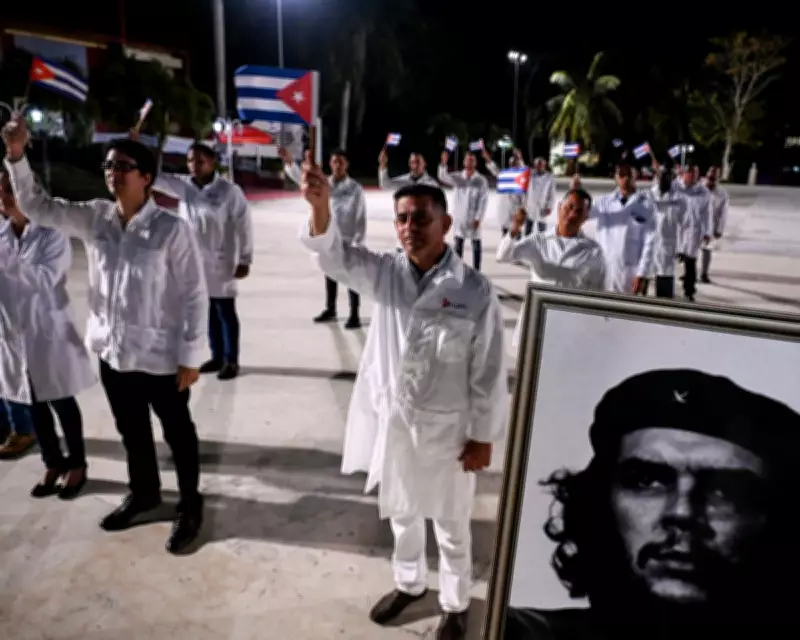
Cuban Medical Missions Expelled as US Pressure Mounts Across Caribbean
For decades, Cuban doctors have served as a lifeline for the world's most marginalised communities, providing essential healthcare across the Caribbean and Latin America. Now, in a stark reversal, these medical professionals are being expelled from host nations, with contracts terminated and health programmes dismantled under intense pressure from the United States. This shift leaves the poorest populations vulnerable to untreated illnesses, unattended births, and undiagnosed cancers, effectively amputating a critical healthcare lifeline.
US Accusations and Regional Capitulation
Cuban Foreign Minister Bruno Rodríguez recently accused the US of "extorting" countries to cancel long-standing agreements with Havana for doctor supplies. The campaign began during Donald Trump's first term, when 8,300 Cuban doctors were forced out of Brazil after then President-elect Jair Bolsonaro, aligned with Washington, threatened the programme. The US has since branded these missions as "forced labour" and "human trafficking," citing Cuba's retention of a share of salaries, while ignoring that Cuban doctors receive free training unlike their debt-burdened counterparts in nations like the UK.
The consequences have been devastating. Countries including Guatemala, Honduras, Jamaica, the Bahamas, Antigua and Barbuda, Guyana, and St Vincent and the Grenadines have capitulated to US demands. Across the region, programmes up to 50 years old are being dismantled, doctors withdrawn, and already fragile healthcare systems strained under the threat of US visa and diplomatic sanctions. Only St Kitts and Nevis and Trinidad and Tobago have resisted so far, leaving millions at risk of losing basic healthcare, with Indigenous communities particularly exposed.

Cuba's Legacy of Solidarity Under Strain
Cuba has long practised solidarity in global health, deploying medical brigades during crises such as the Ebola outbreak in West Africa, hurricanes in the Caribbean, and earthquakes in Nepal and Turkey. The island maintains a network of over 50,000 professionals working in dozens of countries, generating billions in foreign revenue to sustain its economy under a decades-long embargo. In nations like Venezuela, Cuban missions became central to public health, but this model is now under severe strain as US pressure disrupts oil supplies, tightens sanctions, and targets allied governments.
Additionally, Cuba has trained tens of thousands of foreign students, including from the Caribbean, at its Latin American School of Medicine free of charge. Yet, the island, under embargo since 1962, faces economic strangulation, with blackouts, shortages, and collapsing productivity exacerbating its most acute crisis in decades. Precisely when solidarity is most needed, the Caribbean and Latin America have chosen distance, raising moral questions about regional complicity.
Shifting Political Tides and Moral Stands
Historically, Caribbean leaders like Jamaica's Michael Manley praised Cuba as "fundamental" to the region's struggle against imperialism. Today, however, figures such as Jamaica's Prime Minister Andrew Holness emphasise compliance and legality, while Trinidad and Tobago's Prime Minister Kamla Persad-Bissessar, once an admirer of Fidel Castro, now echoes Trump's condemnations. In contrast, Barbados' Prime Minister Mia Mottley has defended Cuba's medical missions, rejecting insinuations of "trafficking" and vowing to stand by what is right despite potential US punishments, highlighting a moral sovereignty often lacking elsewhere.
Strategically, Cuba's location near vital shipping lanes and its estimated offshore oil reserves of over 4 billion barrels make it a target for US interests, with historical efforts focused on regime change. What is striking is not Washington's predictable posture but the Caribbean's hesitant response. Caricom, once vocal against the embargo, now appears cautious, with aid arriving from Russia and Spain while neighbouring islands offer little more than timid diplomacy, driven by fear of US repercussions.

A Call for Regional Reflection
As Cuban doctors, who have quietly served rural communities and disaster zones for decades, face expulsion, the Caribbean must confront its moral failings. The region prides itself on community and shared struggle, yet in this critical moment, it risks abandoning a neighbour in need. "Love thy neighbour" should not be conditional on visas or trade agreements; it is meant for times like these, when standing by is inconvenient but essential. The question remains: when Cuba needed support, where was the Caribbean?