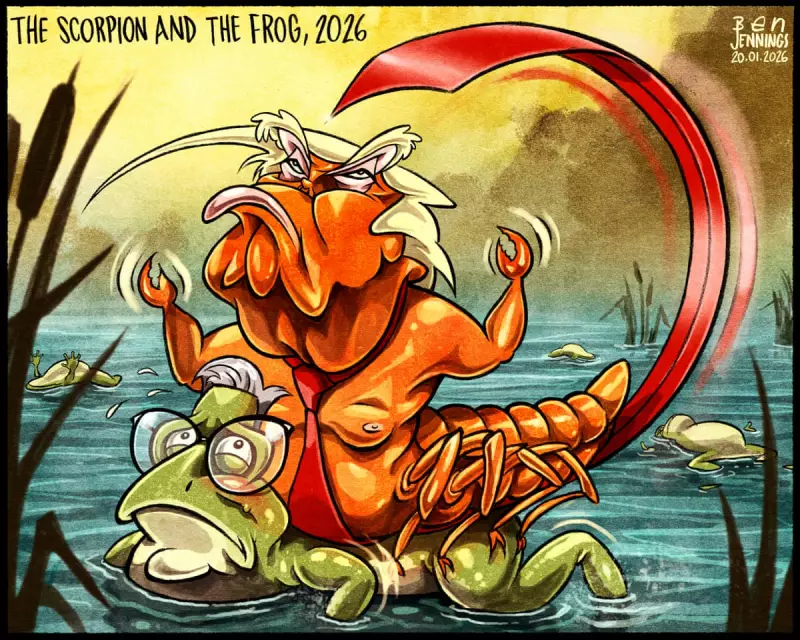
In a striking piece of political commentary, acclaimed cartoonist Ben Jennings has visualised the potential future of the transatlantic 'special relationship' in a powerful new cartoon for The Guardian. Published on 19 January 2026, the artwork presents a sobering forecast of international diplomacy should Donald Trump return to the White House, with UK Prime Minister Sir Keir Starmer cast in a distinctly diminished role.
A Visual Prognosis for the Special Relationship
The cartoon, rich in symbolic detail, serves as a critical analysis of power dynamics. It imagines a scenario where the United Kingdom, under a Labour government led by Starmer, must navigate a renewed and tumultuous partnership with a Trump-led America. Jennings masterfully uses visual metaphor to suggest not a relationship of equals, but one of dominance and deference. The implied subservience of the British position is a central, provocative theme, questioning the very foundation of the long-celebrated bilateral alliance.
The date of publication, 19 January 2026, is strategically significant, positioning the piece as a forward-looking satire rather than a reflection on current events. It forces the viewer to contemplate a political landscape that is still forming, yet feels ominously familiar. The artwork does not merely report but predicts, drawing on patterns from Trump's previous term to extrapolate the challenges for a centre-left UK leader.

Symbolism and the Shadow of American Power
Jennings' illustrative style conveys complex geopolitical critiques through carefully chosen imagery. The depiction of Donald Trump is likely loaded with the cartoonist's characteristic markers of brash, unyielding authority. Conversely, Keir Starmer's portrayal is interpreted as one of cautious, perhaps compromised, diplomacy. The space between the two figures speaks volumes, illustrating the emotional and political distance that could define this phase of the special relationship.
The power of the cartoon lies in its ability to condense multifaceted concerns—over foreign policy, national sovereignty, and diplomatic integrity—into a single, immediate frame. It raises urgent questions about the UK's strategic autonomy and the price of maintaining a close bond with a mercurial superpower. The piece acts as a warning about the potential erosion of British influence on the world stage, framed not through dry policy analysis but through potent visual narrative.
Reactions and Lasting Implications
While the cartoon is a standalone work of commentary, its publication in The Guardian's influential 'Comment is Free' section amplifies its reach and impact. It is designed to provoke debate among the politically engaged, serving as a catalyst for discussion on the future of UK-US ties. The artwork challenges the viewer to move beyond traditional, often romanticised, notions of the Atlantic alliance and confront a more transactional, and potentially unstable, reality.
Ultimately, Ben Jennings' cartoon is more than satire; it is a piece of political foresight. By freezing a hypothetical moment in 2026, it holds a mirror up to present-day anxieties and emerging trends. The cartoon suggests that the special relationship may be tested like never before, requiring a recalibration of British diplomacy that Starmer's government may be ill-prepared to make. It stands as a vivid reminder of how art can frame and advance crucial conversations about power, partnership, and national identity in an uncertain world.