British Tourists Stranded as Iranian Drone Attacks Spark Airport Chaos in Cyprus and Dubai
Brits Stranded as Iranian Drone Attacks Cause Airport Chaos

British Tourists Terrified as Iranian Drone Attacks Force Airport Evacuations

British citizens across the Middle East and Cyprus have been left stranded and terrified after airports were suddenly evacuated and flights cancelled amid fears of drone attacks from Iran. The retaliation following the launch of Operation Epic Fury has plunged the Gulf region and surrounding areas into chaos, trapping thousands of holidaymakers far from home.

Cyprus Airport Plunged into Panic

Just hours after the British base of RAF Akrotiri in Cyprus was struck by an Iranian drone, Paphos International Airport was evacuated on Monday amid fears of further attacks. Travellers were rushed out of the airport around midday after radar systems detected a suspected drone heading toward the Cypriot city.

Airport staff were heard shouting 'there are drones in the sky, we need to get out' as passengers were ushered through emergency exits into car parks for safety. One security guard told reporters he believed the evacuation occurred because a suspected drone appeared to be heading for the adjacent Andreas Papandreou Air Base.

EasyJet and Ryanair flights to the United Kingdom were cancelled, though Ryanair continued operating flights from Paphos to other European destinations including Riga, Warsaw, and Eindhoven. A Ryanair flight from Warsaw to Paphos was ordered to turn around following the evacuation, adding to the disruption.

One anonymous British traveller described the scene: 'We were going through security then the alarms went off, staff started shouting "there is a drone, we need to go now". I have no idea what the plan is now, it seems unclear.'

Chaos for Stranded Passengers

The situation created significant confusion, with Ryanair passengers unable to book new flights or access information online, yet still being asked to report to the airport. A family hoping to fly to Manchester on Ryanair had their flight cancelled and found themselves unable to book alternative routes through online systems.

'It's chaos, we were still told to come to the airport, we don't know what our options are now,' the mother explained. Travellers were eventually permitted back into the airport shortly after 2pm, with scheduled flights resuming as normal, but the psychological impact remained.

Dubai Descends into Conflict Zone

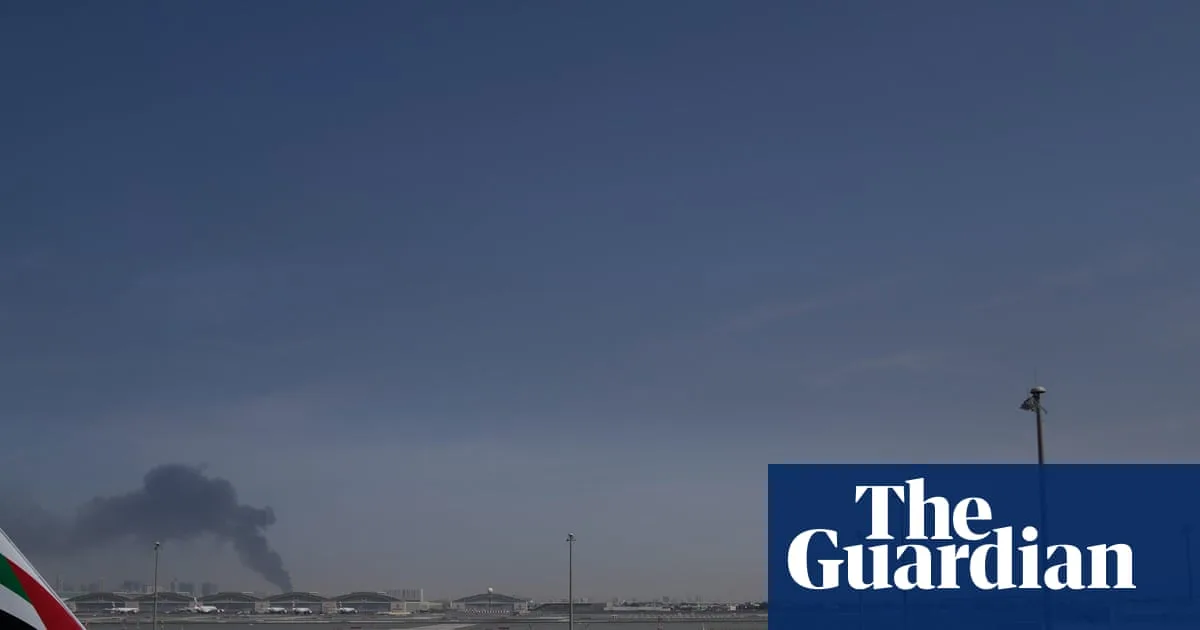
Meanwhile, British residents and tourists in Dubai, United Arab Emirates, have been scrambling for safety after Iran targeted popular hotels and landmarks. The five-star Fairmont hotel on the luxury Palm Jumeirah island was set ablaze at the conflict's outset on Saturday, injuring four people, before The Burj Khalifa—the world's tallest building—was evacuated amid fears it could become a target.

Tourists hid in basements and car parks while missiles flew over the city, which is home to nearly a quarter of a million British citizens. Stacey Gibson, 32, and her partner Charles Wright, 34, from Surrey, were awakened on Monday morning by two loud bangs as Iran continued its assault.

'We're in fight or flight mode,' Ms Gibson revealed. 'Every noise that you hear, every little thing, we're jumping, and asking, what's that? Do we need to move?'

The couple slept in a basement car park at the Mileo Hotel after being shaken by a nearby hotel strike. They were in a taxi heading to the airport following a week-long birthday trip when the conflict erupted.

'We heard this almighty bang, it shivered through our feet. We looked at the cab driver, and he didn't know what it was,' Ms Gibson recalled. 'At the airport it was mayhem. There were so many cars and when we went in we saw everything was cancelled or delayed on the departures board.'

Evacuation Flights and Global Disruption

An evacuation flight from Abu Dhabi, approximately 86 miles from Dubai, is expected to land at Heathrow Airport tonight, transporting stranded British citizens back to London. Etihad Airways flight EY67 is scheduled to arrive shortly after 7pm, one of fifteen flights the airline managed to depart from the city within a three-hour window.

The company stated it is 'accommodating customers with earlier bookings as a priority.' The Middle East conflict has also disrupted British travellers attempting to return from other global locations.

Nathan Silver and Elana Phillips, both 23, found themselves trapped in Oman after their Qatar Airways flight from Sri Lanka to Heathrow via Doha was diverted. 'We already knew about what was going on with the US and Israel, but we didn't think it would affect us,' Mr Silver explained.

Their aircraft landed in Muscat airport instead, where passengers remained on the plane for seven hours with minimal explanation. 'Five hours later they said we'd be getting off the plane - but there were more than 10 Qatar Airways planes landed there in the small airport,' Silver described.

After disembarking, passport control took four hours, and while passengers were transported to a five-star Radisson hotel with meals provided, their luggage remained missing. 'It was a very nice hotel and all the food was paid for. But we still don't have our luggage,' Silver added.

Escalating Conflict and Military Threats

The Gulf conflict entered its third day following US and Israeli offensive strikes targeting Iran's leadership on Friday. The country's Supreme Leader Ayatollah Ali Khamenei was killed on Saturday, prompting immediate retaliation from Iran.

Iranian missiles have targeted multiple nations including Israel, Bahrain, Kuwait, Qatar, the United Arab Emirates, and Saudi Arabia, as well as ships passing through the strategic Strait of Hormuz. Cyprus has since become a target after American aircraft relocated to the island.

Sardar Jabbari, a senior Iranian military commander, warned on Monday: 'The Americans have moved most of their aircraft to Cyprus. We will launch missiles at Cyprus with such intensity that the Americans will be forced to leave the island.'

President Donald Trump has shown no signs of backing down, refusing to rule out deploying US troops in Iran 'if they were necessary.' The American leader warned the conflict could persist for up to four weeks, stating: 'I don't have the yips with respect to boots on the ground - like every president says, "There will be no boots on the ground." I say "probably don't need them," (or) "if they were necessary."'

Trump also dismissed concerns about political consequences, telling reporters 'I don't care about polling' and emphasizing that 'You cannot let Iran, who's a nation that has been run by crazy people, have a nuclear weapon.' In a separate interview, he alluded to major forthcoming action, warning: 'We haven't even started hitting them hard. The big wave hasn't even happened. The big one is coming soon.'




